Tencent Open-Sources World Model Hy-Nomas: Hands-On, Principles, and Deployment Guide
Tencent Hunyuan's open-source world model Hy-Nomas hands-on: segmented autoregressive generation for seamless long video, deployable on a single 4090.
Based on Bilibili creator "我不吃番茄"'s hands-on video, this article covers the performance, principles, and deployment of Tencent Hunyuan's open-source world model Hy-Nomas. Testing shows natural scene transitions and multi-prompt continuation with quality close to the official demo, supporting text prompts and camera control. Technically, it uses segmented autoregressive generation and KV Cache for temporal coherence, comprising Qwen2.5-VL-7B, a DiT video diffusion Transformer, and a Pixel UMM decoder. Deployment requires eight cards officially, but INT8-quantized DiT, FP8 decoder, and CPU offload enable single RTX 4090 operation, though compilation issues make community images advisable.
Tencent Hunyuan team recently open-sourced a world model called Hy-Nomas, which has attracted considerable attention in the AI community. Bilibili creator "我不吃番茄" (I Don't Eat Tomatoes) gave it high praise after hands-on testing, calling it the "strongest world model" they have encountered. This article, based on that creator's hands-on video, summarizes Hy-Nomas's actual performance, technical principles, and key information for local deployment.
Hands-On Performance: Seamless Interactive Generation
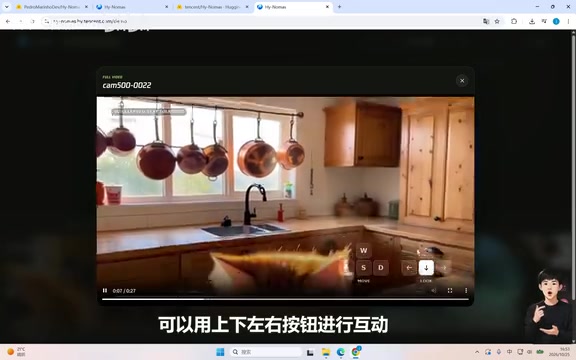
The creator conducted multiple rounds of testing on the official demo platform. From the official examples, scene transitions show no obvious stuttering or "frame-skipping" feel, and transitions between different scenes such as underwater and indoor environments are quite natural. The creator specifically noted that their own generated results were "almost identical" to the official demo, with little quality gap.
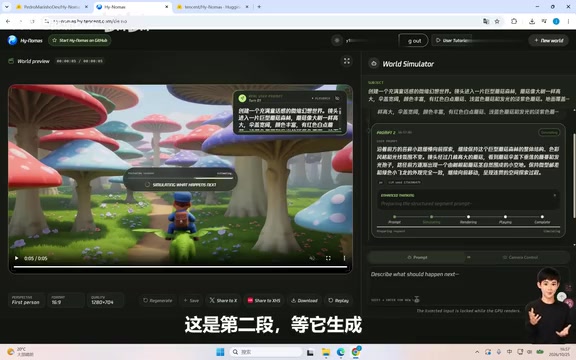
In actual testing, the creator used GPT to help write prompts, entering environment descriptions and object descriptions before clicking generate. The first video segment was about 5 seconds and took roughly 30 seconds to generate (based on high-performance GPU inference). They then entered a second prompt to have the scene "explore forward," generating about 8 seconds of content that seamlessly connected with the previous segment's frames, with natural transitions in surrounding scenes.
Beyond text-prompt generation, Hy-Nomas also supports a camera control mode. Users can control the viewing direction via up/down/left/right buttons, and the system records the operation trajectory to generate video from the corresponding viewpoint. The creator tried moving right and tilting the view upward, and the generated result basically reproduced the intended operations.
Core Principles: Segmented Autoregressive Generation and KV Cache
The key to Hy-Nomas achieving continuous long video generation lies in its "segmented autoregressive generation" strategy. The model splits a longer video into multiple segments generated sequentially, with each subsequent segment using the previous segment's content as contextual conditioning, thereby achieving temporal coherence.
An important technique used here is KV Cache (key-value caching in the attention mechanism). It can be understood as the model's "memory mechanism" for video context—when generating the latter half, the model conditions on the content already generated in the first half to avoid abrupt scene changes.
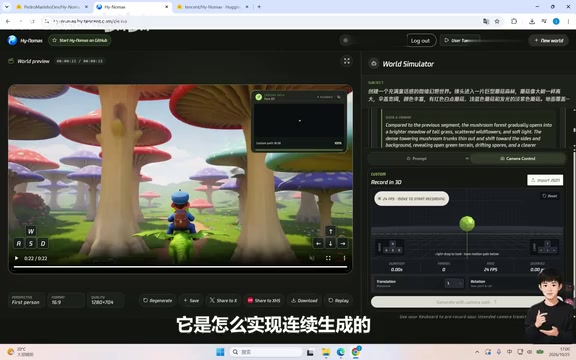
Architecturally, Hy-Nomas consists of three main parts: a language model responsible for understanding input text prompts, which uses Qwen2.5-VL-7B; a DiT (video diffusion Transformer) responsible for generating video frames; and a decoder using Pixel UMM to compress and decode the video latent space, reducing VRAM pressure for high-resolution generation.
Additionally, the official demo includes a PE (prompt enhancement) step that converts user-input natural language prompts into structured descriptions more easily understood by the model. This module can also be deployed locally.
Autoregressive generation is a fundamental paradigm for sequence generation models: the model predicts only the next element in the sequence at each step, then uses that prediction as part of the input to continue predicting subsequent elements, looping in this manner. Language models like GPT generate text in a token-by-token autoregressive fashion. When transferred to video generation, the basic unit changes from tokens to video segments (several frames), and when generating the Nth segment, the model uses the content of the previous N-1 segments as conditional context, thereby continuing scenes, objects, and motion states along the temporal dimension. This approach avoids the VRAM explosion and consistency challenges of generating an entire long video at once, but it also introduces the risk of error accumulation—deviations in earlier segments may be inherited and amplified by later segments, making context encoding and cache management critical.
DiT (Diffusion Transformer) is a video/image generation backbone that combines diffusion models with the Transformer architecture. Traditional diffusion models mostly use U-Net as the denoising network, whereas DiT replaces U-Net with a Transformer, splitting noisy latent features into patch sequences and modeling global dependencies through self-attention. The scaling properties of Transformers make them perform better as parameter count and data volume increase, and they are also more convenient for cross-modal conditional fusion with text encoders, making them the mainstream choice for video generation models after Sora. The INT8-quantized DiT mentioned in the article refers to compressing DiT weights from FP16 to 8-bit integers to significantly reduce VRAM usage and inference overhead, at the cost of possible slight quality loss.
Deployment Essentials: VRAM Optimization and Practical Tips
VRAM is a threshold many developers care about. The official standard inference solution requires eight-card parallelism, but a single-card optimized version is also provided. According to the creator, the official reference GPU is the RTX 4090, and optimization measures include using an INT8-quantized DiT model, an FP8 version of the video decoder, and a CPU offload strategy, making it possible to run on a single 4090.
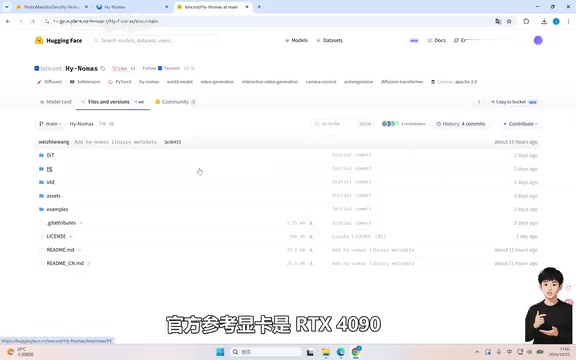
The creator candidly noted that local deployment is "relatively troublesome," encountering issues such as flash-attention compilation failures and missing header files, and recommends directly using ready-made images for deployment. The creator has deployed the model on a computing platform and provided an image in the application center (search for the suffix related to "我不吃番茄"), along with a Feishu document explaining specific usage.
It should be noted that the creator did not enable the prompt enhancement module during local testing, and the resolution was slightly lower than the official demo (about 720p), so generation quality may be slightly discounted. When using the official demo platform, users may need to queue when there are many people.
CPU offload is a VRAM optimization strategy: during inference, some model weights or intermediate tensors not currently involved in computation are transferred from GPU VRAM to host memory (CPU side) and called back to the GPU when needed. Since data transfer bandwidth between CPU and GPU is much lower than VRAM bandwidth, offload typically lengthens single-step inference time, but it can significantly reduce peak VRAM usage, making it possible to run large models on consumer-grade GPUs. Combined with the INT8-quantized DiT and FP8 decoder, the three together form the VRAM optimization combination described in the article as "runnable on a single 4090." FP8 refers to an 8-bit floating-point format that, compared to INT8, preserves floating-point dynamic range and is often used in decoding stages more sensitive to numerical precision.
Application Prospects and Observations
The value of world models lies in their ability to model physical environments and spatial relationships. Based on the creator's analysis, potential application directions for Hy-Nomas include VR content production, 3D scene construction in game development, architectural simulation, and drone/wireless scenario simulation.
From image models to video models to world models, the types of models available in the open-source community are rapidly expanding. Tencent Hunyuan team has already accumulated work in 3D and video generation (such as the earlier Hunyuan3D and HunyuanVideo 1.1), and Hy-Nomas can be seen as an extension in the direction of spatial intelligence. The creator also revealed in the video that Tencent has more world model-related releases in preparation.
For developers wanting to try it out, it is recommended to first experience the effects on the official demo, then decide whether to deploy locally based on their own hardware conditions. Although the single-card 4090 solution is feasible, compilation and dependency issues require some patience, and using community images can significantly lower the barrier to entry.
One-line Summary
Tencent Hunyuan's open-source world model Hy-Nomas hands-on: segmented autoregressive generation enables seamless long video generation, deployable on a single 4090.
Paragraph Summary
Based on Bilibili creator "我不吃番茄"'s hands-on video, this article summarizes the performance, principles, and deployment essentials of Tencent Hunyuan's open-source world model Hy-Nomas. Hands-on testing shows that the model transitions naturally during scene changes and multi-segment prompt continuation, with generation quality close to the official demo, and supports both text-prompt and camera-control interaction. Technically, Hy-Nomas maintains temporal coherence through segmented autoregressive generation and KV Cache, and consists of three parts: the Qwen2.5-VL-7B language model, a DiT video diffusion Transformer, and a Pixel UMM decoder. For deployment, the official standard solution requires eight-card parallelism, but with INT8-quantized DiT, FP8 decoder, and CPU offload it can run on a single RTX 4090; however, there are many compilation dependency issues, so using community images is recommended to lower the barrier.
Related articles

Giving Coding Agents Hearing: How AirShot Closes the Audio Feedback Loop
AirShot gives coding agents audio perception: pure CPU offline operation, CLI and MCP invocation modes, with MCP avoiding 20-40s model reload delays. Critic scores against 7 professional launch videos with timestamped suggestions, registers into Cloud Code without a GPU.

MCP Protocol Explained: Giving AI Agents Tools and Memory
MCP lets AI agents securely connect to Gmail, Slack, and other tools with persistent memory. This article explains the three-step loop—connect tools, add memory, define goals—and how it eliminates repetitive work, turning AI from a chat tool into a practical productivity system.

Don't Trust AI Agent Installs? RepoGates' Five-Gate Test in Practice
RepoGates uses five gates to guard AI agents' repo clones, package installs, and MCP server additions, covering browser, Clawed Code, MCP clients, checkup, and deep scan—each with its own blind spots.