Tencent Workbody in Action: AI Agents Let Ordinary People Automate Local Files

Chat-based LLMs only give plans; AI Agents deliver results directly — Workbody is a low-barrier example.
Starting from a real need to batch-convert docx files to PDF, the article notes that chat LLMs like Doubao and DeepSeek can understand intent and provide code but can't operate local files, blocking non-programmers. Tencent Workbody demonstrates the Agent workflow: parse natural language, request file permissions, invoke local tools, execute, and auto-archive — done in about 3 minutes for 1.55 credits. The author acknowledges its limits: a complex Excel design task took 20+ minutes with mediocre results vs. Codex's few minutes. Core conclusion: chat LLMs are "intelligent consultants," Agents are "intelligent assistants" with an execution loop; Workbody — free, China-accessible, and user-friendly — becomes ordinary people's first real Agent tool.
Why Do You Need an AI Agent? Starting from a File Conversion
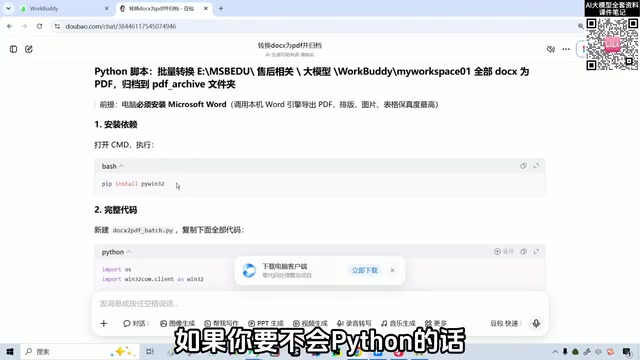
Many people use chat-based LLMs like Doubao and DeepSeekAd in their daily lives and feel they're already good enough. But when you actually want AI to "do the work," you'll find they can only give you a plan, not execute it. A Bilibili creator demonstrated this limitation through a real-world scenario: converting all docx files in a directory to PDF in batch and archiving them.
He first sent the request to Doubao. Doubao accurately understood the intent and even provided Python code and dependency installation steps. But the problem was — Doubao couldn't directly operate files on the computer; the user had to copy the code, configure the environment, and run the script themselves. For non-programmers, this is almost an insurmountable barrier. This is the core divide between chat-based LLMs and AI Agents: the former is an "intelligent consultant," the latter is an "intelligent assistant."
Getting Started with Workbody: The Key Step from "Thinking" to "Doing"
The creator then opened Tencent's Workbody (referred to as workaboutit in the video). Unlike overseas tools that require a VPN and paid subscription, Workbody is directly accessible in China, gives 2000 credits upon registration, and allows users to claim 100 credits daily. The creator had been using it for about half a month, including a holiday period without claiming credits, and still had 3900 credits in the account — indicating that light daily tasks are completely covered.
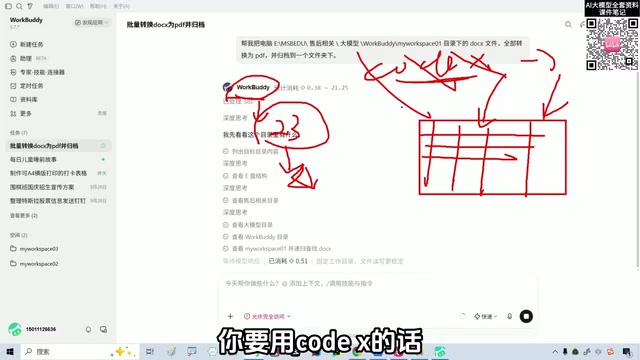
He sent the same request — converting all docx files in a specified directory to PDF and archiving them — directly to Workbody. After granting file access authorization, the Agent began executing, with the interface showing elapsed time and credit consumption in real time. In about three minutes, the task was complete, consuming 1.55 credits, and the converted PDFs were automatically archived into a folder named by timestamp. The creator opened them to check, and the format conversion quality was good.
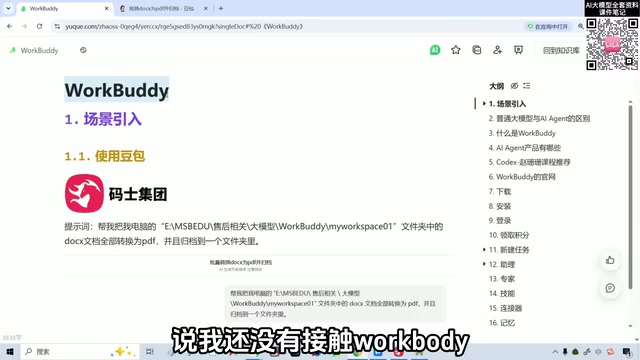
In this process, Workbody demonstrated the typical Agent workflow: understand natural language request → request system permissions → invoke local tools → execute file operations → deliver results. The user doesn't need to write a single line of code or understand what Python dependencies are.
What Is an AI Agent's Execution Loop
In the Agent context, the execution loop refers to the model's ability to autonomously complete the cycle of "planning — invoking tools — observing feedback — correcting" between receiving an instruction and delivering a result, without requiring humans to manually move information between each step. Specifically for file conversion tasks, the loop includes: parsing natural language intent, generating operation steps, requesting file read/write permissions from the operating system, invoking local scripts or command-line tools, reading execution logs to determine success or failure, retrying with an alternative approach upon failure, and finally placing the output in the agreed location. What chat-based LLMs lack is precisely this entire middle section — they can write correct Python code but cannot write that code to disk and run it, nor can they see runtime errors and fix them automatically. Function calling capability and a sandbox/local runtime are the two cornerstones supporting this loop: the former lets the model "press the button," the latter ensures there's actually something behind the button that gets executed.
Capability Boundaries: The Real Gap Between Workbody and Codex
The creator didn't shy away from Workbody's shortcomings. He shared a comparison test: giving Workbody and Codex the same task — designing an Excel file in the same style as an Excel screenshot from Xiaohongshu. Workbody took 20 to 23 minutes and the result was unsatisfactory; Codex took only two and a half to three and a half minutes to meet the requirement.
The cost logic behind the gap is realistic: Codex costs about 200 yuan per month for membership plus VPN, while Workbody's daily free credits cover light tasks. The creator's judgment is that if you don't want to spend money, trade time for cost — through multiple rounds of dialogue and repeated corrections, Workbody can eventually reach the goal too. He also mentioned an industry trend: as domestic and international products gradually align in functionality, comprehension, reasoning, and hands-on capability will eventually converge; the current gap is merely a difference in development stages.
The Relationship Between Credit Systems and Token Costs
Domestic Agent products often use "credits" rather than direct token-based billing, essentially packaging model calls, tool execution, and sandbox runtime into a user-perceivable pricing unit. How many credits a task consumes typically depends on input/output token volume, number of tool invocations, and task duration. The article mentions that file conversion consumed 1.55 credits, while the complex Excel design task took over 20 minutes — indicating that credit consumption correlates positively with task complexity and number of trial-and-error rounds. For users, the significance of a credit system is converting unpredictable API bills into a budgetable quota; for vendors, it facilitates lowering the trial threshold with gifted credits while maintaining user activity through daily check-ins. Understanding this is necessary to judge whether "free credits are enough" depends on the task type, not a fixed number.
Chat-Based LLMs vs AI Agents: Where's the Essential Difference
In the video, the creator outlined the capability boundaries of the two types of tools. Understanding natural language, breaking down tasks, and providing solutions — chat-based LLMs can all do these; they're standard features of AI tools. But invoking local tools, executing system commands, and operating files — chat-based LLMs are powerless.
The more critical difference lies in the execution loop. After an ordinary chat model gives a result, it doesn't follow up on whether it succeeds or fails; the user must judge for themselves and pass along the next instruction. An Agent, however, can self-debug during execution: if one approach doesn't work, try an alternative; if intermediate results are unsatisfactory, adjust automatically; ultimately deliver a complete result. In the creator's words, Doubao is an "intelligent consultant," while Workbody is an "intelligent assistant."
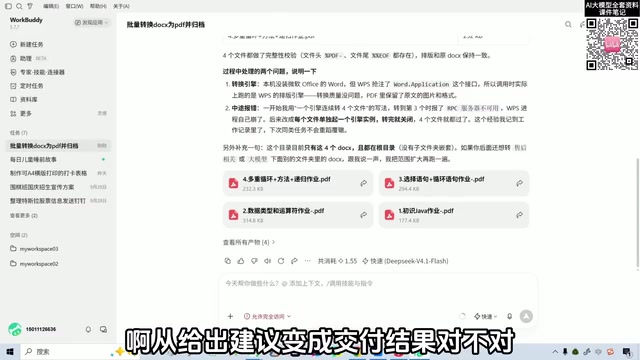
This difference is very obvious in actual use. In the file conversion task, Workbody not only completed the conversion but also automatically created an archive folder, named it by timestamp, and placed the results inside. Throughout the process, the user sent only one message; the rest was completed by the Agent's loop.
Positioning Differences Between Codex and General-Purpose Agents
Codex in this article refers to a coding agent oriented toward code and structured output, whose underlying model has been specifically optimized for code generation, format restoration, and multi-step reasoning, and typically comes with a stronger sandbox execution environment. Therefore, it can complete tasks like "replicating Excel styles from a screenshot" — which demand high precision and reasoning depth — in two to three minutes. Workbody, as a general-purpose Agent, targets ordinary users' daily computer operations; its advantages are out-of-the-box usability, Chinese interaction, and local file permission integration, while its disadvantage is taking more detours on tasks requiring fine structured reasoning. The two are not substitutes in the same lane: one leans toward "professional productivity," the other toward "low-barrier automation." The judgment that "capabilities will eventually converge" presupposes alignment of underlying model capabilities and completion of the tool ecosystem; in the short term, the gap will still manifest in time consumption and first-attempt success rates on complex tasks.
What Can Ordinary People Use It For?
The video title mentions three scenarios: batch processing of local files, automatically creating PPTs, and building a personal check-in workstation. The creator focused on demonstrating batch file conversion; the other two scenarios weren't elaborated but point in the same direction — handing repetitive computer operations to an Agent. For ordinary users who don't write code, this means things that previously required dozens of manual clicks or a paid WPS membership can now be done by describing them in natural language.
Of course, an Agent's capability ceiling depends on the underlying model and tool-calling ecosystem. Workbody is currently better suited for light tasks with clear rules; complex creative work (like designing Excel from an image) still has gaps. But the creator's experience offers a pragmatic conclusion: if you don't want to pay high subscription fees for AI tools and are willing to spend some time training through dialogue, domestic Agents like Workbody can already help you automate quite a few tasks.
Final Thoughts
The proliferation of AI Agents is changing how ordinary people use AI. From "asking AI for answers" to "letting AI deliver results," Workbody provides a low-barrier entry point. It's not perfect — not the fastest, not the most capable — but being free, directly accessible in China, and user-friendly makes it enough to become many people's first Agent tool they truly use. As for whether the gap with Codex and others will narrow, the creator's judgment is "it will converge eventually" — perhaps that's also the most promising aspect of domestic AI tools.
One-line Summary
Chat-based LLMs can only give plans; AI Agents can directly deliver results — Workbody is a low-barrier example.
Paragraph Summary
Starting from a real need to batch-convert docx files to PDF, the article points out that chat-based LLMs like Doubao and DeepSeek can understand intent and provide code solutions but cannot directly operate files on the user's computer, leaving non-programmers locked out. Tencent Workbody demonstrates a typical Agent workflow: understanding natural language requests, requesting file permissions, invoking local tools, executing operations, and automatically archiving — completing in about three minutes at a cost of 1.55 credits. The author also acknowledges its shortcomings: in a comparison test with Codex, a complex Excel design task took over twenty minutes with poor results, while Codex needed only a few minutes. The core conclusion: chat-based LLMs are "intelligent consultants," Agents are "intelligent assistants" with an execution loop, and Workbody — free, directly accessible in China, and user-friendly — becomes ordinary people's first Agent tool they truly use.
Related articles

"Black October": Did AI Uncover 3% of All Critical Vulnerabilities Ever?
A Reddit post claims 3% of all critical software vulnerabilities ever were found in the past month, dubbed 'Black October.' We break down the statistical issues, how AI-assisted code auditing accelerates discovery, and how developers should respond.

Microsoft Project Gecko: Using AI to Bridge Language Gaps for African Farmers
Microsoft's Project Gecko launches PharmaChat, letting African farmers ask questions in their native language and get precise video clips and farming book chapters via AI. The project also releases three interactive manuals to advance inclusive AI.

Musk's Space Dominance: How Starlink Throttling Undermines Ukraine's Defense
SpaceX's Starshield throttling disabled Ukraine's high-speed interceptor drones, exposing how Musk's private control over low Earth orbit communications affects battlefield dynamics and national security, and highlighting the risks of commercial space militarization and space governance dilemmas.