Tenlai-TTS 2.0: An End-to-End Continuous Representation LLM Speech Synthesis System
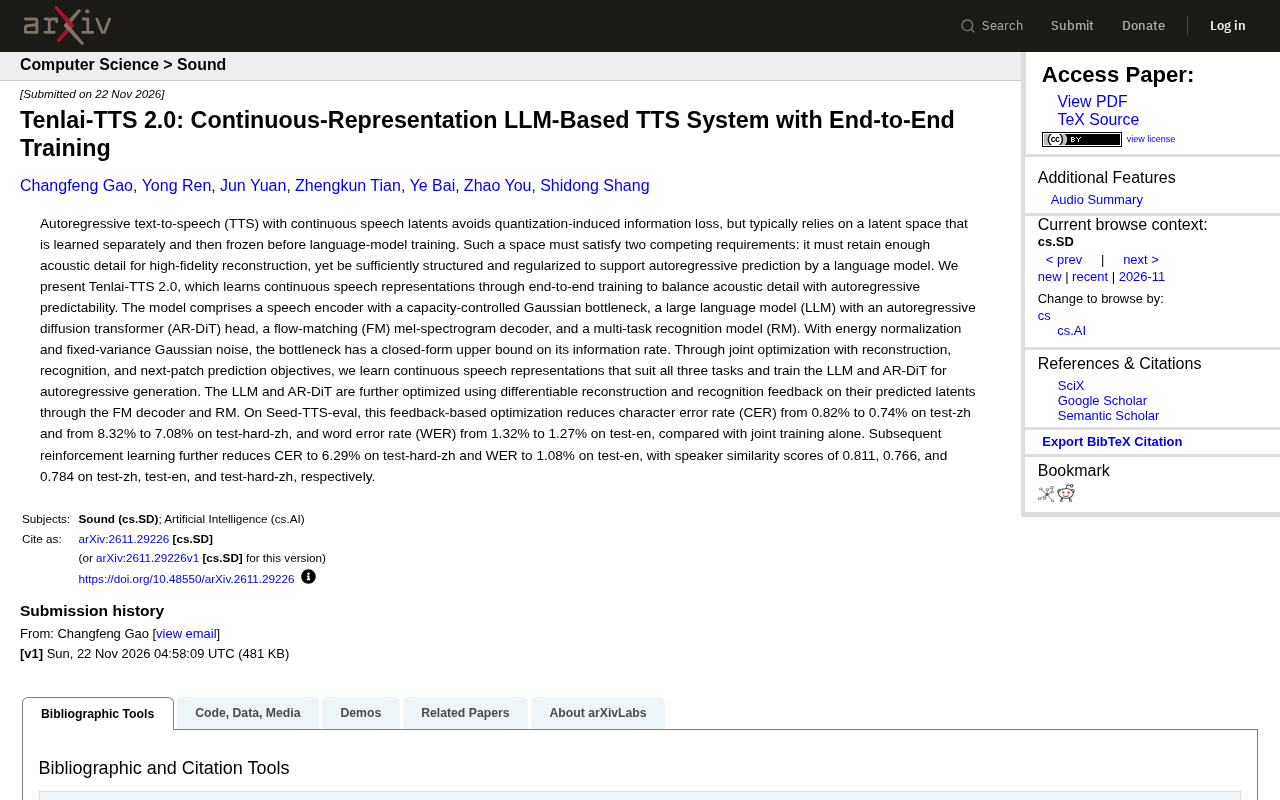
Tenlai-TTS 2.0 brings continuous speech representation learning into end-to-end training, balancing acoustic detail and autoregressive predictability.
Tenlai-TTS 2.0 addresses the disconnect between reconstruction and predictability objectives in traditional autoregressive TTS caused by freezing the latent space before training the language model, proposing instead to incorporate continuous speech representation learning into end-to-end joint training. The system consists of a capacity-controllable Gaussian bottleneck speech encoder, a language model with an AR-DiT head, a flow-matching mel-spectrogram decoder, and a multi-task recognition model, jointly optimizing reconstruction, recognition, and next-segment prediction. Differentiable feedback lets generation results feed back into the representation and generative components, and reinforcement learning further fine-tunes the model. On Seed-TTS-eval, test-hard-zh CER drops from 8.32% to 7.08% and then to 6.29%, test-en WER drops to 1.08%, and speaker similarity remains between 0.766 and 0.811.
Autoregressive TTS (text-to-speech) using continuous speech latent variables can avoid the information loss caused by quantization, but such systems typically learn the latent space first, freeze it, and only then train the language model. This frozen space must simultaneously satisfy two competing requirements: it must retain enough acoustic detail to support high-fidelity reconstruction, and it must be sufficiently structured and regularized for the language model to make stable autoregressive predictions. The core idea of Tenlai-TTS 2.0 is to incorporate the learning of continuous speech representations into end-to-end training, allowing acoustic detail and autoregressive predictability to be balanced under a single optimization objective.
Why "Learn the Latent Space First, Then Freeze It" Is a Problem
The traditional approach trains the speech encoder and the language model in two separate stages. The encoder is responsible only for reconstruction and tends to retain as much acoustic information as possible; the language model, however, wants the latent variable distribution to be regular and predictable. The two objectives are optimized independently, with no negotiation mechanism between them. The result is often that the encoder output is too rich for the language model to model, or that regularization is too strong and reconstruction quality degrades. Tenlai-TTS 2.0 moves this negotiation into joint training, so that the representation simultaneously serves three types of tasks: reconstruction, recognition, and next-segment prediction.
The trade-off between continuous speech latent variables and discrete tokens. Autoregressive TTS fundamentally requires the speech sequence to be split into predictable units. Quantization schemes (such as VQ-VAE and RVQ) map continuous frames to a finite codebook to obtain discrete tokens, which naturally suit classification-based language models, but the quantization process discards details outside the codebook, and the reconstruction ceiling is constrained by codebook size. Continuous latent variables preserve the full acoustic information, at the cost of a harder modeling problem for the language model, which must model continuous distributions. Tenlai-TTS 2.0 chooses the continuous route precisely to avoid quantization loss, while using joint training to alleviate the difficulty of continuous modeling.
Information rate control via a Gaussian bottleneck. A common practice in variational autoencoders is to add Gaussian noise to the encoder output and apply KL regularization, bringing the latent space close to a standard normal distribution. Tenlai-TTS 2.0's Gaussian bottleneck builds on this by introducing energy normalization and fixed variance, creating a closed-form relationship between the latent variables' signal-to-noise ratio and the information rate. This allows a tunable parameter to directly set how much information the latent space carries, rather than relying on empirical tuning of the KL weight.
System Architecture: Four Components Working Together
The model consists of four parts. The speech encoder has a capacity-controllable Gaussian bottleneck; the language model is equipped with an autoregressive diffusion Transformer (AR-DiT) head; the decoding end uses a flow-matching (FM) mel-spectrogram decoder; and there is also a multi-task recognition model (RM).
The design of the Gaussian bottleneck is worth noting. With energy normalization and fixed-variance Gaussian noise, the bottleneck's information rate has a closed-form upper bound. This means researchers can explicitly control how much information the latent space carries, rather than guessing through trial and error. Capacity control makes the trade-off between "detail preservation" and "structural regularity" explicit rather than implicit.
Joint Optimization Objective
During training, three objectives are optimized simultaneously: reconstruction, recognition, and next-segment prediction. The continuous speech representation must perform well on all three types of tasks, while the language model and AR-DiT handle autoregressive generation. This multi-task constraint prevents the latent space from biasing toward any single objective, making it better suited to downstream autoregressive prediction.
Flow-matching decoder. Flow matching is a class of continuous-time generative models that regress a vector field to transport a simple prior distribution (usually Gaussian noise) along an ordinary differential equation to the data distribution. Compared with diffusion models, it does not require a pre-specified noise schedule, has a more direct training objective, and can complete generation in fewer sampling steps. In TTS, the FM mel-spectrogram decoder is responsible for restoring the latent variables output by the language model to high-fidelity mel spectrograms; its continuous, differentiable nature is also the prerequisite for gradients to backpropagate through the subsequent feedback pathway.
Autoregressive diffusion Transformer head. AR-DiT combines autoregressive sequence prediction with diffusion-style generation: the language model provides the contextual condition for the current segment, and the diffusion Transformer generates continuous latent variables under that condition. This design allows the generation of continuous representations to retain the temporal structure of autoregression while also possessing the diffusion model's ability to model complex distributions.
Differentiable Feedback: Letting Generation Results Feed Back into Representation Learning
Beyond joint training, Tenlai-TTS 2.0 introduces a feedback pathway: the latent variables predicted by the language model and AR-DiT are fed into the FM decoder and RM, and differentiable reconstruction and recognition feedback is used to optimize these two generative components. In other words, the generation side does not merely passively accept fixed representations; it adjusts its own predictions in reverse through decoding and recognition results.
According to the paper's evaluation on Seed-TTS-eval, compared with joint training alone, this feedback-based optimization reduces the character error rate (CER) on test-zh from 0.82% to 0.74%, on test-hard-zh from 8.32% to 7.08%, and the word error rate (WER) on test-en from 1.32% to 1.27%. The improvements are not equal across test sets; the absolute improvement is more pronounced on the hard set, suggesting that the feedback mechanism is more effective at correcting edge cases.
The difference between differentiable feedback and reinforcement learning. The feedback pathway here can backpropagate gradients because the FM decoder and recognition model are both differentiable, so the gradients of the reconstruction loss and recognition loss with respect to the predicted latent variables can be passed directly back to AR-DiT and the language model; this is supervised fine-tuning. The reinforcement learning stage is different: it constructs a reward signal from final metrics (such as character error rate and speaker similarity) and optimizes the generation policy through policy-gradient-style methods, without requiring the reward itself to be differentiable. The two are stacked: the former provides dense, stable gradients, while the latter directly aligns with the evaluation objective, which is why the error rate can drop further after feedback optimization.
Reinforcement Learning Further Reduces Error Rates
After feedback optimization, the research team continued with reinforcement learning fine-tuning. The CER on test-hard-zh dropped further to 6.29%, and the WER on test-en dropped to 1.08%. Meanwhile, speaker similarity scores on test-zh, test-en, and test-hard-zh were 0.811, 0.766, and 0.784, respectively.
This set of numbers reveals a noteworthy point: while error rates decrease, speaker similarity remains at a relatively high level. TTS systems are prone to degradation during reinforcement learning, "sacrificing timbre for clarity," but the similarity scores here indicate that timbre preservation has not been significantly damaged. Of course, similarity scores themselves are affected by the evaluation set and speaker distribution, so cross-system comparisons should be made with caution.
What This Approach Means
The value of Tenlai-TTS 2.0 lies not in any single metric, but in how it links continuous representation learning, language model training, and generation quality optimization into an end-to-end chain. The capacity-controllable Gaussian bottleneck provides a theoretically grounded means of information rate control; multi-task joint training allows the representation to balance acoustic detail and predictability; and differentiable feedback and reinforcement learning turn generation results into optimization signals for the representation and generative components.
For TTS engineering practice, this route suggests that the design of the latent space need not be a one-time decision made before training; it can become an object that is continuously adjusted during training. The difficulty then shifts accordingly: multi-objective joint optimization, differentiable decoding feedback, and reinforcement learning stacked together all impose high demands on training stability and engineering complexity. The error rate numbers reported in the paper were obtained on specific evaluation sets, and robustness in actual deployment still requires further verification.
Frequently Asked Questions
What is the difference between Tenlai-TTS 2.0 and quantization-based approaches? It uses continuous speech latent variables rather than discrete tokens, avoiding the information loss caused by quantization, while end-to-end training addresses the difficulty of autoregressively modeling continuous representations.
What role does the Gaussian bottleneck play? With energy normalization and fixed-variance noise, the bottleneck's information rate has a closed-form upper bound, allowing researchers to explicitly control the information capacity of the latent space.
How much improvement did feedback optimization bring? On Seed-TTS-eval, the CER on test-zh dropped from 0.82% to 0.74%, on test-hard-zh from 8.32% to 7.08%, and the WER on test-en from 1.32% to 1.27%.
One-line Summary
Tenlai-TTS 2.0 incorporates continuous speech representation learning into end-to-end training, balancing acoustic detail and autoregressive predictability.
Paragraph Summary
To address the disconnect between reconstruction and predictability objectives caused by the traditional autoregressive TTS approach of "freezing the latent space first, then training the language model," Tenlai-TTS 2.0 incorporates continuous speech representation learning into end-to-end joint training. The system consists of a speech encoder with a capacity-controllable Gaussian bottleneck, a language model equipped with an AR-DiT head, a flow-matching mel-spectrogram decoder, and a multi-task recognition model, jointly optimizing three objectives: reconstruction, recognition, and next-segment prediction. On this basis, differentiable feedback allows generation results to feed back into the representation and generative components, and reinforcement learning is used for further fine-tuning. On Seed-TTS-eval, the CER on test-hard-zh drops from 8.32% to 7.08% and then to 6.29%, the WER on test-en drops to 1.08%, and speaker similarity remains between 0.766 and 0.811.
Related articles
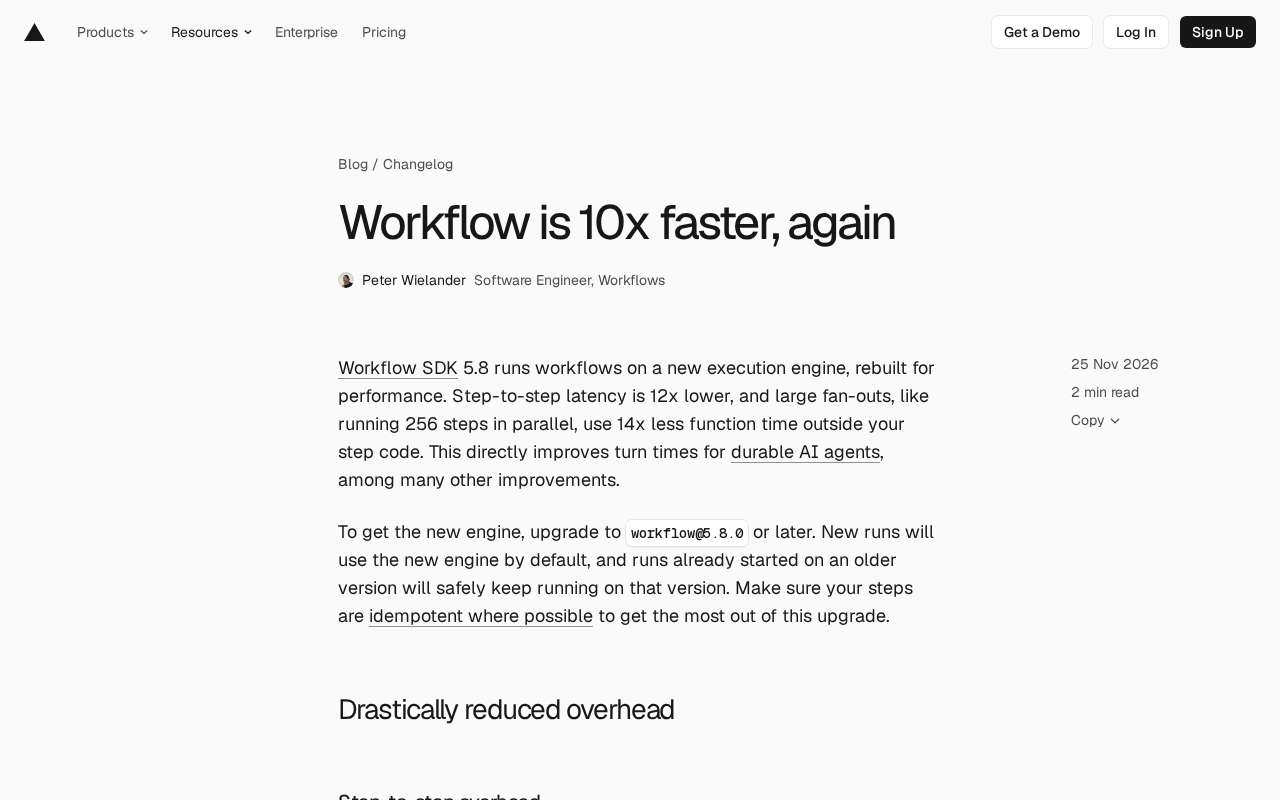
Workflow SDK 5.8 Performance Benchmark: Step Latency Reduced 12x
Workflow SDK 5.8 rebuilds its execution engine, cutting p75 inter-step latency from 85ms to 7ms and 256-way parallel fan-out overhead by 14x, improving durable AI agent turnaround.

David Fincher's New Film Accused of Being AI-Generated? The Truth Behind the Controversy
David Fincher's new film *The Further Misadventures of Cliff Booth* is accused of using AI, with a carriage shot in the trailer sparking controversy. Netflix's acquisition of Ben Affleck's AI company and Fincher's own openness to AI keep suspicions alive. This article sorts out the controversy and the views of all sides.

FCC Clears SpaceX's Space-Based AI Data Centers: A Debate Over Regulatory Boundaries
The FCC approved SpaceX's plan to deploy AI data centers in space but dismissed opponents' key concerns about scientific research impacts as beyond its regulatory authority. This article analyzes the regulatory boundary issues behind the decision, the deeper tensions of space-based AI infrastructure, and its implications for the industry.