Tennyson's Faith: A Nobler Type — Faith and Exploration in the Age of Technology

Starting from Tennyson's "nobler faith," exploring the tech community's deep hunger for meaning and humanistic values.
Using a Hacker News post titled "Tennyson's Faith: A Nobler Type" as a starting point, this article interprets the "nobler type of faith" proposed by Victorian Poet Laureate Tennyson in *In Memoriam A.H.H.*—an attitude that accommodates scientific discovery, confronts doubt, and persists in moral pursuit. The author argues that its appearance in the tech community is a metaphorical reflection by practitioners seeking meaning beyond algorithms and efficiency, and connects Tennyson's constructive doubt with "responsible innovation" in AI ethics.
Introduction: When Technology Meets Faith
On Hacker News, a discussion about "Tennyson's Faith: A Nobler Type" quietly appeared. Although the original material provides only the title and minimal engagement data (3 points, 1 comment), the title itself already contains rich room for interpretation. Tennyson, as the Poet Laureate of the Victorian era, explored faith, science, and human destiny in his work—themes that in today's era of runaway AI and technology have gained renewed relevance.
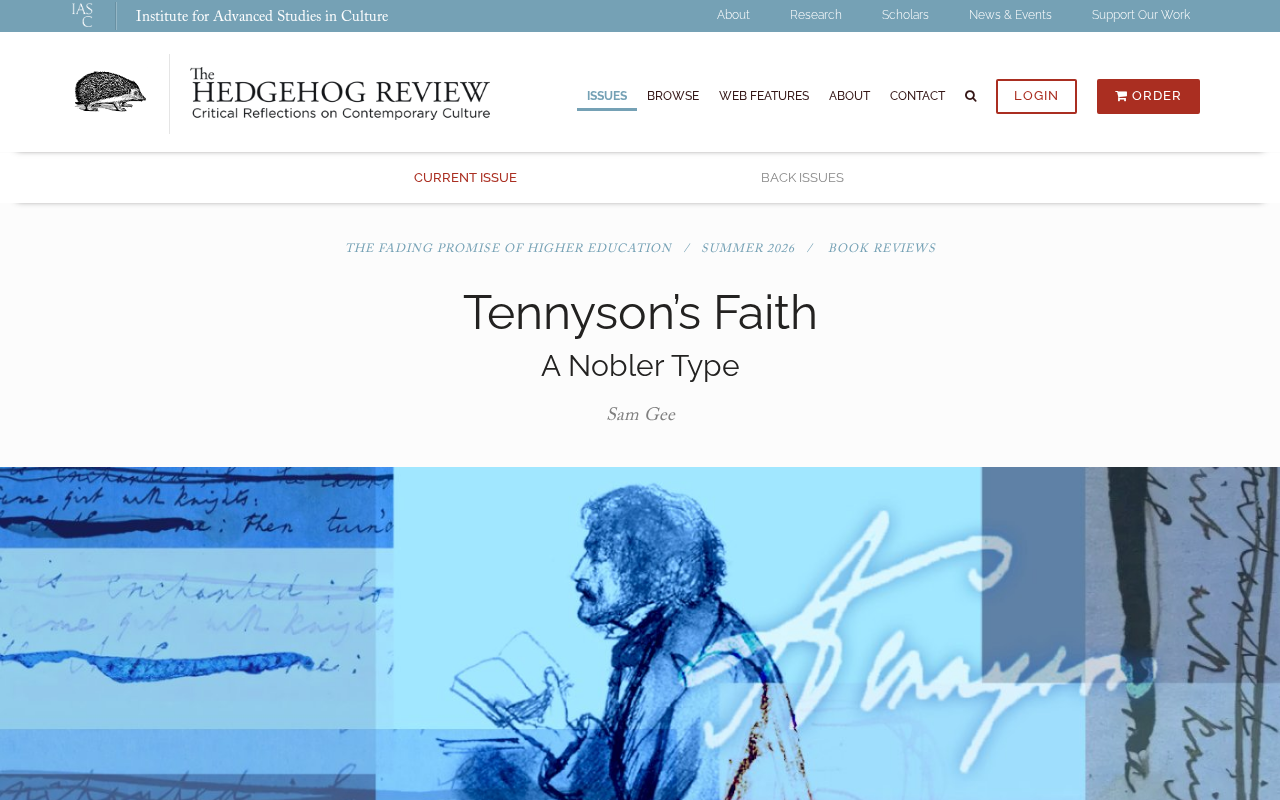
Tennyson's Faith: Seeking a Nobler Form Amid Doubt
Alfred Lord Tennyson's long poem In Memoriam A.H.H. has been called a mirror of the Victorian crisis of faith. Facing the impact of geology and evolutionary theory on traditional religion, Tennyson did not simply reject or blindly follow; instead, he proposed "a nobler type of faith"—an attitude capable of accommodating scientific discovery, confronting doubt directly, and maintaining moral and spiritual pursuit amid uncertainty.
This faith is not dogmatic but exploratory. It acknowledges the limits of knowledge while refusing nihilism. In the context of Hacker News, this concept being raised again may precisely be a metaphorical reflection by the tech community on its own "belief system": are we also constructing a nobler technological faith?
In Memoriam A.H.H. is a long poem Tennyson wrote to mourn the early death of his close friend Arthur Henry Hallam. It took seventeen years to complete and was published anonymously in 1850. The poem consists of 131 short poems plus a prologue and an epilogue, recording in the form of a lyrical sequence the poet's emotional journey from despair and doubt to the re-establishment of faith. Hallam was Tennyson's Cambridge classmate and his most important spiritual confidant, and his sudden death dealt Tennyson a tremendous spiritual blow. The work is not only personal mourning but also became the collective voice of Victorian Britons facing a crisis of faith—at the time, geological discoveries showed that the Earth was far older than the Bible recorded, and Darwin's forthcoming theory of evolution would overturn the doctrine of the fixity of species, challenging traditional Christian faith as never before. The poem's most famous lines, "'Tis better to have loved and lost / Than never to have loved at all," embody Tennyson's effort to seek meaning in pain, while "There lives more faith in honest doubt / Believe me, than in half the creeds" directly echoes the concept of "a nobler type of faith" mentioned in the text.
The "Faith" Metaphor in the Tech Community
As a gathering place for global tech elites, Hacker News discussions often revolve around code, startups, and tools. Yet occasional philosophical or humanistic topics often strike a deeper chord. The appearance of Tennyson's title here suggests tech practitioners' hunger for "meaning"—beyond algorithms and efficiency, do we need a nobler conviction to guide the direction of technological development?
Based on the single comment on the post (due to limited data, specific views cannot be elaborated), it can be inferred that the discussion may involve the balance between faith and reason, the limitations of techno-utopianism, and similar topics. Although engagement was low, the title itself constitutes a proposition worth exploring.
Hacker News was founded in 2007 by the venture capital firm Y Combinator. Its content focuses mainly on technology, startups, and computer science, but there is an unwritten tradition in the community culture: occasionally allowing and even encouraging philosophical, history-of-science, and humanistic topics, as long as the discussion maintains intellectual rigor. The community features sections such as "Show HN" and "Ask HN," and its users are mainly engineers, founders, and researchers, who both identify with and critique technological determinism and Silicon Valley utopianism. Historically, Hacker News has repeatedly seen topics on the history of science, religion, and philosophy, such as Newton's theological research and Wittgenstein's philosophy, and these posts often spark discussions beyond the tech circle. The phrase "technological faith" in the text actually touches on a long-standing tension in Silicon Valley culture: on one hand, an optimistic belief that technology can solve all problems; on the other, reflection and doubt about that belief itself.
Cross-Validation from Multiple Perspectives
Since the original material comes from only a single platform, Hacker News, and contains very little information, this article cannot perform multi-source cross-validation. The following analysis is based on semantic interpretation of the title and general discussion patterns in the tech community, and is labeled as inference from a single source.
The Potential Connection Between Faith and AI Ethics
The "nobler type of faith" advocated by Tennyson emphasizes maintaining moral courage in the face of the unknown. This resonates with the concept of "responsible innovation" in current AI ethics discussions. The tech community's reference to Tennyson may be a reminder: while pursuing model performance and commercial value, we should not abandon our commitment to humanistic values.
The Positive Value of Skepticism
Tennyson's faith is not blind optimism but contains profound doubt. In the technology field, skepticism is likewise a driving force of progress—questioning existing solutions breeds innovation, and vigilance about technological risks drives safety research. This "constructive doubt" is precisely the contemporary embodiment of "a nobler faith."
Conclusion: Between Code and Lines of Poetry
The brief appearance of "Tennyson's Faith: A Nobler Type" on Hacker News is like a pebble dropped into the lake of technology. Though the ripples are small, it reminds us that the tech community does not care only about efficiency and growth; it is also searching for narratives that can house spiritual pursuits. The questions Tennyson raised a century and a half ago are still worth pondering for every tech practitioner today—what kind of faith are we building?
As AI and biotechnology accelerate, this kind of dialogue between the humanities and technology will become increasingly important. Perhaps the inspiration for the next technological breakthrough lies hidden in a line of Victorian poetry.
One-line Summary
Starting from Tennyson's "nobler faith," this explores the tech community's deep hunger for meaning and humanistic values.
Paragraph Summary
Using a Hacker News post titled "Tennyson's Faith: A Nobler Type" (with only 3 points and 1 comment) as a starting point, this article interprets the "nobler type of faith" proposed by the Victorian Poet Laureate Tennyson in In Memoriam A.H.H.—an attitude that can accommodate scientific discovery, confront doubt directly, and persist in moral pursuit. The author argues that the appearance of this concept in Hacker News, a community of tech elites, is no accident but a metaphorical reflection by tech practitioners seeking meaning beyond algorithms and efficiency. The article further connects Tennyson's constructive doubt with the concept of "responsible innovation" in AI ethics, pointing out the positive value of skepticism in technological innovation and safety research. Although the original material comes from a single source with very little information, the author still uses it to raise a core proposition: the tech community needs to build a "technological faith" capable of accommodating doubt and humanistic care, finding a place for spiritual narrative between code and lines of poetry.
Related articles

AI Digital Twin in Action: Using DOT to Automatically Track Bugs and User Feedback
DOTS engineers demonstrate how AI digital twin DOT collects cross-platform user feedback, categorizes issue themes, opens threads to investigate bug root causes, and submits PRs—showcasing a complete AI agent workflow for defect triage with auditable design.

Why Transistors Are No Longer Flat: The Evolution from Planar to Gate-All-Around
Transistor evolution from planar to FinFET to gate-all-around: why gates went from three-sided to four-sided wrapping to suppress short-channel effects and leakage current, extending Moore's Law.

Swarm Intelligence = a Single RL Agent? A Proof of Multi-Armed Bandit Equivalence
A paper proves that collective decision-making through local imitation in swarms is mathematically equivalent to single-agent reinforcement learning: N blind imitators act as N parallel environment samples, with an effective learning rate of 1/N. This article explains the derivation and implications of the Maynard-Cross Learning algorithm.