TensorRT Edge-LLM Benchmarked: Jetson AGX Thor Runs MLPerf Edge Agentic Workloads 6.4x Faster
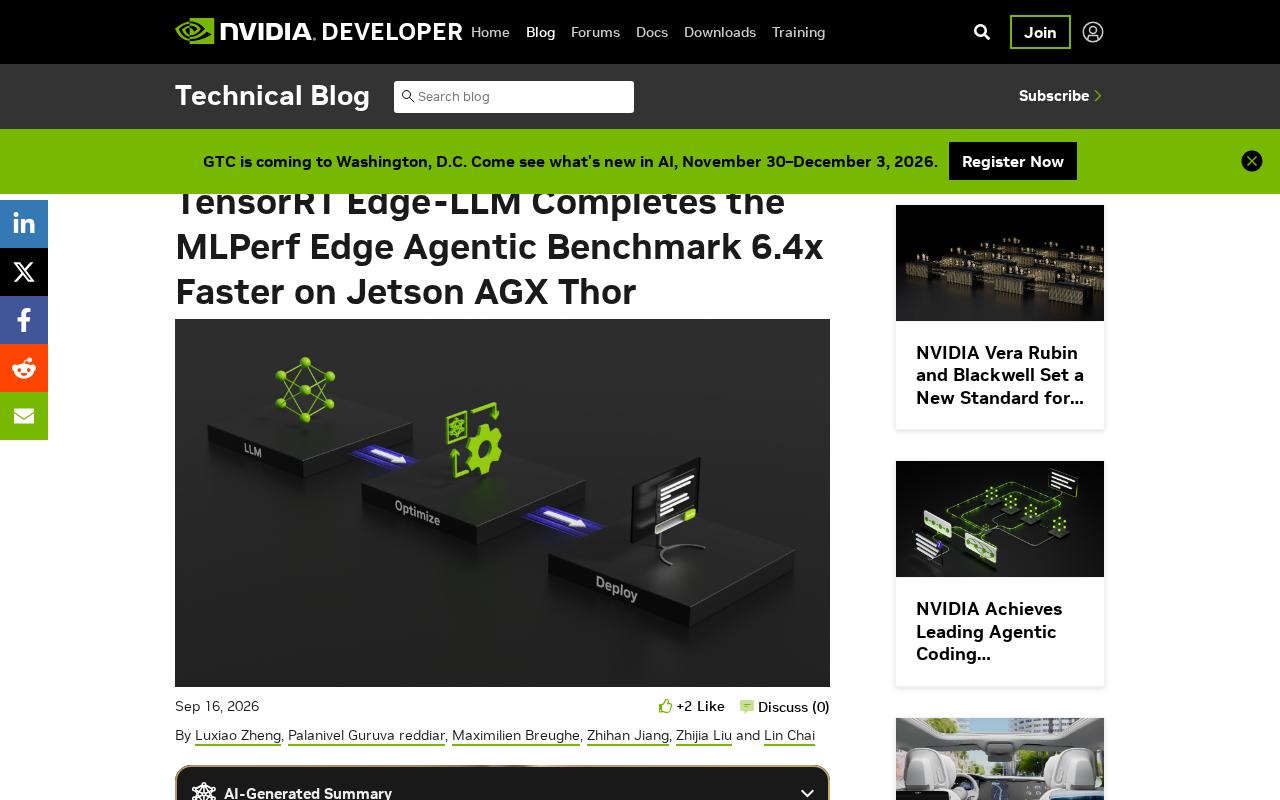
TensorRT Edge-LLM and Jetson AGX Thor co-optimization delivers 6.4x faster edge agent inference.
AI agents are moving from the cloud to edge devices like vehicles and robots, where their multi-step chained reasoning accumulates latency across every model call — placing far stricter demands on edge hardware than single-turn inference. NVIDIA's benchmark results show that deep co-optimization between the TensorRT Edge-LLM software stack and Jetson AGX Thor hardware achieves a 6.4x speedup on the MLPerf edge Agentic benchmark, which is specifically designed to reflect real multi-step agent workloads rather than simple throughput. This milestone indicates that as inference stacks and dedicated edge hardware continue to advance, agent capabilities that once required cloud compute are becoming viable for real-time local execution — with meaningful implications for low-latency, privacy-preserving edge deployment in autonomous driving and industrial robotics.
AI agents are rapidly migrating from cloud data centers to edge devices like vehicles and robots. Unlike chatbots that simply respond to a single query, agents must continuously invoke models across multi-step chains for reasoning, planning, and execution — placing far greater demands on edge hardware inference efficiency than ever before. NVIDIA recently announced that its TensorRT-based Edge-LLM achieves a 6.4x speedup on the MLPerf edge Agentic benchmark when running on Jetson AGX Thor, setting a new reference point for deploying agents at the edge.
From Cloud to Edge: The Fundamental Shift in Agent Workloads
To appreciate the significance of this performance gain, it helps to understand how edge agents differ from traditional inference tasks. A chatbot receives a prompt and generates a response — a classic single-turn inference. An agent, by contrast, must repeatedly reason, invoke tools, evaluate results, and decide on the next action throughout the course of completing a task, often requiring many model calls in a single workflow.
This "chained" operating mode means that any latency in a single inference step gets multiplied across multiple steps. In the cloud, large GPU clusters and generous power budgets can absorb this overhead. But when agents are moved to edge devices like vehicles or robots, compute, memory, and power are all tightly constrained. Making each inference step fast enough under limited resources becomes the critical bottleneck determining whether edge agents can be deployed in practice.
The chained reasoning pattern of agents is typically implemented through frameworks like ReAct (Reasoning + Acting): the model generates a Thought at each step, decides which tool to call (Action), receives the tool's returned result (Observation), and then enters the next reasoning round until the task is complete. A moderately complex agent task often requires 5 to 20 model calls. If each call has a 500ms latency, end-to-end completion time could reach 2.5 to 10 seconds. This may be acceptable in the cloud, but for autonomous driving or industrial robotics scenarios requiring real-time response, that accumulated latency can directly affect safety or production throughput — which is the fundamental reason why edge inference efficiency is such a critical bottleneck.
The Significance of the MLPerf Edge Agentic Benchmark
MLPerf is a widely recognized machine learning performance benchmarking framework in the industry. Its edge Agentic benchmark is specifically designed for the real-world workloads that agents face on edge devices. Unlike traditional benchmarks that only measure single-inference throughput, the Agentic benchmark more closely reflects the multi-step characteristics of agents at runtime and can capture the overall efficiency of end-to-end task completion.
Achieving strong results on this class of benchmark means that the hardware-software combination performs well not just on peak theoretical compute, but also maintains stable, high efficiency across complex, continuous reasoning chains. This provides far more meaningful signal for evaluating the real-world viability of edge agents.
The TensorRT Edge-LLM and Jetson AGX Thor Synergy
The 6.4x performance improvement comes from deep co-optimization between the TensorRT Edge-LLM software stack and the Jetson AGX Thor hardware platform. TensorRT is NVIDIA's core inference optimization toolkit, squeezing hardware performance through operator fusion, precision quantization, and automatic kernel tuning. Edge-LLM represents a specialized optimization path for deploying large language models in edge scenarios.
Jetson AGX Thor, as an edge computing platform targeting robotics and automation, delivers dramatically higher compute density than its predecessors. When a deeply optimized inference software stack runs on hardware purpose-built for edge AI, the combined effect makes multi-step agent workloads — previously very challenging for edge devices — genuinely practical. The 6.4x speedup is a direct reflection of this hardware-software co-optimization.
TensorRT's core optimization techniques are worth explaining further. Operator fusion merges multiple consecutive compute operations into a single kernel call, reducing memory bandwidth usage and scheduling overhead. Quantization lowers model weight precision from FP32 or FP16 to INT8 or even INT4, dramatically shrinking memory footprint and compute requirements within acceptable accuracy bounds. Auto-tuning runs multiple operator implementations on the target hardware and selects the best-performing option, ensuring optimizations are tightly matched to specific hardware characteristics. Jetson AGX Thor features NVIDIA's next-generation GPU architecture and dedicated deep learning accelerators, with significantly improved on-chip memory bandwidth and performance-per-watt (TOPS/W) compared to the previous Jetson AGX Orin. It can deliver hundreds of TOPS of AI compute within a ~60W power envelope — precisely the hardware foundation needed to support multi-step agent chains running in real time at the edge.
Implications for Edge Agent Deployment
These results have practical significance for developers and enterprises exploring edge AI deployment. For agent applications to truly leave the cloud and enter the physical world, edge devices must be able to sustain complete reasoning chains at acceptable latency and power consumption. Previously, multi-step agents running at the edge often struggled to meet real-time requirements due to accumulated latency.
As inference software stacks continue to improve and dedicated edge hardware iterates forward, the performance ceiling for edge-side agents keeps rising. For autonomous driving, industrial robotics, intelligent terminals, and similar scenarios, this means more agent capabilities that previously required cloud infrastructure can gradually move to local devices — bringing lower latency, better privacy protection, and stronger offline availability.
Conclusion
The 6.4x acceleration achieved by TensorRT Edge-LLM on Jetson AGX Thor demonstrates the trajectory of edge agent inference optimization. As AI agents move from chat interfaces into real-world vehicles and robots, inference efficiency is no longer just a throughput number — it's a practical threshold that determines whether applications can be deployed at all. Hardware-software co-optimization is steadily lowering that threshold, bringing large-scale edge agent deployment one step closer to reality.
Related articles
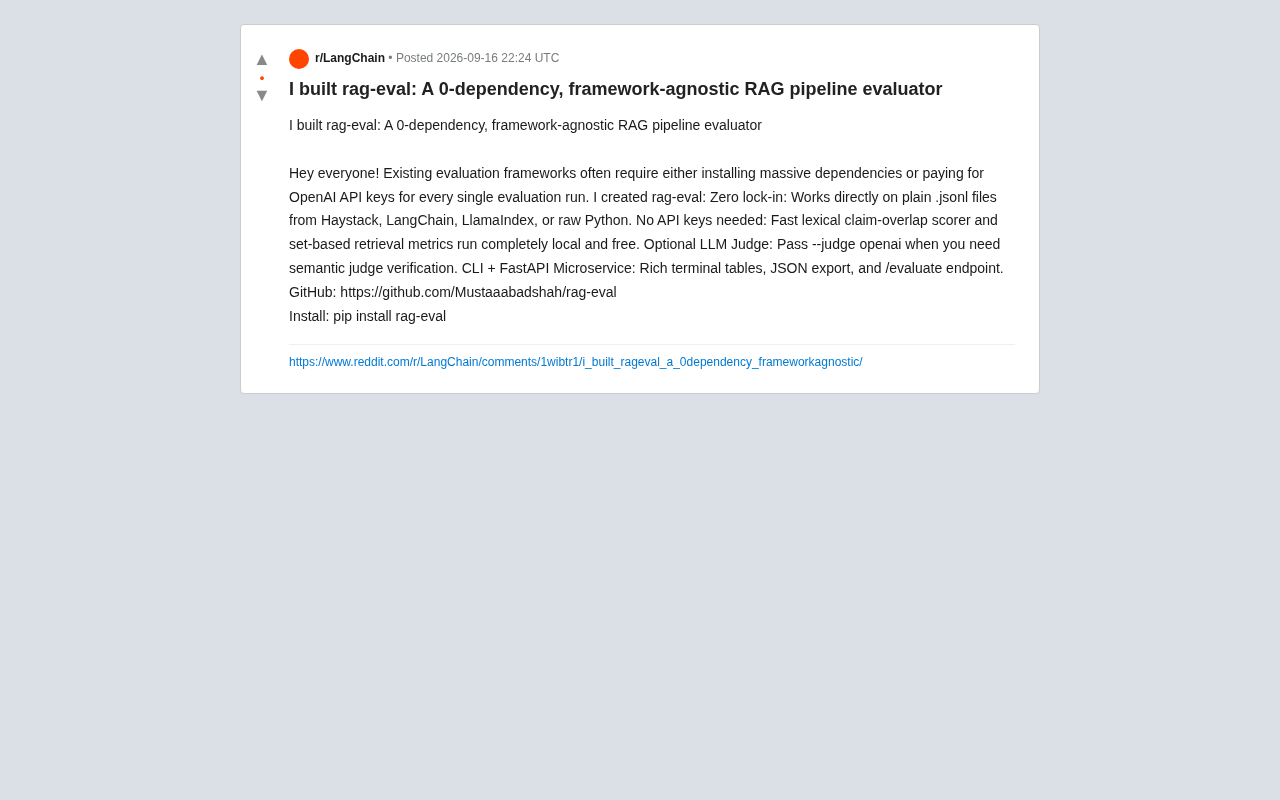
rag-eval: A Zero-Dependency, No-API-Key RAG Evaluation Tool
rag-eval is a zero-dependency, framework-agnostic open-source RAG pipeline evaluation tool. It supports free local lexical and retrieval metrics with no API keys required, and offers optional LLM Judge for semantic validation. Compatible with Haystack, LangChain, and LlamaIndex.
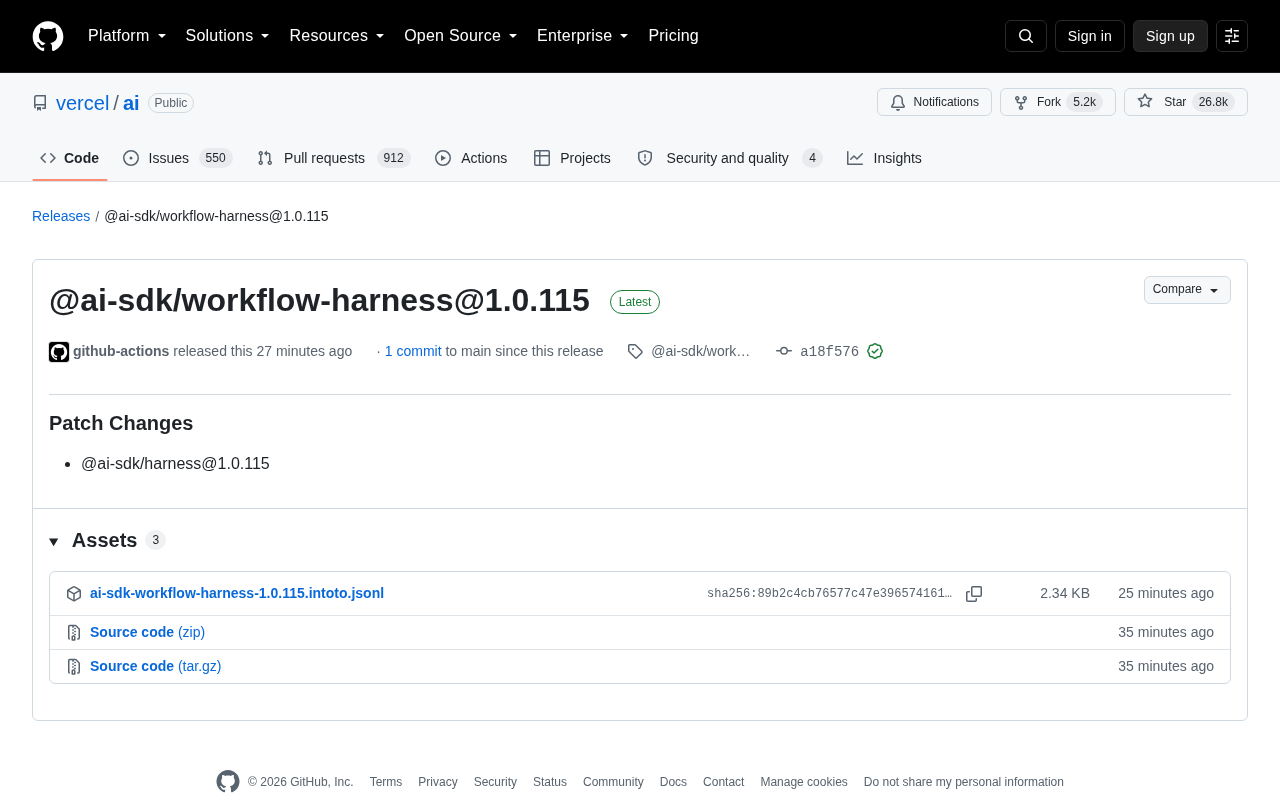
Vercel AI SDK Releases workflow-harness 1.0.115 Patch Update
Vercel AI SDK releases @ai-sdk/workflow-harness 1.0.115 patch update, syncing the @ai-sdk/harness dependency. Learn about the update, release mechanism, and what it means for developers.
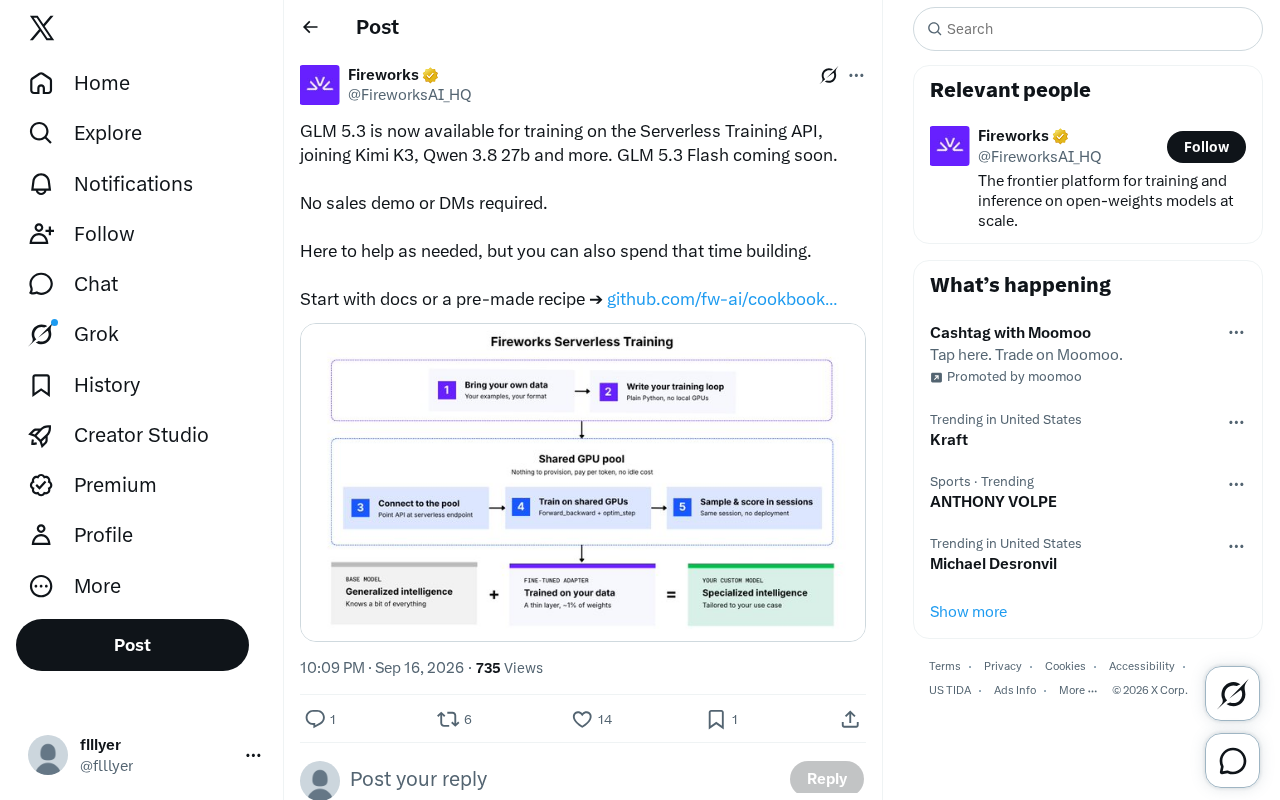
GLM 5.3 Now Available on Serverless Training API — No Sales Process Required
GLM 5.3 is now available on Serverless Training API alongside Kimi K3 and Qwen 3.8 27b. No sales process needed — start fine-tuning directly via docs or pre-made recipes.