Terence Tao Explains 6 Core Mathematical Concepts: From Mathematical Thinking to AI Engineering Practice

Terence Tao's six core math concepts and how they apply to AI and software engineering.
Fields Medal laureate Terence Tao outlines six core concepts for understanding modern mathematics, including abstraction, structure, and order-of-magnitude reasoning. This article examines how these mathematical thinking patterns transfer to AI, algorithm design, and software engineering, and argues that mathematical intuition becomes even more important — not less — in the age of AI-assisted research.
When a Top Mathematician Talks About "Essential Concepts"
Fields Medal laureate Terence Tao recently released a video that sparked discussion on Hacker News (134 points, 18 comments). In it, one of the most celebrated mathematicians of our time laid out six core concepts he considers crucial for understanding modern mathematics. For practitioners working in AI, algorithms, and computational science, this isn't just a math lesson — it's a masterclass in how to think.
The Fields Medal is widely regarded as one of the highest honors in mathematics, awarded every four years to mathematicians under 40 who have made outstanding contributions to the field. Tao received the award in 2006 at just 31 years old. He has made pioneering contributions across harmonic analysis, partial differential equations, combinatorics, analytic number theory, and many other areas, and is considered one of the most broadly accomplished mathematicians of our time. His research style is known for making cross-disciplinary connections, often combining tools from seemingly unrelated branches of mathematics to solve long-standing open problems.
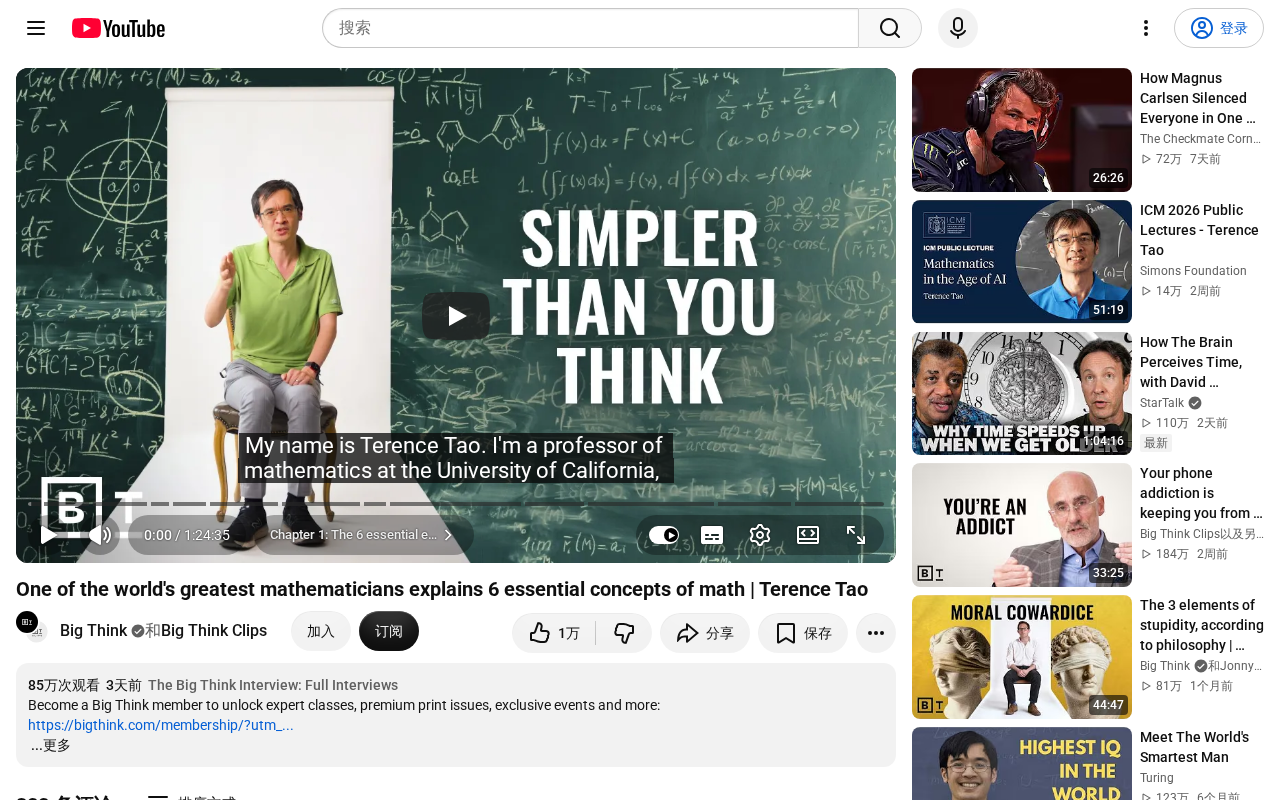
Tao is renowned for the clarity of his public communication. He excels at translating highly abstract objects into intuitively accessible language — a skill that is among the scarcest resources in mathematics education and technical communication. When someone standing at the pinnacle of a discipline is willing to step back and re-explain foundational concepts, the value often exceeds that of any specific theorem.
Why Foundational Math Concepts Deserve to Be Re-Explained by Top Scholars
At the intersection of mathematics and computer science, many people fall into a common trap: believing that mastering tools (libraries, frameworks, formulas) is the same as understanding principles. What Tao repeatedly emphasizes are the "meta-concepts" that run through multiple branches and support the entire edifice of knowledge — they don't belong to any specific theorem but are prerequisites for understanding all theorems.
Abstraction and Structure: The Source of Mathematics' Power
The power of mathematics comes from abstraction: extracting the common structure from different problems and treating them with a unified language. Group theory, topology, and category theory are all products of this approach. Group theory studies the algebraic structure of symmetry — any system of operations with associativity, an identity element, and inverses can be described in a unified framework. Topology concerns properties of spaces that remain invariant under continuous deformation, enabling mathematicians to distinguish fundamentally different geometric objects like a "donut" and a "sphere." Category theory is called "the mathematics of mathematics" — rather than studying specific mathematical objects, it studies the mappings and relationships between mathematical structures, providing a unified language that spans algebra, geometry, logic, and other branches. Together, these three embody the core methodology of modern mathematics: unifying superficially different phenomena by identifying deep structure.
This is especially relevant for AI practitioners — many breakthroughs in machine learning are essentially about finding the right abstraction for data structure. The revolutionary success of Convolutional Neural Networks (CNNs) in image recognition hinges on the fact that the convolution operation inherently possesses translation invariance — whether a cat appears in the top-left or bottom-right of an image, the same convolutional kernel can capture its features. This mathematical property directly corresponds to the physical prior of image data. The attention mechanism in the Transformer architecture, on the other hand, models relationships between arbitrary positions in sequential data, abandoning CNN's locality assumption and instead letting the model learn which positions have important correlations. Both examples illustrate that choosing the right mathematical abstraction to match the intrinsic structure of data is the fundamental reason deep learning succeeds.
Order of Magnitude and Approximation: From Exact Solutions to Engineering Judgment
Tao extensively uses "estimates" and "order-of-magnitude analysis" in his own research. Real-world mathematics rarely demands exact solutions — more often, it's about judging "roughly how large" something is or "how fast it grows." Order-of-magnitude analysis has a long tradition in mathematics, from Big-O notation to asymptotic analysis. The core idea is to ignore constant factors and lower-order terms, focusing on the dominant behavior of a quantity in the limiting case. In algorithm design, this means distinguishing between an O(n log n) and an O(n²) sorting algorithm is often far more important than optimizing constant factors. In machine learning, determining a model's convergence rate — whether it approaches the optimal solution at a rate of 1/n or 1/√n — directly determines training strategy and computational resource allocation. Tao's work in partial differential equations and harmonic analysis relies heavily on refined estimation techniques. This mindset of "not pursuing exact answers but accurately grasping the order of magnitude" has direct practical implications for engineering.
Transferring Mathematical Thinking to AI and Engineering Practice
For the tech community, the significance of content like Tao's lies in methodological transfer. The following thinking habits can be applied almost directly to AI and software engineering:
-
Reduction: Transforming an unfamiliar problem into one that has already been solved — this is a universal strategy in algorithm design and proof construction. Reduction is a foundational concept in computational complexity theory. The classical theory of NP-completeness is built entirely on reductions: if you can prove that problem A can be transformed into problem B in polynomial time, then an algorithm that solves B also solves A. The Cook-Levin theorem proved that the SAT problem is NP-complete, and nearly all subsequent NP-completeness proofs are accomplished by reducing from a known NP-complete problem. In everyday software engineering, reduction thinking is equally prevalent — mapping new requirements to existing design patterns, or transforming an unknown debugging problem into a reproducible minimal test case, are both engineering applications of this idea.
-
Counterexample thinking: Before validating a conjecture or architectural assumption, trying to construct a counterexample can quickly eliminate wrong directions.
-
Multi-perspective switching: The same object can be understood from algebraic, geometric, analytical, and other perspectives — in engineering terms, this means examining the same problem from the data layer, the model layer, the system layer, and other different levels.
The Hacker News comment section echoed this point: many developers felt that the "how to ask questions" Tao conveys is more valuable than "what the answers are." In an era where AI tools are increasingly ubiquitous and answers are readily available, the ability to ask the right questions and judge whether answers are reasonable has become an even more critical competitive advantage.
Why Mathematical Intuition Matters More in the AI Era
A popular view holds that as large models become capable of assisting with derivations and even generating proofs, the necessity for humans to master mathematical fundamentals is declining. But Tao's own practice suggests the opposite — he has been actively exploring the use of AI (such as the formal proof tool Lean and large language models) to assist mathematical research, and this kind of collaboration precisely demands stronger judgment from the user: knowing what to delegate to the tool, how to verify the output, and where to intervene.
Lean is an interactive theorem prover and functional programming language primarily developed by Leonardo de Moura at Microsoft Research. It allows mathematicians to formalize the proof process into computer-verifiable code, fundamentally eliminating logical gaps that may exist in manual proofs. In 2023, Tao used Lean to successfully formally verify his proof (with collaborators) of the Polynomial Freiman-Ruzsa conjecture, a practice that generated widespread attention in the mathematical community regarding AI-assisted proofs. Meanwhile, projects like DeepMind's AlphaProof and Meta's HyperTree Proof Search are also exploring the use of large language models to automatically generate formal proof steps. These developments indicate that future mathematical research will increasingly adopt human-machine collaboration models, with the role of human mathematicians shifting from "manually deriving every step" to "setting direction, decomposing problems, and verifying results."
In other words, AI is not a substitute for mathematical intuition — it's an amplifier. A person with solid conceptual understanding can leverage AI to go much further, while those lacking fundamentals are more easily misled by outputs that appear reasonable but are actually wrong.
Conclusion: The Value of Returning to First Principles
The very act of Tao explaining six core concepts sends a simple but profound signal: no matter how complex a field, understanding always begins with a handful of truly important foundational concepts. For tech practitioners who face new frameworks, new models, and new terminology every day, occasionally pausing to return to these first principles may be the most effective way to cope with information overload.
It's worth noting that when consuming this type of content, one shouldn't be satisfied with merely "getting it." Instead, try to restate the ideas in your own words and find their counterparts in your own work. This is the crucial step from "knowing" to "understanding."
Related articles

Free Unlimited Claude Code Solution: Agnes AI + CC Switch Setup Guide
No paid subscription needed — pair the free AI platform Agnes AI with the open-source tool CC Switch to provide a backend for Claude Code, enabling unlimited free calls to text, image, and video models. This guide covers the full setup, test results, and usage boundaries.

A Complete Zero-Cost Guide to Getting Started with Claude Code for Beginners in China
A beginner's guide to Claude Code for users in China: two installation methods (command line and IDE plugin), full configuration steps for replacing the official API with the free domestic LongCat model, and a hands-on demo of building a small tool with natural language, plus tips.

When the NSA Gets Involved: The AI Supply Chain Crisis Behind Open-Source CVEs and API Key Hijacking
Multiple open-source projects disclosed severe CVEs in one day, PHP flaws alarmed the FBI, and Railway and OpenCode were breached with API keys stolen. This article breaks down the vulnerability window, AI-accelerated exploitation, and the AI supply chain crisis behind the API key black market, with a developer defense checklist.