Terry Tao: Math Is More Than Proofs — How Should We Recognize Everything Else?
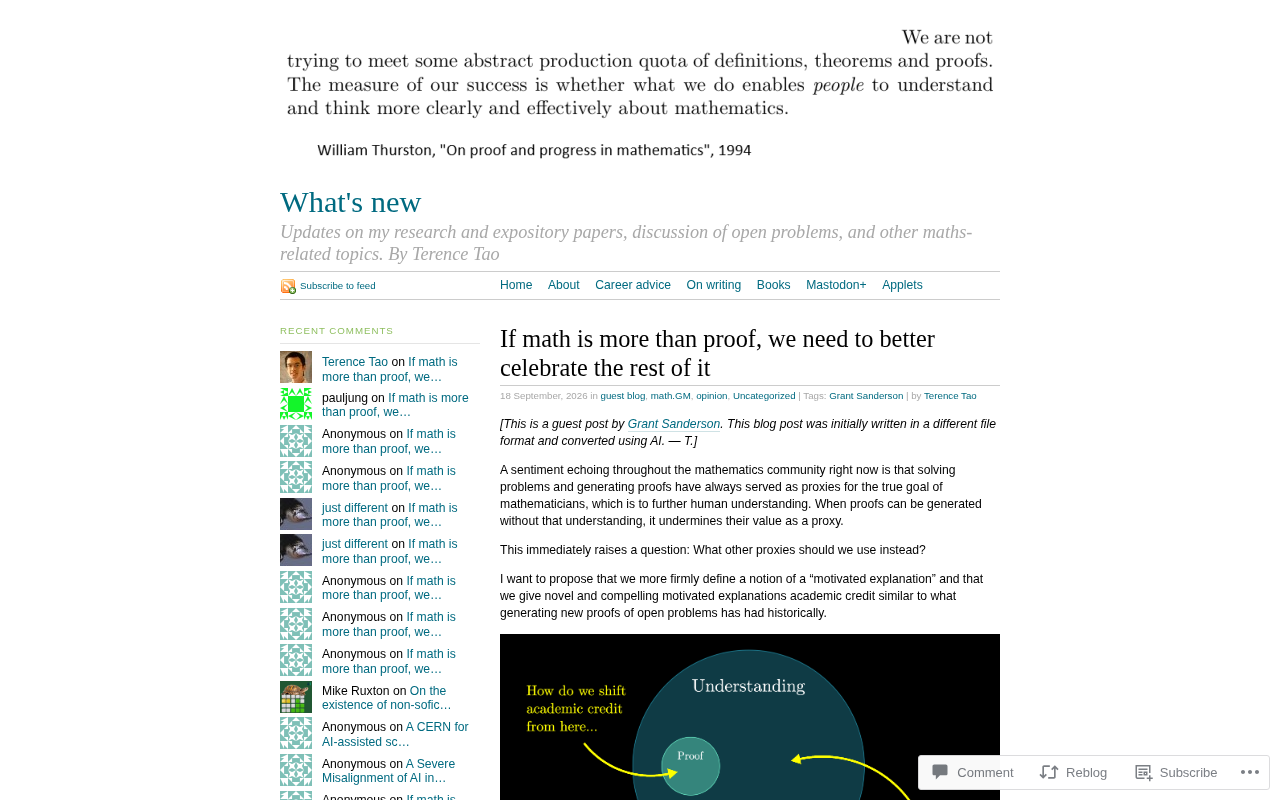
Terry Tao calls on mathematicians to recognize contributions beyond proofs, from asking questions to building intuition.
Fields Medal laureate Terry Tao argues in a widely discussed blog post that mathematics systematically undervalues work beyond formal proofs — including posing good questions, introducing new concepts, transmitting intuition, and writing surveys. He surveys overlooked contribution types and, against the backdrop of rapidly advancing AI proof tools like Lean, asks where the unique value of human mathematicians truly lies. The post drew broad resonance on Hacker News, with practitioners widely citing incentive misalignment that fails to reward high-risk expository and exploratory work.
Fields Medal laureate Terry Tao published a widely discussed post on his personal blog addressing a long-overlooked issue in mathematics: if math is far more than just proofs, we should do a better job of recognizing and celebrating everything beyond them. The post earned 256 upvotes and 207 comments on Hacker News, reflecting strong resonance across the technical and research communities.
The Value of Mathematics Goes Beyond Proof
In the public imagination — and even in parts of academia — the core output of mathematics is often reduced to "theorems and their proofs." A mathematician's contributions are frequently measured by which famous conjectures they have proved. Yet Tao argues that this proof-centric evaluation framework obscures other equally essential dimensions of mathematical activity.
Proofs are, of course, the ultimate guarantee of mathematical rigor — but they are more like the tip of an iceberg. What truly drives mathematical progress also includes the ability to ask the right questions, to build explanatory conceptual frameworks, to uncover deep connections between disparate fields, and to provide clear intuitions for complex phenomena. These contributions are hard to quantify in terms of "what was proved," yet they substantively shape the direction of the entire discipline.
The Types of Mathematical Work That Go Undervalued
Tao's central argument is that the mathematical community's culture and incentive structures are too heavily skewed toward proof, causing a range of equally valuable work to be systematically undervalued.
Asking Questions and Building Concepts
Asking the right question is sometimes harder — and more impactful — than answering it. Many major breakthroughs in history originated with a mathematician who reframed the problem itself. Similarly, introducing a new definition or concept — such as groups, topological spaces, or schemes — can open up entirely new fields of research, with value far exceeding that of any single theorem.
One of the most instructive historical examples is Alexander Grothendieck's introduction of the concept of a "scheme." Schemes generalized the objects of algebraic geometry from concrete solution sets of polynomial equations to more abstract spectra of rings, enabling number theory and geometry to interact within a unified framework — directly giving rise to the modern tools on which Wiles's proof of Fermat's Last Theorem depended. Grothendieck is not remembered for "proving a famous conjecture" but for "reinventing the language of mathematics." Similarly, Poincaré's introduction of homotopy groups and Kolmogorov's axiomatization of probability theory are prime examples where the value of conceptual construction surpasses that of any single proof — precisely the kind of systematic undervaluation Tao describes.
Exposition, Surveys, and Transmitting Intuition
Rewriting an obscure proof into a clear and accessible account, synthesizing scattered results into a coherent theoretical narrative, or distilling reusable intuitions for others — this "expository" work is vital to the health of the discipline. It lowers the barrier for newcomers and allows knowledge to spread effectively, yet in traditional academic evaluation it is often treated as secondary.
Computation, Experimentation, and Counterexamples
Exploratory work in mathematics — discovering patterns through extensive computation, constructing counterexamples to disprove conjectures, or testing boundary cases — is also an important force driving the advance of knowledge. This kind of work does not always present itself as an elegant proof, yet it paves the way for rigorous results to emerge.
Why This Topic Is Timely
Tao's post has generated such strong discussion in large part because of AI's rapid encroachment into mathematics. With the rise of automated theorem proving, formal verification tools (such as Lean), and large language model-assisted research, the "proof" step is increasingly something that machines can handle or accelerate.
This raises a profound question: if machines can efficiently generate and verify proofs, where does the unique value of human mathematicians lie? The answer likely falls precisely in the parts beyond proof — asking meaningful questions, judging what is worth studying, and giving results meaning and intuition. In the age of AI, reconsidering and recognizing these "softer" contributions is not merely a cultural matter; it goes to the heart of how mathematics as a discipline defines its future role.
Lean is an interactive theorem prover and functional programming language developed by Microsoft Research, and a flagship example of formal verification tooling. Formal verification requires mathematicians to translate every logical step of a proof into a machine-checkable formal language, eliminating errors that human reviewers might miss. In recent years, the Lean 4 ecosystem has matured rapidly; the Mathlib project led by mathematician Kevin Buzzard has formalized a large body of modern mathematics, and organizations such as DeepMind are exploring combining large language models with Lean to let AI automatically complete proof steps. This trend means that "writing a rigorously correct proof" — once considered a core skill of mathematicians — is gradually being taken over by machines. Tao himself has publicly stated that he expects AI-assisted tools to handle large amounts of routine proof detail in the not-too-distant future, freeing mathematicians to focus on more creative work.
Community Resonance and Discussion
In the Hacker News discussion, many practitioners shared their own experiences in agreement. Numerous commenters noted that in tenure decisions, paper publishing, and award selection, quantifiable theorem results tend to be favored, while high-quality surveys, teaching materials, or open-source computational tools — produced at considerable effort — struggle to receive equivalent recognition. This misalignment of incentives may push researchers away from high-risk, high-value exploratory work that is difficult to "score."
Other voices pointed to the root of the problem: the operationalizability of evaluation. Whether a proof is correct is binary and verifiable, whereas "insight" or "conceptual elegance" is highly subjective and difficult to standardize. How to build a fair recognition system for diverse mathematical contributions while maintaining rigor remains an open challenge.
This incentive misalignment has a dedicated discussion in academic economics, often called "measurability bias" — the tendency of evaluation systems to reward easily quantifiable outputs, even when harder-to-quantify contributions matter more for the long-term health of a field. The same tension appears outside mathematics: in software engineering (the reward gap between writing documentation and writing features), and in biomedicine (the difficulty of publishing negative results). Some universities have begun experimenting with including quality textbook writing, math competition coaching, or open-source software contributions in promotion criteria, but the lack of cross-institutional standards makes reform slow. Commenters on Hacker News also noted that the peer review system itself presupposes proof as the core currency, and that changing recognition mechanisms may require structural reform starting from journal editorial boards and the review criteria of funding agencies.
Conclusion
Tao's post is not a rejection of proof's central place in mathematics, but a call for the mathematical community to broaden its understanding of "mathematical achievement." In an era where proofs can be increasingly automated, the uniquely human capacities for questioning, explanation, connection, and intuition may be the most irreplaceable parts of mathematics. How to better celebrate these contributions will be a question worth sustained reflection as the culture of the discipline continues to evolve.
Related articles
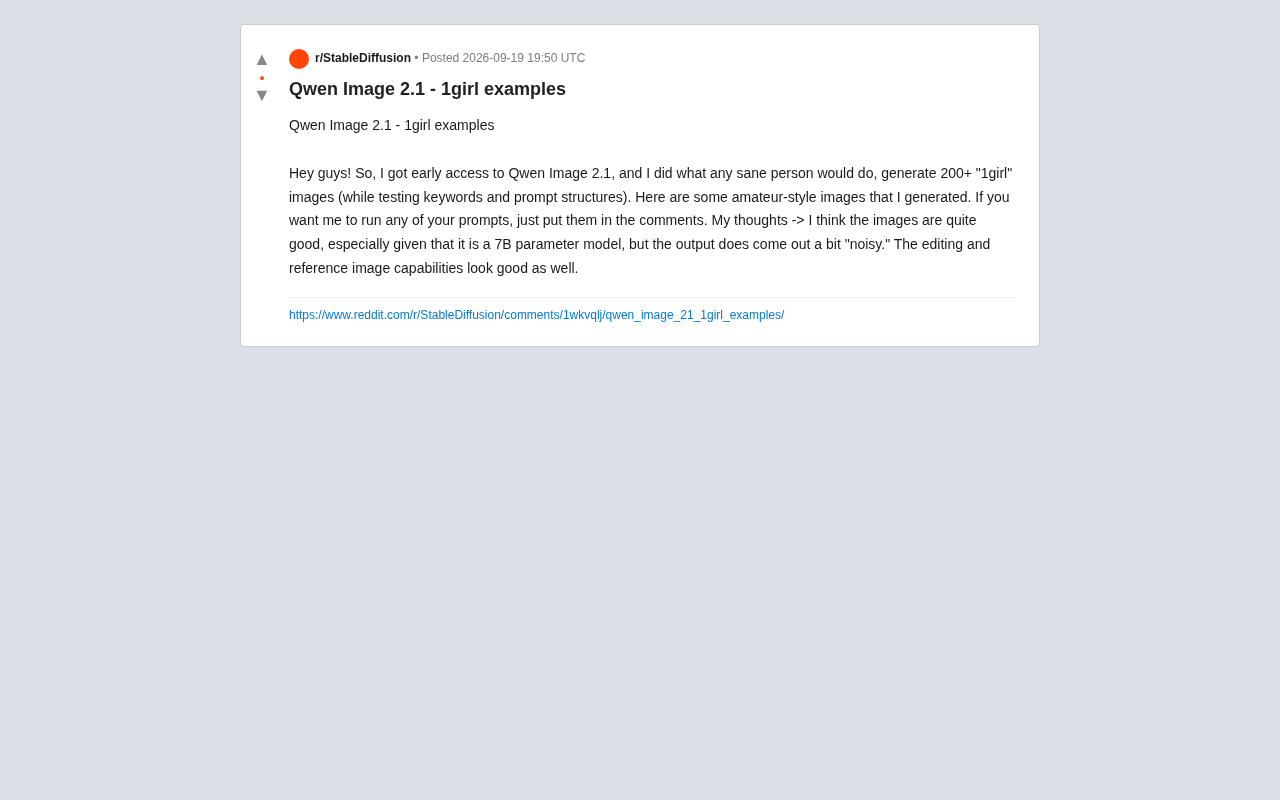
Qwen Image 2.1 Early Testing: How Good Is Image Generation from a 7B Model?
A Reddit user tested Qwen Image 2.1 early access, generating 200+ portrait images. We break down this 7B model's image quality, noise issues, and editing capabilities.
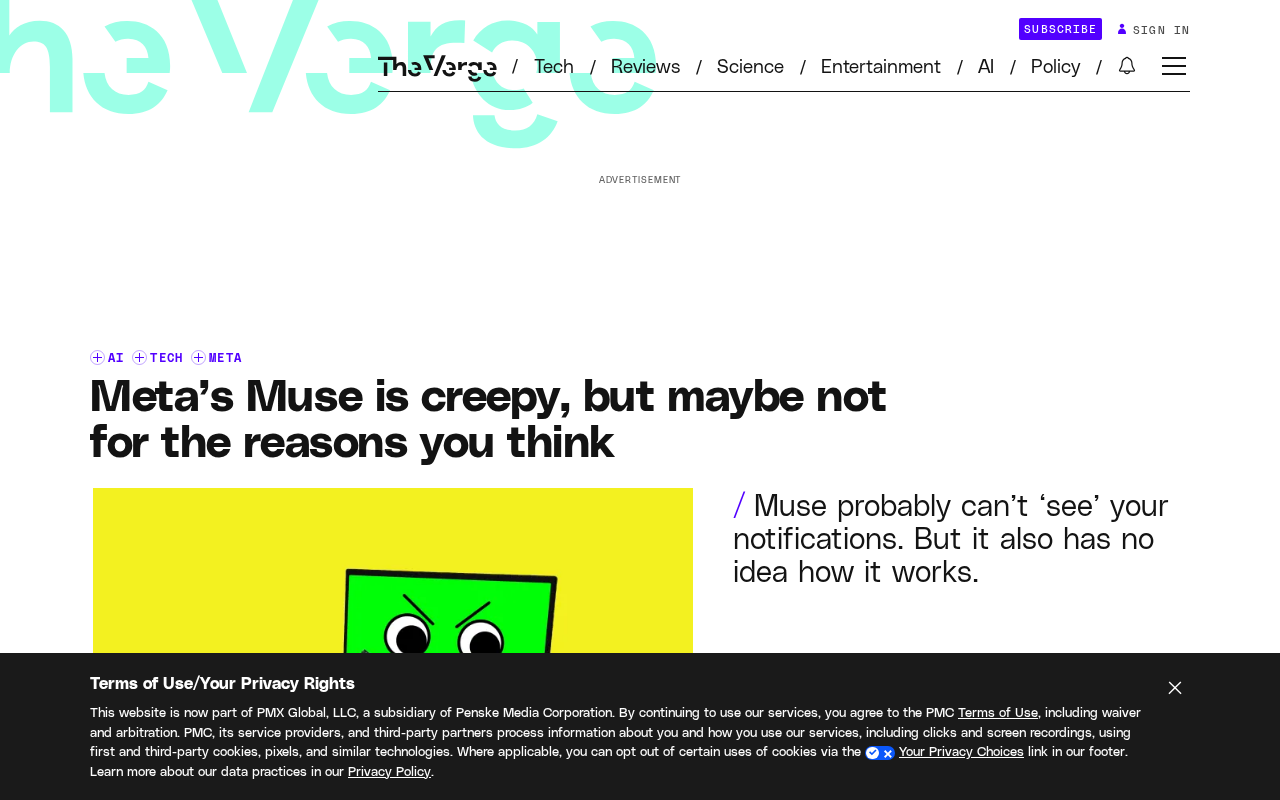
Meta Muse Review: A Powerful Yet Unsettling AI Assistant
Meta's AI assistant Muse is powerful but unsettling. Its Mac app accesses Messages, Calendar, and Notes, raising privacy concerns — and it can't even describe itself.
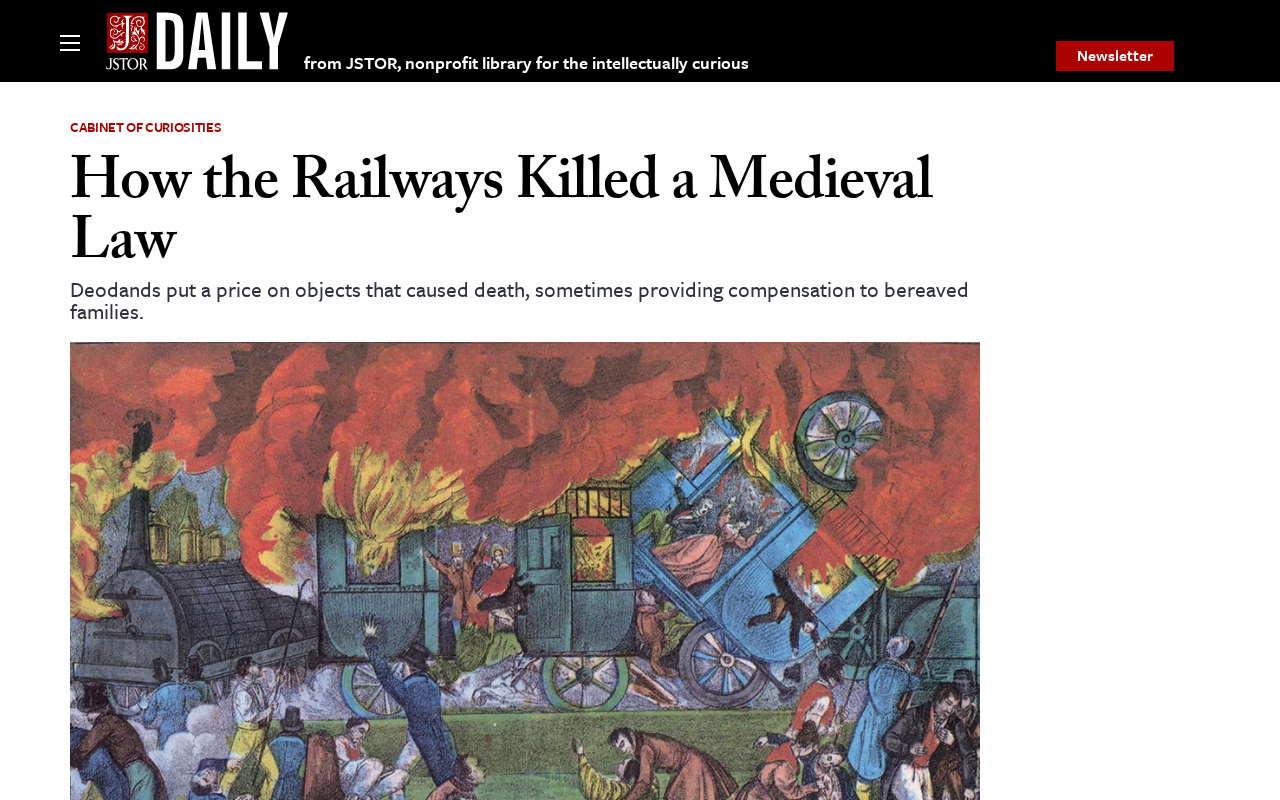
Deodand: The Ancient English Law That Put a Price on Deadly Objects
Deodand was an English common law doctrine that valued and forfeited deadly objects. This article examines its legal logic, evolution from religious rite to fiscal tool, and its relevance to AI and autonomous vehicle liability today.