Tesla Driver Says He Fell Asleep on FSD and Crashed into Police Car

Tesla driver asleep on FSD crashes into police car; CHP warns the name does not mean full autonomy.
A Tesla driver told the CHP he was asleep when his FSD-enabled car hit a parked patrol vehicle. The CHP said FSD is not fully autonomous and drivers remain responsible. The article notes FSD is still L2, with known weaknesses recognizing stationary emergency vehicles, and that NHTSA has investigated related crashes.
A Tesla driver admitted to the California Highway Patrol (CHP) after a crash that he was asleep at the time of impact, with the vehicle in FSD (Full Self-Driving) mode. The accident not only damaged multiple police vehicles but also pushed the gap between Tesla's driver-assistance naming and its real capabilities back into the center of public debate.
How It Happened: Driver Asleep, FSD Fails to Recognize Stationary Police Car
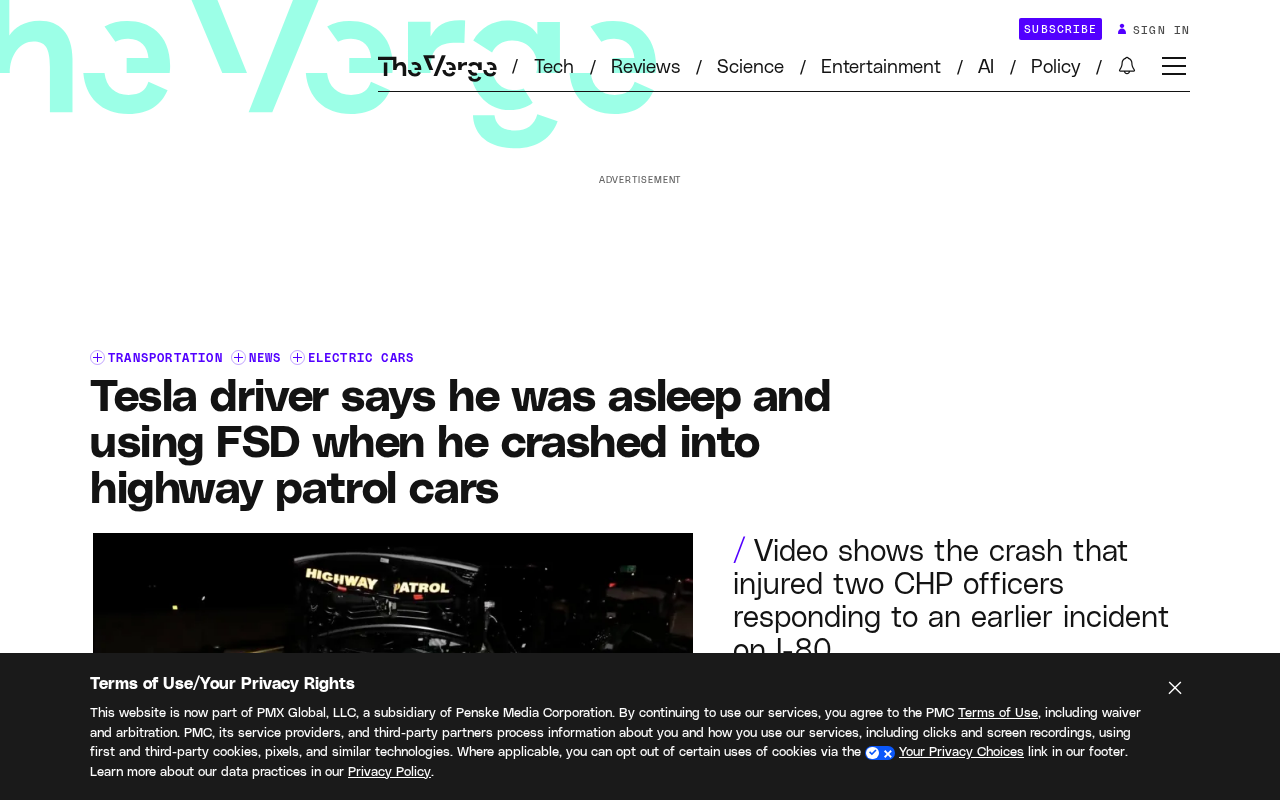
According to information released by the CHP, the accident occurred at a highway patrol scene. Police vehicles were parked on the roadside handling another incident when a Tesla in FSD mode approached at high speed and struck the patrol car directly. The driver later said he had fallen asleep before the impact and the vehicle was fully controlled by FSD. Video released by the CHP shows the Tesla did not noticeably slow down or steer away as it approached the police car.
This is not the first time Tesla's FSD has failed to recognize stationary vehicles or emergency scenes. There have been multiple similar reports involving stationary targets such as police cars, fire trucks, and tow trucks. A pure vision-based approach can struggle with recognition delays or misjudgments when approaching stationary objects at high speed, and once the driver's attention lapses, the window for manual takeover is nearly zero.
CHP's Warning: It's Called Full Self-Driving, But It Isn't
After the accident, the CHP issued a clearly worded statement: "Despite the name Full Self-Driving, it is not fully autonomous. The technology does not absolve the driver of the responsibility to operate the vehicle safely." This comment directly targets Tesla's long-standing naming controversy—the FSD name leads many consumers to believe the vehicle can fully replace human driving.
From a technical classification standpoint, Tesla FSD is still an L2 driver-assistance system, requiring the driver to continuously monitor road conditions and be ready to take over at any time. But there is an obvious gap between the literal meaning of "Full Self-Driving" and the actual requirements of L2. The CHP's decision to specifically emphasize this point in its accident report indicates that law enforcement has come to view naming misrepresentation as part of the safety hazard.
About SAE Autonomous Driving Levels
The J3016 standard developed by the Society of Automotive Engineers (SAE) divides driving automation into six levels from L0 to L5 and has become a common global reference for regulators and industry. L0 is fully manual driving; L1 and L2 fall under "driver assistance," where the system can control both steering and acceleration/deceleration simultaneously, but the driver must continuously monitor the environment and be ready to take over—both Tesla Autopilot and FSD fall under L2. L3 is "conditional automation," allowing the driver to look away in specific scenarios but requiring takeover when the system requests it; only L4 and L5 gradually move toward no human intervention. The key dividing line in this classification is "who is responsible for monitoring the road": at L2 and below, it is the human; at L3 and above, the system is responsible under defined conditions. Precisely because of this, if an FSD whose name contains "Full" still requires the driver to keep hands on the wheel and eyes on the road, it is far from the literal meaning of L5—which is the fundamental reason regulators repeatedly emphasize its L2 nature.
Who Is Responsible: The Sleeping Person and the Imperfect System
The core contradiction in this accident is that the driver fell asleep, and the system failed to provide a backstop. From a legal perspective, a driver who falls asleep while driver assistance is engaged will almost certainly be found primarily at fault. The CHP statement made this clear as well—technology does not transfer responsibility.
But the issue goes beyond that. If a system is marketed as "Full Self-Driving" yet cannot recognize a stationary police car at a critical moment, then the boundary of the manufacturer's naming and promotion deserves scrutiny. The common thread across multiple similar accidents is that system capabilities are overestimated while human attention is systematically underestimated. Together, these create a predictable risk scenario.
About Driver Monitoring Systems and Attention Management
L2 driver assistance depends on the driver being ready to take over at any time, making the Driver Monitoring System (DMS) a key part of safety design. It typically uses steering-wheel torque sensors or cabin cameras to determine whether the driver has hands on the wheel and eyes on the road. If it detects prolonged hands-off driving or closed eyes, the system issues visual and audible warnings in stages, ultimately slowing to a stop and disabling assistance for the rest of the trip. However, such monitoring has clear limitations: torque sensors can be fooled by weights, camera recognition rates drop at night or when obstructed, and in extreme states such as being asleep—where responsiveness is completely lost—warnings often still go unanswered. In this case, the driver was already asleep before impact, indicating that existing monitoring failed to wake him in time or effectively force the vehicle to disengage, which has prompted regulators to consider stricter mandatory standards for DMS.
The Limits of FSD and Regulatory Pressure
Tesla FSD is based on a pure vision approach, relying on cameras and neural networks for environmental perception. Its performance on structured roads continues to improve, but recognition of stationary irregular objects, emergency vehicle lights, and temporary roadblocks remains unstable. This crash into a police car falls precisely within a known weak area.
On the regulatory side, the National Highway Traffic Safety Administration (NHTSA) has opened investigations into multiple accidents involving FSD and Autopilot. California, as a major Tesla market, gives the CHP's public statement an added warning tone. As driver-assistance features spread rapidly, how to draw clear lines in naming, marketing, and user education is becoming a more urgent issue than the technology itself.
For drivers, the lesson from this accident is straightforward: no matter what the system is called, the person behind the steering wheel is always ultimately responsible.
About the Pure Vision Approach and the Challenge of Recognizing Stationary Objects
Tesla is one of the few manufacturers committed to a "pure vision" path, meaning it does not rely on lidar or millimeter-wave radar and instead uses only cameras plus neural networks to reconstruct a three-dimensional environment. This approach is already quite mature for recognizing common targets such as moving vehicles and lane lines, but it has structural difficulties in judging stationary objects: cameras lack the direct ranging capability of lidar, so the system must infer distance and relative speed from multiple frames of images; and when approaching a completely stationary target at high speed, the target's size changes very little across frames, making it easy for the neural network to classify it as background (such as a road sign or overpass), thereby delaying braking decisions. The industry calls this the "stationary object misjudgment" problem. In addition, emergency vehicles often have flashing lights, non-standard parking angles, and temporary roadblocks, all of which are long-tail scenarios in training data, further amplifying recognition uncertainty. This is precisely the shared technical background behind multiple Tesla accidents involving stationary police cars and fire trucks.
One-line Summary
A Tesla driver fell asleep on FSD and crashed into a police car, and the CHP warned that a name does not mean full autonomy.
Paragraph Summary
A Tesla driver admitted to the California Highway Patrol after a crash that he was asleep at the time of impact and the vehicle was in FSD mode. The Tesla struck a patrol car parked on the roadside at high speed, and video showed it did not noticeably slow or steer away. The CHP stated that although FSD is called "Full Self-Driving," it is not fully autonomous, and technology does not absolve the driver of safe-operation responsibility. The article notes that FSD remains an L2 driver-assistance system, and its pure vision approach is unstable at recognizing stationary emergency vehicles—a common weakness in several similar crashes. The core contradiction is that the driver was asleep while the system failed to provide a backstop: legally, the driver is almost certain to bear primary responsibility, but the manufacturer's boundaries in naming and marketing also deserve scrutiny. NHTSA has opened investigations into related accidents.
Related articles

Cursor AI Programming in Practice: Build a Student Management System from Scratch in 30 Minutes
A Bilibili creator demonstrates Cursor AI programming: generating a student management system in 30 minutes with natural language. Details on Agent mode, Claude selection, prompt techniques, and thresholds.

Top 20 AI Coding Tools Ranking: From Rock-Solid to Lackluster, a Scored Matrix
Bilibili creator releases top 20 AI coding tools ranking, tiered T0–T4 from rock-solid to lackluster, with Claude Code and Codex tied at T0. This article details the scoring dimensions (capability, reliability, robustness, durability, cost, domestic availability) and tool performances to help developers choose the right AI coding assistant.

Vibe Coding Systematic Tutorial: Master AI-Assisted Programming from Zero
A three-month Vibe Coding tutorial from a Bilibili creator covering Codex, ClaudeCode, and Cursor, from core logic to commercial project practice for beginners.