Tesla FSD V15 Upgrade Analysis: End-to-End Network Fully Evolves
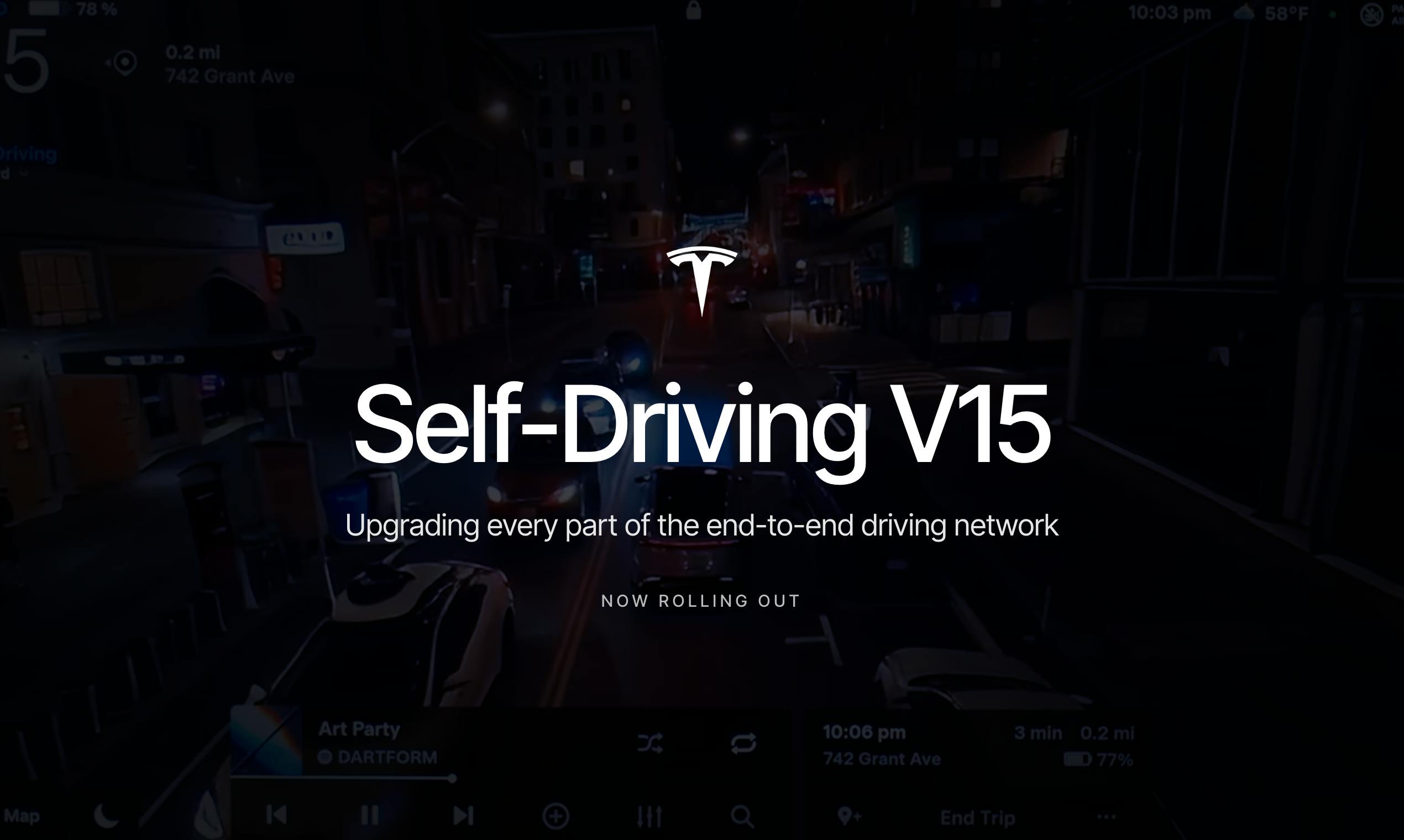
Tesla FSD V15 fully upgrades the end-to-end network, claiming a 25x improvement in safety-critical scenarios and introducing Reality View visualization.
Tesla FSD V15 debuted on Product Hunt, centered on upgrading every link of the end-to-end driving network. Safety-critical scenario handling is claimed to improve 25x; detection of signs, animals, debris, potholes, and standing water is enhanced; speed control is smoother in school zones and bad weather. The system now learns start/end routing from fleet preferences. The most intuitive feature is Tesla Reality View, which presents and controls FSD planning intent via a real-time generated overhead view, easing end-to-end opacity. It offers full-screen, map, split-screen, and quiet modes. It received 84 upvotes, ranking 8th, with limited discussion; key metrics remain undisclosed.
Tesla FSD V15 has debuted on Product Hunt, with its core upgrades centered on every link of the end-to-end driving network. From safety-critical scenario handling to user visualization interactions, this update attempts to make the autonomous driving "black box" more transparent and more controllable.

Safety-critical scenario handling improved 25x
According to the Product Hunt page, FSD V15 achieves a 25x improvement in handling safety-critical cases. The exact metric behind this figure has not been disclosed, but the direction is clear: reducing the probability of failure in extreme situations.
At the same time, the system's detection of signs, animals, debris, potholes, and standing water has all been enhanced, and smoother speed control is achieved in school zones and adverse weather. These improvements point to the same goal — making the end-to-end network more robust in unstructured environments.
Notably, the start and end point routing of navigation paths has begun learning from fleet route preferences, meaning the system no longer relies solely on a single vehicle's real-time perception but incorporates collective driving experience.
Commentary
"Safety-critical scenarios" typically refer to edge cases that have low probability of occurrence but severe consequences when they fail, such as pedestrians suddenly crossing, dropped objects, construction detours, and sudden drops in visibility under extreme weather. When the industry evaluates such capabilities, it often relies on metrics such as scenario library replay, adversarial testing, or collision rates and takeover rates in simulation. The article mentions a 25x improvement but does not disclose the measurement baseline, which is critical: if the baseline is a simulation scenario pass rate, there is still a gap between that and the failure probability on real roads; if the baseline is a relative improvement on a specific subset, the absolute safety level also needs to be understood in light of the base number. Therefore, this figure should be treated with caution, with attention to its denominator, test set composition, and statistical confidence.
Tesla Reality View: Making planning results "visible"
V15's most intuitive new feature is Tesla Reality View. It provides a real-time generated view from a virtual camera above the vehicle, allowing users to see and control FSD's planning intent.
This design attempts to solve a long-criticized problem of end-to-end autonomous driving: the decision process is opaque. By presenting the planned trajectory through a generative view, drivers can more intuitively judge what the system "wants to do" and intervene when necessary.
At the interface level, V15 supports four display options: full screen, map, split screen, and quiet mode. Navigation turns are displayed directly in the visualization view, and the turn signal alert sound has also been noise-reduced. These detail adjustments point to a less distracting driving experience.
Commentary
In the autonomous driving context, "planning intent" refers to the system's prediction and decision-making regarding the driving trajectory, lane selection, acceleration/deceleration, and steering actions over the next few seconds. Traditionally, this information is only indirectly reflected through steering wheel movement and speed changes, making it difficult for drivers to anticipate the system's next move. Presenting the planned trajectory as a generative 3D view is essentially externalizing the model's internal hidden states into readable visual signals — an engineering attempt at "visual explanation" within explainable AI (XAI). The value of such approaches lies in building trust and anticipation during human-machine co-driving, but the generated view itself also introduces additional computation, and its refresh latency and consistency with real perception will directly affect the reliability of the driver's judgment.
What "upgrading every part of the end-to-end driving network" means
The phrase "Upgrading every part of the end-to-end driving network" in the title deserves scrutiny. The end-to-end architecture compresses perception, planning, and control into a single neural network. The advantage is reduced information loss between modules; the cost is increased difficulty in interpretability and debugging.
V15's upgrade path shows that Tesla is addressing the shortcomings of end-to-end in two directions: first, increasing intent communication between human and machine through Reality View; second, learning route preferences from fleet data, using collective experience to supplement the deficiencies of single-vehicle models.
This combination of "end-to-end + fleet data + visual interaction" may be a realistic path for deploying pure end-to-end solutions. However, key metrics such as the specific baseline for the 25x improvement and the generation latency and accuracy of Reality View remain limited in currently disclosed information.
Commentary
The core idea of end-to-end autonomous driving is to use a unified neural network to map directly from sensor inputs (cameras, radar, etc.) to vehicle control commands (steering, acceleration, braking), replacing the traditional modular architecture in which perception, prediction, planning, and control are each independent and connected through manually designed interfaces. The advantage of modular architecture is that each link can be tested and debugged separately, but information transfer between modules is often accompanied by loss and delay, and manually designed interfaces struggle to cover all long-tail scenarios. End-to-end architecture allows gradients to backpropagate all the way from the final control signal, theoretically enabling the learning of better global policies, but this also makes intermediate decision processes difficult to trace — precisely the root of the "black box" problem, and the reason Tesla introduced visual interaction and fleet data learning to compensate for interpretability shortcomings.
Market feedback and points to watch
On Product Hunt, FSD V15 received 84 upvotes, ranking 8th, categorized under robotics, transportation, and artificial intelligence. The single comment indicates that community discussion has yet to gain momentum.
For practitioners following autonomous driving, V15's highlight is not the length of its feature list but how the end-to-end network balances safety and interpretability. Whether Reality View can truly reduce drivers' cognitive load, and whether fleet route learning will bring privacy or regional adaptation issues — these all require real-world road test data to answer.
Each version iteration of Tesla FSD pushes the end-to-end paradigm forward. V15's comprehensive upgrade is a continuation of this direction, but it remains to be verified how far it is from "trustworthy end-to-end driving."
One-line Summary
Tesla FSD V15 comprehensively upgrades the end-to-end network, claiming a 25x improvement in safety-critical scenarios and launching the Reality View visualization.
Paragraph Summary
Tesla FSD V15 has debuted on Product Hunt, with its core focused on upgrading every link of the end-to-end driving network. Safety-critical scenario handling is claimed to improve 25x, detection of signs, animals, debris, potholes, and standing water is enhanced, and speed control is smoother in school zones and adverse weather; the system has begun learning start and end point routing from fleet route preferences, incorporating collective driving experience. The most intuitive new feature is Tesla Reality View, which presents and controls FSD planning intent through a real-time generated view from a virtual camera above the vehicle, attempting to alleviate the opacity of end-to-end decisions. The interface offers four modes: full screen, map, split screen, and quiet. It received 84 upvotes and ranked 8th on Product Hunt, with limited discussion; key metrics such as the baseline for the 25x improvement and the latency of the generated view have not been disclosed.
Related articles
Workflow SDK 5.8 Performance Benchmark: Step Latency Reduced 12x
Workflow SDK 5.8 rebuilds its execution engine, cutting p75 inter-step latency from 85ms to 7ms and 256-way parallel fan-out overhead by 14x, improving durable AI agent turnaround.
David Fincher's New Film Accused of Being AI-Generated? The Truth Behind the Controversy
David Fincher's new film *The Further Misadventures of Cliff Booth* is accused of using AI, with a carriage shot in the trailer sparking controversy. Netflix's acquisition of Ben Affleck's AI company and Fincher's own openness to AI keep suspicions alive. This article sorts out the controversy and the views of all sides.
FCC Clears SpaceX's Space-Based AI Data Centers: A Debate Over Regulatory Boundaries
The FCC approved SpaceX's plan to deploy AI data centers in space but dismissed opponents' key concerns about scientific research impacts as beyond its regulatory authority. This article analyzes the regulatory boundary issues behind the decision, the deeper tensions of space-based AI infrastructure, and its implications for the industry.