Tesla Q3 Revenue Stalls as Flying Roadster Fails to Mask Growth Woes
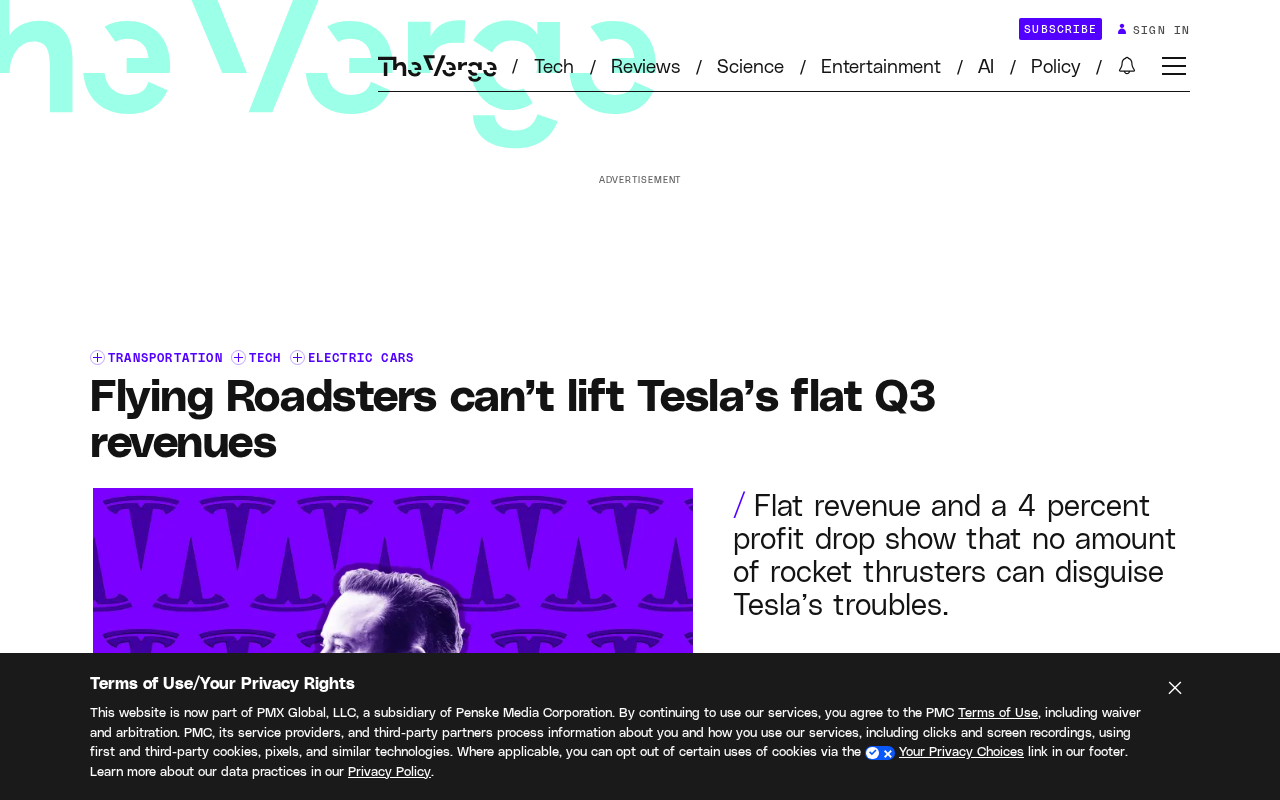
Tesla Q3 revenue flat, profit down 4%; flying Roadster demo fails to mask stalled growth.
Tesla's Q3 report showed revenue of $28 billion, flat year over year, and net profit of $1.7 billion, down 4%. Although the Roadster flying car demo went viral, this far-off concept is far from mass production and cannot contribute revenue. Tesla faces an aging lineup, intensifying competition, a price war eroding margins, and new businesses not yet ready to take over; the flying Roadster is more a visionary supplement than a financial cure. The key question is how to find the next sustainable growth pillar as the core business slows.
Tesla reported its third-quarter earnings on Wednesday, just days after its Roadster flying car demonstration set social media abuzz. Yet the dazzling tech showcase did not translate into financial growth momentum — revenue was flat, profit declined, and Tesla is confronting the reality of stalled growth.
Flat Revenue, Falling Profit: Key Financial Data
According to Tesla's quarterly report for the period ending in September, the company posted a net profit of $1.7 billion on total revenue of $28 billion. Compared with the same period last year, revenue was flat while profit fell 4%.
The numbers send a clear signal: Tesla's revenue growth has ground to a halt. For a tech company long defined by high growth, zero revenue growth means its core business — electric vehicle sales — may be hitting a temporary ceiling. The simultaneous profit decline further suggests that price competition and cost pressures are eroding profitability.
Judging by market reaction, investors' enthusiasm for the flying Roadster demo did not carry over into their reading of the earnings. The gap between technological vision and financial reality is the most noteworthy narrative thread in this report.
GAAP vs. Non-GAAP. "Net profit" in Tesla's earnings typically refers to net profit under U.S. Generally Accepted Accounting Principles (GAAP), whereas the "adjusted earnings per share" commonly cited in market analysis is usually based on Non-GAAP figures that exclude one-time items such as stock-based compensation and restructuring charges. The difference between GAAP and Non-GAAP profit directly affects investors' judgment of a company's true profitability, so it is essential to clarify which basis is being used when interpreting earnings.
What "flat revenue" means. "Flat" revenue means year-over-year growth is close to zero (typically defined as a change within a single-digit percentage in either direction; here Tesla's revenue was nearly identical to the same period last year). For tech stocks with high growth expectations, zero revenue growth often draws more attention than falling profit, because it implies that total market demand for the company's core products may have reached a temporary plateau.
The Flying Roadster: Marketing Highlight or Strategic Distraction?
The Roadster flying demonstration was undoubtedly Tesla's most viral moment of the quarter. A sports car that can lift off the ground is visually striking and fits the "future narrative" style Musk has long excelled at.
But the problem is that such demonstrations have no direct connection to Tesla's current core business revenue. The flying Roadster is still a long way from mass production, regulatory approval, and commercialization, and cannot contribute to revenue in the near term. When the growth curve of the core EV business is flattening, directing public attention to far-off concept products may instead raise questions about the company's strategic focus.
A deeper issue is that Tesla needs to answer a key question: amid intensifying EV competition and a sustained price war, what is the next business that can deliver revenue growth at scale? The flying Roadster is clearly not the near-term answer.
The Roadster flying car and the mass-production threshold. The Roadster is a high-performance all-electric sports car first unveiled by Tesla in 2017, originally slated for production in 2020 but repeatedly delayed. The so-called "flying demonstration" is a proof-of-concept exercise, and multiple obstacles remain before a truly road-ready — or airworthy — product: first, the technical challenge of achieving the power and safety redundancy required for low-altitude flight; second, the regulatory hurdle, as flying cars must obtain airworthiness certification from aviation authorities (such as the U.S. FAA), a lengthy process with stringent standards; third, commercialization issues including cost, infrastructure, and insurance. As such, these demonstrations are financially a "long-dated option" that cannot generate any revenue contribution in the near term.
Behind the Stagnation: Structural Challenges Facing Tesla
Flat revenue is not an isolated phenomenon — it reflects several structural challenges Tesla currently faces.
An aging product lineup and intensifying competition. Tesla's core model lineup has not seen a major update in some time, while legacy automakers and emerging brands continue to launch competitors across multiple price segments, squeezing Tesla's market share and pricing room.
Diminishing marginal returns from pricing strategy. Although previous rounds of price cuts helped stabilize sales to some extent, the damage to profit margins is now visible in the financials — the 4% profit decline is a direct reflection of the cost of this strategy.
New businesses have yet to take over. Whether it is energy storage, autonomous driving software subscriptions, or the Optimus humanoid robot, none is yet sufficient to become a second engine supporting revenue growth. The flying Roadster is more of a visionary supplement than a financial cure.
The marginal effect of the price war. "Diminishing marginal returns" here refers to the weakening effect of each round of price cuts on stimulating sales: early cuts significantly boosted orders, but as competitors followed suit and consumers came to expect further price reductions, each round generated fewer incremental sales while per-vehicle profit was continuously squeezed. This is precisely the micro-mechanism behind flat revenue and a 4% profit decline — the strategy of trading price for volume is gradually losing effectiveness in an increasingly competitive market.
Second growth engine. Capital markets typically use the term "second growth curve" to describe a new business that takes over growth after a company's core business matures. For Tesla, energy storage (Megapack), FSD software subscriptions, and the Optimus humanoid robot are highly anticipated, but all three currently have limited revenue share and profit contribution and have not yet reached a scale sufficient to offset the slowdown in the automotive business — a key reason for the divergence in how the market values the company.
Conclusion: Balancing Technological Narrative and Financial Reality
Tesla's Q3 earnings present a classic high-tech company dilemma: when the narrative pace of disruptive technology outruns the speed of commercialization, capital markets will ultimately return to financial fundamentals. A flying sports car can capture attention, but it cannot fill the gap in revenue growth. For Tesla, the real question is not whether it can build a car that flies, but how to find the next sustainable growth pillar as its core business slows.
One-line Summary
Tesla Q3 revenue was flat and profit fell 4%, with the flying Roadster demo failing to mask stalled growth.
Paragraph Summary
Tesla's Q3 report showed revenue of $28 billion, flat year over year, and net profit of $1.7 billion, down 4% year over year, as growth in its core EV business stalled. Although the Roadster flying car demo went viral on social media, this far-off concept product is still far from mass production and commercialization and cannot contribute to revenue. The article notes that Tesla faces multiple structural challenges — an aging product lineup, intensifying competition, a price war eroding margins, and new businesses not yet ready to take over — and that the flying Roadster is more a visionary supplement than a financial cure. For Tesla, the key question is how to find the next sustainable growth pillar as its core business slows.
Related articles

M&M's Spent Millions Replacing Artificial Blue Dye — Why Is It So Hard?
Mars spent millions trying to replace artificial blue dye in M&M's with spirulina, but thick material clogs pipes and residue risks mold, forcing a full production-line rebuild. Here's the engineering behind the reformulation.
Teammate Wanted for Meta Global AI Developer Hackathon: Computer Vision & Medical AI
A Reddit developer seeks teammates for the Meta Global AI Developer Hackathon, focusing on computer vision and medical AI. This article analyzes the track logic, skills-complementarity needs, and topic selection strategy behind this teaming signal.
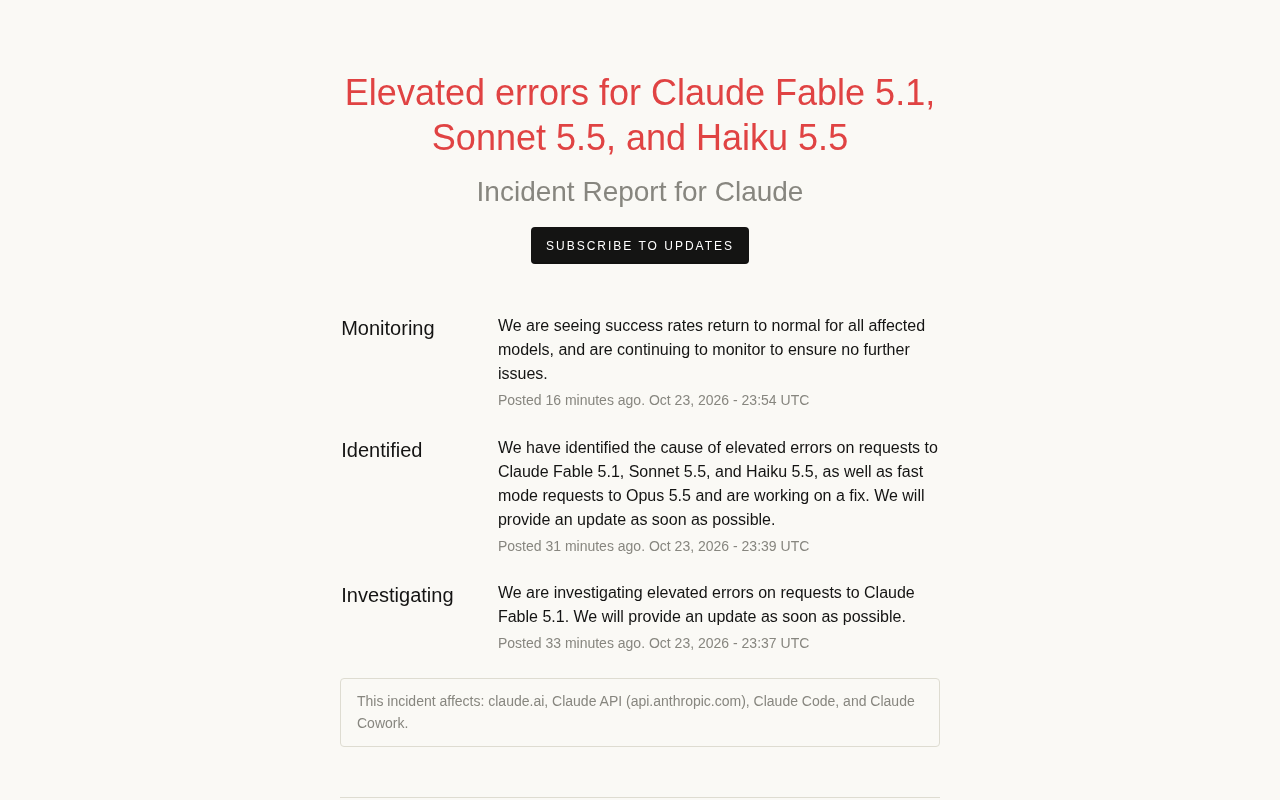
Multiple Claude Models Hit by Errors: A Postmortem of Fable 5.1, Sonnet 5.5, and Haiku 5.5
Claude Fable 5.1, Sonnet 5.5, Haiku 5.5, and Opus 5.5 fast mode saw elevated errors; Anthropic identified and resolved the issue in 17 minutes. This postmortem covers the timeline, the technical reasons for the multi-model cascading failure, and practical lessons for retry and degradation strategies.