Tesla Roadster 2 Launch Delayed Again by Weather: SpaceX Thrusters Remain the Key Mystery

Tesla Roadster 2 launch postponed again as weather prevents the outdoor SpaceX thruster "flight" demo.
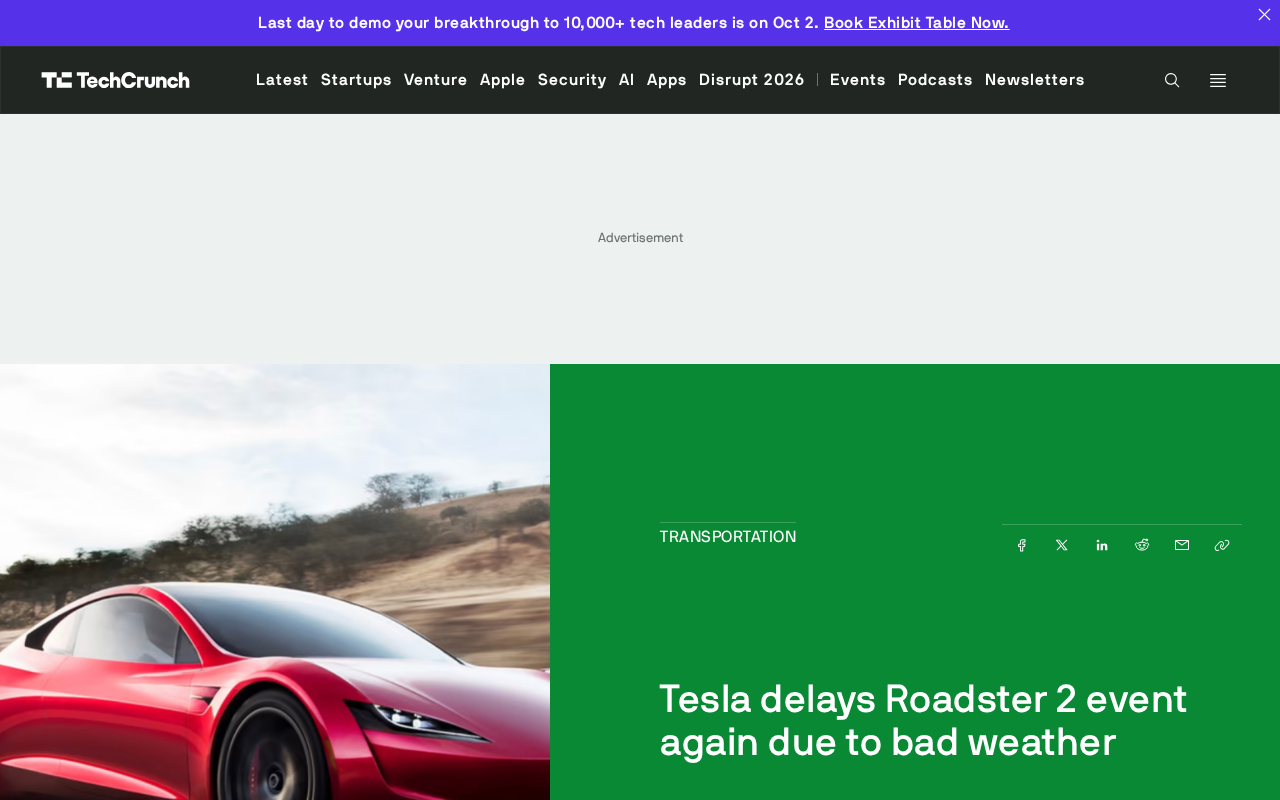
Tesla's second-generation Roadster reveal has been postponed again due to unsuitable weather conditions. Because the event plans to demonstrate the car's ability to "fly" using SpaceX cold gas thrusters, the high-pressure gas jet demo can only be staged outdoors and is highly sensitive to wind, rain, and visibility. The long-rumored "SpaceX Package" remains the Roadster 2's biggest technical mystery — believers cite real synergies between Musk's two companies, while skeptics question whether such a system can realistically reach mass production given regulatory and reliability hurdles. Having already missed multiple delivery deadlines since its 2017 unveiling, the latest delay further tests market confidence in this flagship supercar.
Tesla Roadster 2 Launch Delayed Again by Weather: SpaceX Thrusters Remain the Key Mystery
Tesla's highly anticipated second-generation Roadster supercar reveal has been postponed once again due to unsuitable weather conditions. According to sources, Tesla stated that the launch event "can only be held outdoors" because it plans to demonstrate the new car's ability to "fly" in some form — a capability that relies on thruster technology sourced from SpaceX.
Why the Launch Has to Be Outside
What makes this event unusual is the core feature it aims to showcase: the Roadster 2 is said to be equipped with a SpaceX-derived thruster system that gives the vehicle the ability to "fly" or hover. Demonstrations involving high-pressure gas or rocket-grade propulsion systems require outdoor environments for safety and technical reasons, making them nearly impossible to stage in an enclosed indoor venue.
This makes weather an unavoidable variable. Outdoor demonstrations are highly sensitive to wind speed, precipitation, visibility, and other environmental factors — any unfavorable conditions could compromise the safety and visual impact of a thruster demo. This explains why Tesla would rather keep postponing than push ahead in bad weather.
SpaceX Thrusters: Marketing Gimmick or Real Capability?
The most talked-about rumor surrounding the Roadster 2 is the "SpaceX Package" that Musk has mentioned multiple times — cold gas thrusters that would boost the car's acceleration, braking, and even brief airborne performance. The insistence on an outdoor venue and a "flying" demonstration further reinforces this long-standing mystery.
Opinions in the industry remain divided. Proponents argue that with SpaceX and Tesla both under Musk's umbrella, technical synergies are grounded in reality. Skeptics, however, point out that fitting rocket-grade propulsion into a production supercar faces significant hurdles around safety regulations, energy consumption, and reliability — making true mass-market deployment extremely difficult.
A cold gas thruster is a device that uses high-pressure inert gas (typically nitrogen) as a propellant, expelling it at high speed through a nozzle to generate thrust. Unlike rocket engines, it requires no combustion, making it relatively simple in design — though its thrust output is also modest. These systems are commonly used in spacecraft attitude control. The "SpaceX Package" Musk envisions reportedly involves placing multiple such nozzles around the car body, using gas jets to provide additional acceleration or braking force over extremely short intervals, and even achieving brief liftoff. This is a fundamentally different propulsion logic from conventional vehicles, which rely entirely on tire-to-road friction. The core challenges of transplanting cold gas thrusters into a consumer car include: the volume and weight of pressure tanks, the convenience of gas replenishment, and the fact that most countries currently have no clear traffic regulations governing such devices on public roads.
The Delivery Pressure Behind Repeated Delays
It's worth noting that the Roadster 2 has been delayed multiple times since it was first announced, with delivery timelines repeatedly pushed back. While this latest weather-related postponement has a reasonable technical explanation, it raises further questions about the car's ultimate production timeline.
For Tesla, the Roadster 2 carries more symbolic weight as a flagship brand statement and technology showcase than as a volume seller. A jaw-dropping "flying" demonstration would generate enormous buzz and lend Tesla significant technical credibility. But repeated delays also erode market patience and test consumer confidence in the car's ability to deliver on its promises.
The second-generation Tesla Roadster made its surprise debut in November 2017, with Musk promising deliveries would begin in 2020. That timeline has since been pushed back repeatedly — from 2020 to 2021, then to "around 2023" — and the car has still not entered mass production. Customers who paid reservation deposits ($100,000 for the base model, $250,000 for the Founder Series) have now been waiting over seven years. This kind of extended delay is not unprecedented in Tesla's lineup — the Cybertruck was also about four years late — but as Tesla's highest-priced reservation product, the Roadster puts the brand's promises under particularly direct scrutiny.
What to Watch Next
For those following this car and broader industry observers, several key questions are worth tracking: whether a new launch date will be announced soon, whether the thruster demonstration constitutes true "flight" or merely limited assisted functionality, and how large the gap will be between the demo version and the production model. The answers to these questions will determine whether the Roadster 2 turns out to be a revolutionary product — or an elaborately staged tech spectacle.
Related articles

Cursor AI Programming in Practice: Build a Student Management System from Scratch in 30 Minutes
A Bilibili creator demonstrates Cursor AI programming: generating a student management system in 30 minutes with natural language. Details on Agent mode, Claude selection, prompt techniques, and thresholds.

Top 20 AI Coding Tools Ranking: From Rock-Solid to Lackluster, a Scored Matrix
Bilibili creator releases top 20 AI coding tools ranking, tiered T0–T4 from rock-solid to lackluster, with Claude Code and Codex tied at T0. This article details the scoring dimensions (capability, reliability, robustness, durability, cost, domestic availability) and tool performances to help developers choose the right AI coding assistant.

Vibe Coding Systematic Tutorial: Master AI-Assisted Programming from Zero
A three-month Vibe Coding tutorial from a Bilibili creator covering Codex, ClaudeCode, and Cursor, from core logic to commercial project practice for beginners.