Tesla Roadster Flying Car: A Technical Analysis of Cold Gas Propulsion

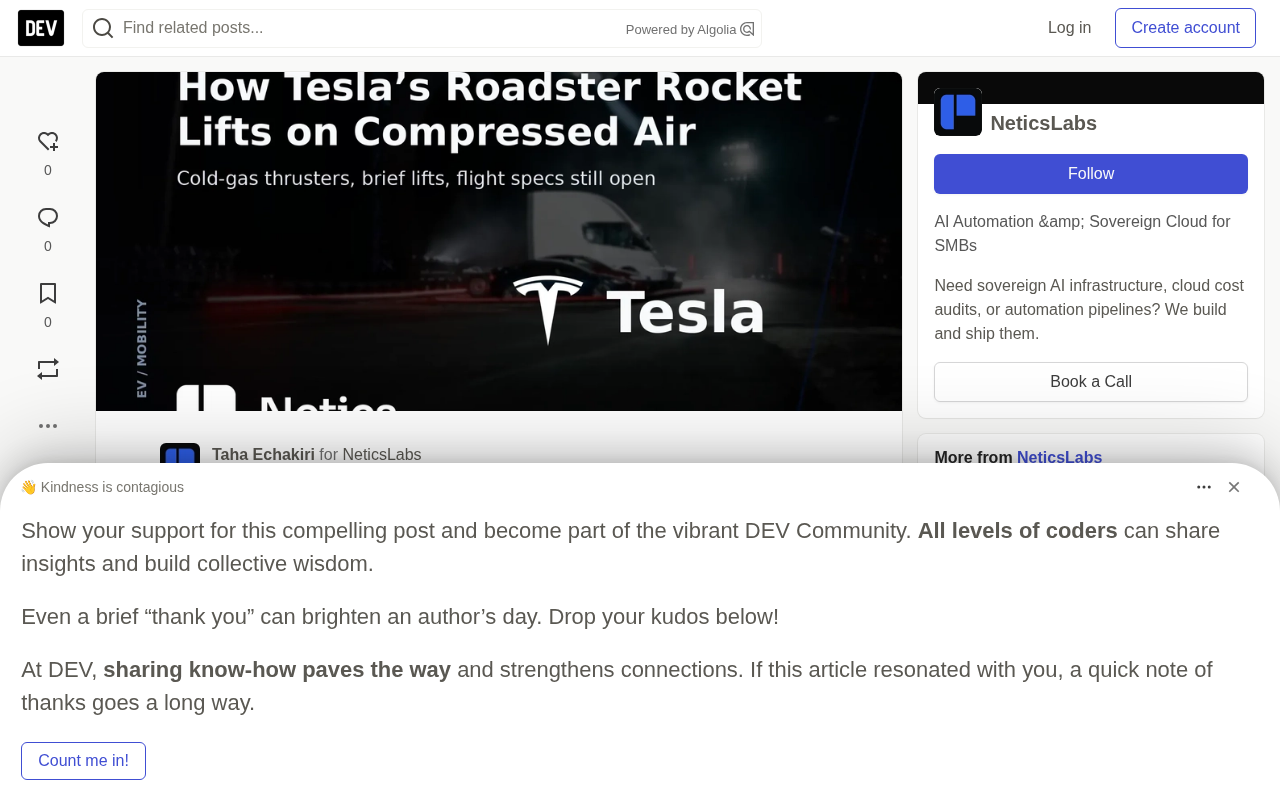
Tesla's Roadster Rocket uses cold gas propulsion for short flights, but core flight parameters and airworthiness certification remain blank.
Among the three Roadster models Tesla unveiled, only the single-seat Rocket version has cold gas propulsion flight capability, equipped with 10 thrusters and a 600-liter compressed air tank. The cold gas propulsion principle is mature; NASA calls it simple and safe but notes its limited total impulse, and flight time is constrained by gas storage. The launch event demonstrated lift-off and rotation, but key parameters such as flight duration, range, payload, safety redundancy, and airworthiness certification have not been published. Musk says production will begin in 2028, but his statement that "safety is not the primary goal" contrasts sharply with the strict standards required for flying cars. The article argues that until a verified flight envelope and operating approvals emerge, the Rocket's "air-ready" claim rests on a single demonstration.
Three Roadster Variants: From Track to "Air-Ready"
First, we need to clarify a fact that is easily obscured by headlines: the Roadster is above all an electric sports car, and flying capability belongs only to the top-tier Rocket version. Tesla showed three configurations in total, differing mainly in seating capacity, aerodynamic packages, and propulsion systems.
- Performance: two-seat "road-ready," equipped with active aerodynamics and a multi-mode suction system, aimed at track driving.
- Thrust: also two-seat, billed as "track-ready," adding a rear cold gas thruster. According to TechCrunch, this version can achieve 0-60 mph acceleration in under 1 second.
- Rocket: single-seat "air-ready," with 10 cold gas thrusters arranged around the body, available by invitation only.
According to TechCrunch, all three models claim 300 miles (about 483 km) of range and a top speed exceeding 230 mph (about 370 km/h). These figures all come from company statements, with no independently verified flight performance data. At the launch event, Tesla VP of Engineering Lars Moravy said the Rocket connects 600 liters of compressed air through 10 thrusters to achieve lift-off and mid-air rotation.
How Cold Gas Thrusters Generate Lift
The principle is not complicated: a pressure vessel stores gas, valves control the release of gas through nozzles, and the reaction force pushes the vehicle in the opposite direction. If the nozzles point downward, the reaction force points upward and the vehicle gains lift; adjusting nozzle direction enables forward motion or rotation—exactly matching the lift-off and rotation demonstrated at the event.
NASA describes cold gas propulsion systems as "simple, mature, and safe," but also notes that their "total impulse is relatively limited." In other words, the amount of gas carried is fixed, and thrust duration is finite. Tesla's 600-liter compressed air tank can be refilled, but TechCrunch's report does not mention refueling equipment, turnaround time, or the duration of a single flight.
From an engineering perspective, the flight envelope of cold gas propulsion depends not only on thrust magnitude but also on attitude control, descent and landing strategies, and pressure system management. At the launch event, the vehicle completed an inverted ramp climb, rotation, and landing; according to TechCrunch, this maneuver combination used high-power fans working in coordination with thrusters. The vehicle also drove past models including the Cybercab, Cybertruck, Semi, Model Y, and Model 3.
Cold Gas Propulsion is a propulsion method that does not rely on combustion. Its working fluid (usually compressed air, nitrogen, or helium) is accelerated through valves and out of nozzles at room temperature, generating reaction force through conservation of momentum. Although specific impulse (impulse per unit mass of working fluid) is far lower than chemical propulsion, the system is simple in structure, fast in response, and produces no combustion products, making it long used for satellite attitude control and space station fine-tuning. In engineering, its capability is often measured by "total impulse": total impulse equals working fluid mass multiplied by effective exhaust velocity, so gas storage capacity and nozzle efficiency directly determine the total momentum that can be provided. For an aircraft, this means thrust duration is limited by tank volume and initial pressure; once the gas is exhausted, lift disappears, and it cannot continuously draw energy from the environment like an internal combustion engine or battery-driven rotors.
Flight Parameter Gaps and Regulatory Uncertainty
In the demo video, blue jets are visible beneath the Roadster, and the imagery is striking. But at the technical parameter level, several key questions remain unresolved:
- What are the flight duration and range?
- What are the payload limits?
- What safety redundancy exists in the event of valve, sensor, or pressure vessel failure?
- How is stability maintained in gusty conditions? How does it land when gas reserves are insufficient?
- What testing and airworthiness approvals are required before customers can use the flight function?
Among the materials reviewed, there is no evidence that the Tesla Roadster has obtained aircraft airworthiness certification, airspace access, or air taxi operating authorization. TechCrunch reported that Musk has said "safety is not the primary goal" for the new car, and stated outright on a podcast: "If safety is your primary goal, don't buy the Roadster." This stands in stark contrast to the strict safety standards required for flying cars.
On the timeline, Musk says Tesla will put the car into production in 2028 but has not announced pricing. Currently, the reservation deposit is $50,000 for the Performance version and $250,000 for the Thrust version, while the Rocket version is invitation-only. The production maturity of the Rocket's flight hardware has not been explained.
Airworthiness certification is a prerequisite for an aircraft to legally fly. In the United States, the FAA typically requires manned aircraft to obtain a standard airworthiness certificate or a special airworthiness certificate (such as experimental or light sport), and to meet corresponding structural strength, flight performance, and system redundancy standards; commercial passenger service also involves operating qualifications (such as Part 135) and airspace access. For crossover products like "flyable cars," regulatory jurisdiction remains ambiguous: they may be classified as light sport aircraft, or because of their road-driving attributes they may need to satisfy both FMVSS (Federal Motor Vehicle Safety Standards) and aviation airworthiness requirements. There is currently no public record showing that Tesla has submitted a type certificate application or exemption request to the FAA for the Rocket, which means its flight function is still a long approval path away from legal customer use.
What the "Flying Car" Label Really Means
What Tesla showed is a road-car-shaped vehicle that lifts off the ground using onboard thrusters. The public materials describe a single-seat Rocket version, limited gas reserves, and one launch event demonstration. For potential buyers, the decisive missing information is a verified flight envelope: range, payload, safe landing margins, and operating approvals. Until these data are published, the Rocket's "air-ready" label rests on nothing more than a brief live demonstration.
Cold gas propulsion technology itself is not new; spacecraft attitude control has used it for years. Tesla's breakthrough lies in miniaturizing it and integrating it into a passenger vehicle platform—but between demonstration and mass production, and between controlled environments and open airspace, there remains a long engineering and regulatory road. The flying car narrative is eye-catching enough, but what truly deserves attention are the questions that have not yet been answered.
Flight Envelope refers to the range of parameters within which an aircraft can operate safely, typically including boundaries for speed, altitude, payload, load factor, and attitude angle. For cold gas propulsion vehicles, the envelope is jointly constrained by gas storage capacity, thrust vector control precision, structural strength, and landing cushioning capability. Public demonstrations can only show individual points within the envelope (such as low-altitude hovering and rotation), but cannot prove safety margins at the envelope boundaries. Key indicators determining product usability include: hover time at maximum takeoff weight, payload (driver weight plus equipment), attitude-holding capability in gusts, and controllable landing strategies when gas reserves are insufficient. These data must be obtained through repeatable testing and fault-injection tests, and none have been disclosed so far.
One-line Summary
Tesla's Roadster Rocket uses cold gas propulsion for short flights, but core flight parameters and airworthiness certification remain blank.
Paragraph Summary
Among the three Roadster models Tesla unveiled, only the single-seat Rocket version has cold gas propulsion flight capability, equipped with 10 thrusters and a 600-liter compressed air tank. The cold gas propulsion principle is mature; NASA calls it simple and safe but notes its limited total impulse, and flight time is constrained by gas storage. The launch event demonstrated lift-off and rotation, but key parameters such as flight duration, range, payload, safety redundancy, and airworthiness certification have not been published. Musk says production will begin in 2028, but his statement that "safety is not the primary goal" contrasts sharply with the strict standards required for flying cars. The article argues that until a verified flight envelope and operating approvals emerge, the Rocket's "air-ready" claim rests on a single demonstration.
Related articles

AI Compute Is the New Oil, But the Market Mechanism Has Yet to Take Shape
Hacker News compares AI compute to the new oil, noting the lack of price discovery, concentrated supply, and no hedging tools. The article analyzes structural issues in compute trading and explores a possible three-tier market of spot, contracts, and derivatives, plus the real impact on AI practitioners' cost management.

Running Full iOS 16.5 Firmware on Android Devices: Technical Demo or Marketing Gimmick?
A Hacker News post claims full iOS 16.5 firmware can run on Android, with 315 upvotes. This analysis argues it is more likely a web UI simulation than a true firmware port, and explores the value and risks of such projects.

Etsy Cracks Down on AI Slop: Addressing Buyer and Seller Anxieties
Etsy introduces stricter rules limiting AI-generated content in listings, addressing buyer confusion over AI products and seller fears of original work being diluted by AI slop.