Tesla Roadster Flying Car: Impressive Demo or Marketing Gimmick?
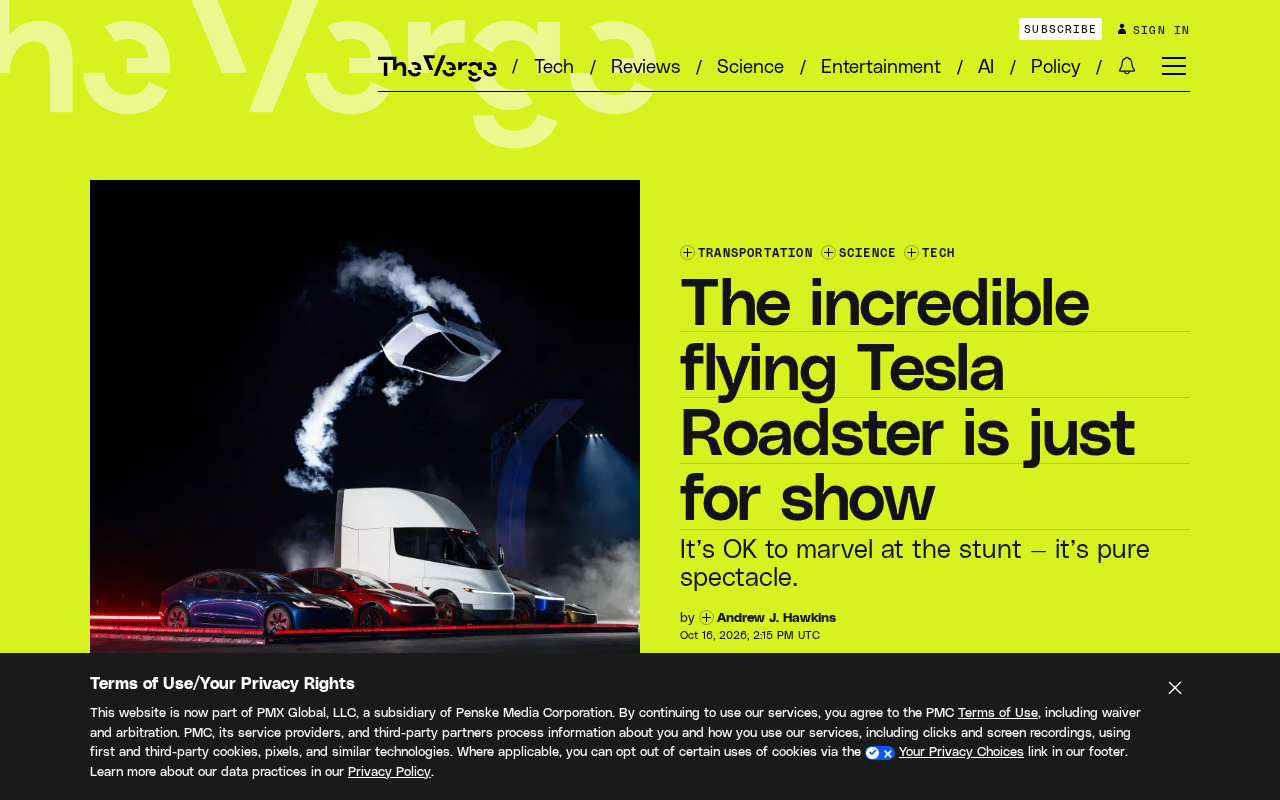
Tesla's flying Roadster demo is a technical performance, not a deliverable product—flying cars still face multiple obstacles to practicality.
The article analyzes the nature of Tesla's Roadster flying demo: it showcases vertical climbing, thrust vector control, and cold-gas thruster landing, but these technologies individually are not new—the key is Musk assembling them into a visually striking continuous performance. Flying cars face four major dilemmas: energy/range, airspace regulations, safety redundancy, and cost. Musk continues his 'demo economics' strategy. Global eVTOL companies pragmatically focus on specific scenarios. The conclusion: treat a performance as a performance, and pay attention to companies quietly solving real problems.
Musk has once again left the world holding its breath. A Tesla Roadster climbed vertically along a multi-level ramp, launched off the edge, performed an aerial "kick-flip" maneuver over several other Teslas, and then landed smoothly using cold-gas thrusters. The demo video quickly went viral on social media—the long-awaited "flying car" finally seemed to have stepped out of science fiction and into reality.
But let's pause and think: what does this performance actually mean?
A Carefully Choreographed Visual Spectacle
From a technical standpoint, this demo does showcase several noteworthy capabilities: the vertical climb demonstrates the advantages of an EV's instantaneous torque; the mid-air attitude adjustment relies on precise thrust vector control; and the cold-gas thruster landing shows that the system has some degree of hovering and attitude stabilization capability.
Individually, none of these technologies are new. Cold-gas thrusters have long been used for spacecraft attitude control, and high torque output is an inherent characteristic of electric vehicles. What's truly striking is how they were combined—Musk pieced together scattered, mature technologies into a continuous performance with strong visual impact.
The problem is that there's a massive gulf between "can perform" and "can be practical."
Thrust vector control is the key technology behind the automatic attitude adjustment in this demo. The principle is to control the aircraft's pitch, yaw, and roll by changing the direction of thrust (not just its magnitude). In aerospace and missile applications, this is typically achieved through gimbaled engine nozzles or gas rudders; on multi-rotor drones, it's done indirectly by differentially adjusting rotor speeds. In the Tesla Roadster demo, cold-gas thrusters are distributed at different positions on the vehicle body, generating torque through precise pulsed jets, allowing the car to complete aerial flips without wings or aerodynamic control surfaces. The challenge lies in solving attitude errors in real time and rapidly allocating the on/off timing of each thruster—demanding far more from sensor fusion and control algorithms than ground vehicles.
The Real Dilemmas Facing Flying Cars
Even if the propulsion system is powerful enough, flying cars face challenges far beyond simply "getting off the ground":
Energy and range. The energy required for hovering and flight is several times—or even dozens of times—that of ground driving. At current battery energy densities, a flying car's range could be embarrassingly short.
Regulations and airspace management. Low-altitude flight involves complex airspace control, pilot licensing, noise restrictions, and insurance liability issues. These aren't things a single company can solve alone—they require coordination across the entire regulatory system.
Safety redundancy. A ground vehicle failure means pulling over; an aircraft failure means falling out of the sky. Meeting aviation-grade safety standards requires multiple redundant systems and rigorous airworthiness certification—completely different from the iteration pace of consumer electronics.
Cost. Cold-gas thrusters require carrying compressed gas, which must be replenished after every flight. The maintenance and operating costs of this system would likely far exceed what ordinary consumers can afford.
Battery energy density is the fundamental bottleneck limiting flying car range. Current mass-production lithium-ion batteries for vehicles have an energy density of about 250-300 Wh/kg, while aviation kerosene is about 12,000 Wh/kg—a gap of nearly 40 times. The power density required for hovering is extremely high—a multi-rotor eVTOL can draw more than twice the power during hover compared to cruise, meaning the battery discharge rate must be high enough while also managing heat. Even with higher-energy-density semi-solid or solid-state batteries, it will be difficult in the short term for flying cars to achieve range comparable to ground vehicles. More critically, aircraft have far stricter battery safety requirements than ground vehicles: once thermal runaway causes a fire, there's virtually no escape window in the air, requiring additional fire barriers, pressure relief, and redundant power supply designs—which further adds weight, creating a vicious cycle.
Musk's "Demo Economics"
The key to understanding this performance lies in recognizing Musk's consistent product launch strategy: using highly impactful prototype demos to generate buzz and sustain public imagination about the brand's future.
From the Cybertruck's "bulletproof glass" demo (which backfired), to the high-speed underground tunnel concept, to the humanoid robot Optimus walking on stage, Tesla and SpaceX launches often combine tech appeal with entertainment. This flying Roadster demo essentially follows the same logic—it showcases "possibility," not "product."
The original article title directly addresses this: "The incredible flying Tesla Roadster is just for show." This judgment isn't derogatory. In the tech industry, vision demos have legitimate value: attracting talent, boosting stock prices, educating the market. But when the gap between demo and deliverable product is deliberately blurred, consumer expectations can easily be misled.
The Real Progress in the Flying Car Race
It's worth noting that flying cars aren't Tesla's concept alone. Dozens of companies worldwide are exploring electric vertical takeoff and landing aircraft (eVTOL), some of which have already entered the airworthiness certification phase. These companies generally focus on specific scenarios—such as airport shuttles and short-distance intercity transport—rather than directly targeting individual consumers with a "flying sports car."
This pragmatic approach stands in sharp contrast to Musk's performance. The former is solving boring but critical problems like airspace approval, takeoff/landing sites, and operating costs; the latter is creating a visual symbol of the future.
Both paths have their significance, but if you're waiting for a commuter flying car that can park in your garage and take off at any time, it may still take quite a while.
eVTOL (electric vertical takeoff and landing aircraft) refers to aircraft powered by electricity that can take off and land vertically and achieve cruise flight, typically using multi-rotor, compound-wing, or tilt-rotor configurations. Compared to helicopters, eVTOLs have simpler structures, lower noise, reduced maintenance costs, and no tail rotor or complex transmission systems. Major global players currently include Joby Aviation, Archer Aviation, EHang, and others, most focusing on air taxi and airport shuttle scenarios. These companies must obtain airworthiness certification from national aviation regulators, such as the FAA's Part 23/27 regulations or EASA's SC-VTOL standards, a process that typically takes years and costs hundreds of millions of dollars. After certification, they still need to build vertiports, plan low-altitude routes, and train pilots—the maturity of the entire ecosystem is far beyond what a single product launch can drive.
Conclusion
The Tesla flying Roadster demo is an excellent engineering performance. It proves technical possibilities and once again demonstrates Musk's ability to mobilize public imagination. But it is not a product launch, nor is it the beginning of the flying car era.
Treat a performance as a performance, and a vision as a vision—this is perhaps the most rational attitude when facing such demos. What truly deserves attention are the companies quietly solving regulatory, safety, and cost problems. They are the key forces that will bring flying cars from science fiction to reality.
One-line Summary
Tesla's flying Roadster demo is a technical performance, not a deliverable product, and flying cars still face multiple obstacles to becoming practical.
Paragraph Summary
The article analyzes the nature of Tesla's Roadster flying demo: it showcases a combination of technologies including vertical climbing, thrust vector control, and cold-gas thruster landing, but these technologies individually are not new—the key is that Musk assembled them into a continuous performance with strong visual impact. The article points out that flying cars face four major real-world dilemmas: energy and range, airspace regulations, safety redundancy, and cost—each difficult to break through in the short term. Musk continues his "demo economics" strategy, using prototype performances to sustain public imagination rather than launching products. Global eVTOL companies, meanwhile, pragmatically focus on specific scenarios like airport shuttles and are advancing airworthiness certification. The article concludes: treat a performance as a performance, and what truly deserves attention are the companies quietly solving regulatory, safety, and cost problems.
Related articles
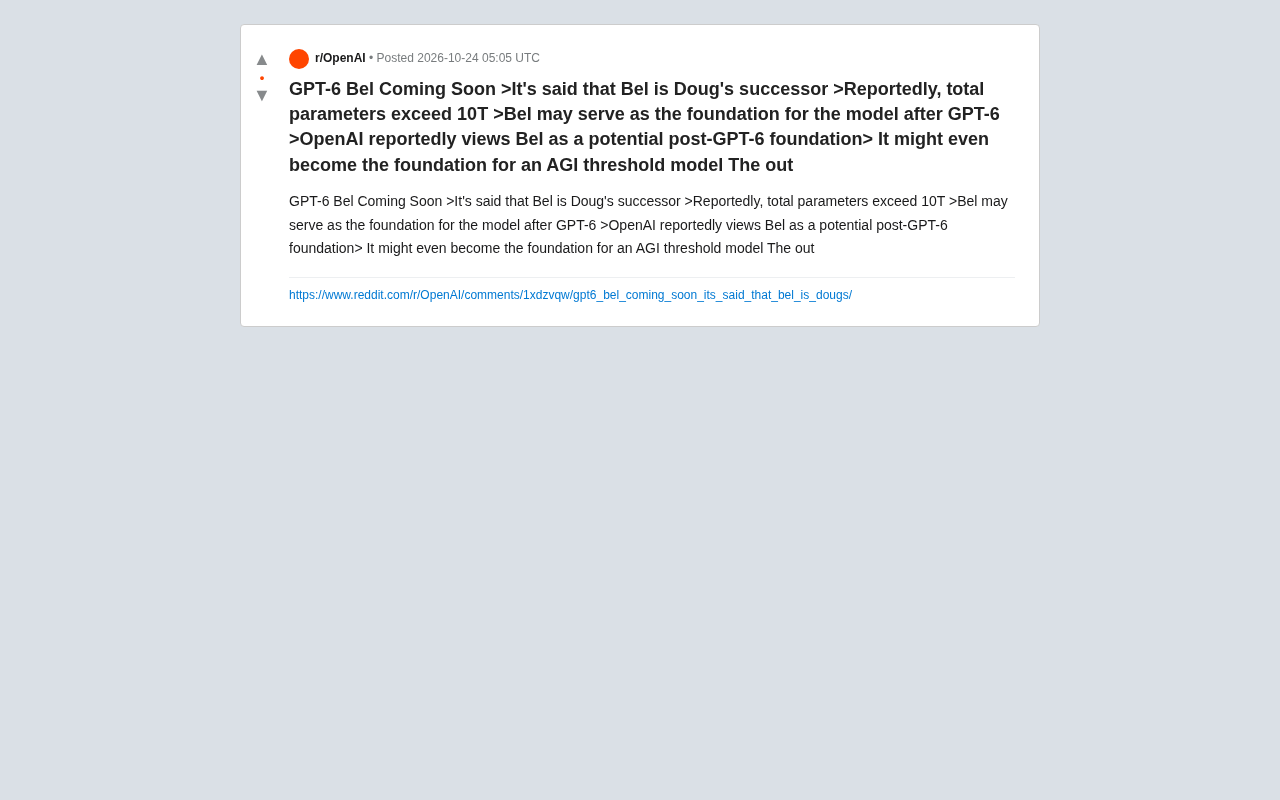
OpenAI's New Model Bel Leaked: 10 Trillion Parameters, Potentially the Foundation for AGI
A Reddit leak claims OpenAI's new model Bel is coming, with over 10 trillion total parameters, possibly serving as the foundation model after GPT-6 or even the base for the AGI threshold. This article breaks down the key claims and assesses their credibility.

Claude Fable 5/5.1 Outage: A 30-Minute Postmortem
Claude Fable 5 and Fable 5.1 saw elevated error rates for about 35 minutes, per the official status page—from Investigating to Resolved in 37 minutes. This post reconstructs the timeline, analyzes impact on other Claude models, and offers developer guidance on retries, multi-model routing, and monitoring alerts.
Kimi K3.1 Open-Weight Model Hands-On: 3 Trillion Parameters Take On Closed-Source Giants
Kimi K3.1 open-weight model hands-on: 3T-parameter MoE, 1M-token context, stunning 3D rendering but weak spatial reasoning and factual accuracy. Benchmarks near Opus 5.5 at $2.11/task.