Tesla Starts Optimus Robot Production in California as Profits Plunge 43%

Tesla's profit fell 43% as it bets on Optimus robot production in California and an AI platform transformation.
Tesla's latest earnings show flat revenue, but profit fell 43% year-over-year due to accelerated investment in the Optimus humanoid robot, AI training infrastructure, and Full Self-Driving. The most signal-rich event is Optimus officially starting production in California, marking its move from lab demos to engineering implementation. Tesla's AI investment serves both FSD and Optimus product lines, creating a platform leverage effect: the same vision perception and neural network capabilities both drive autonomous driving and provide a "brain" for robots. The article argues this is Tesla's deliberate strategic choice to trade short-term profit for long-term options, with success depending on whether Optimus can scale and find real demand, whether FSD commercialization can generate new revenue curves, and whether flat revenue in the core automotive business will turn into a decline.
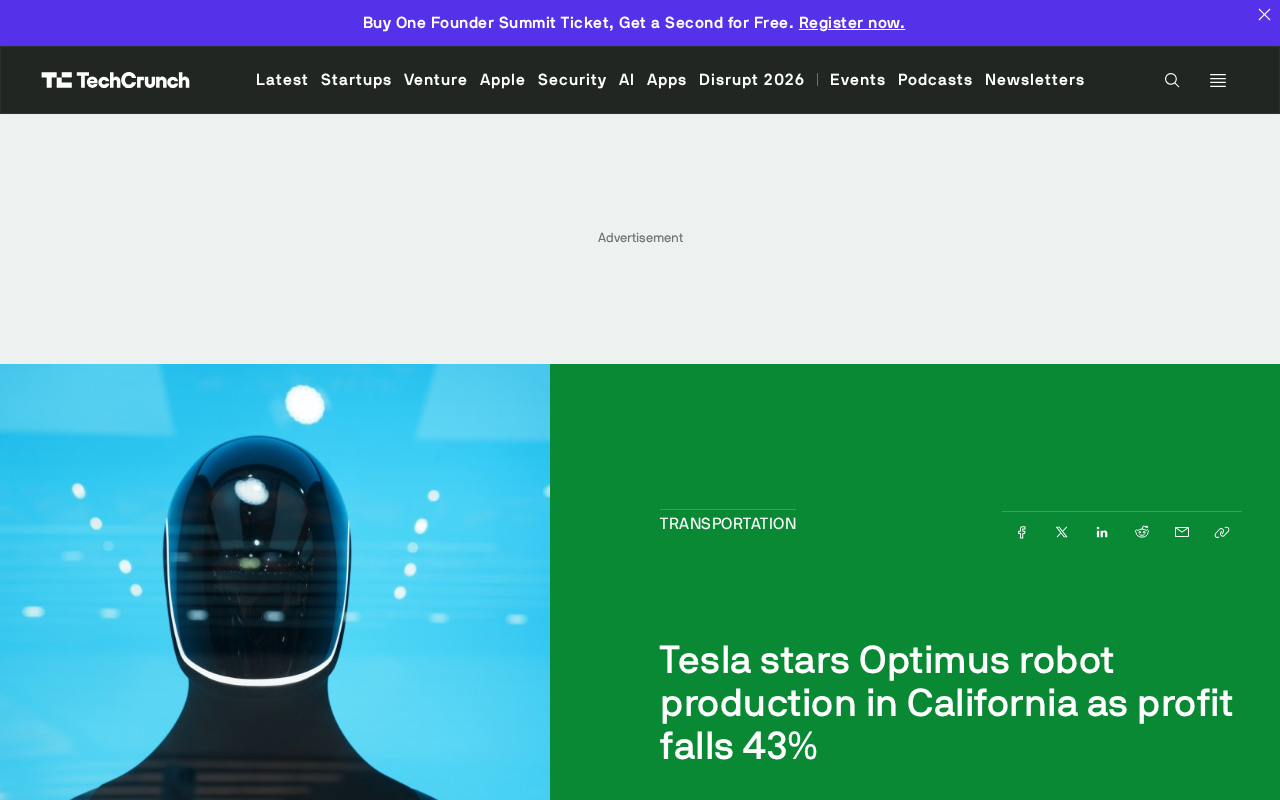
Tesla is betting its future on robots. According to the latest earnings report, revenue was flat, but spending surged due to the accelerated push on the Optimus robot, AI, and autonomous driving, with profit falling 43% year-over-year. Meanwhile, production of the Optimus robot has officially begun in California.
The Strategic Pivot Behind the Profit Decline
Tesla's financial performance this quarter shows a clear "spend now for the future" pattern. Revenue didn't grow, but costs ballooned—funds flowed mainly into the Optimus humanoid robot, AI training infrastructure, and Full Self-Driving (FSD) R&D. A 43% profit drop is a jarring number, but within Tesla's historical narrative, it looks more like a deliberate strategic choice than passive bleeding.
Musk has repeatedly described Optimus as the most important piece of Tesla's long-term value, even predicting its market size will exceed the automotive business. The start of production in California means that prediction is now entering the execution phase.
Full Self-Driving (FSD) is Tesla's advanced driver-assistance system, aiming to complete door-to-door driving without human intervention. It's based on a pure vision approach, relying on onboard cameras and end-to-end neural networks to directly output driving decisions rather than depending on high-definition maps or LiDAR. FSD is currently offered to owners via paid subscription or one-time purchase, and still requires driver supervision. For Tesla, FSD is both a software revenue source and the core vehicle for accumulating data and iterating models on real roads with its AI capabilities.
Humanoid robot (Optimus) is Tesla's bipedal general-purpose robot, about 1.7 meters tall, designed to replace humans in repetitive, dangerous, or tedious physical labor. Its tech stack heavily reuses FSD: also using pure vision perception and neural network control, and also requiring large-scale simulation and real-world data training. Musk has said Optimus's long-term market size could exceed the automotive business, but the product is still in early engineering stages, with mass production capability and application scenarios yet to be validated.
Optimus Production Lands in California
The start of Optimus production in California is the most signal-rich event in this earnings report. It marks Tesla's humanoid robot moving from lab demos to actual manufacturing. Although production scale, target capacity, and specific application scenarios haven't been disclosed, the launch of the production line itself shows that Tesla is pushing robots from "proof of concept" to "engineering implementation."
This move echoes Tesla's investments in AI and autonomous driving. Optimus's intelligence depends on Tesla's accumulated expertise in visual perception and neural network training—technologies that also serve FSD. In other words, Tesla's AI investment is an infrastructure that feeds both the car and robot product lines.
Autonomous Driving and AI: One Investment, Two Outlets
Tesla explicitly cited AI and autonomous driving as reasons for rising expenses in its earnings report. This isn't surprising—training large-scale neural networks requires expensive compute, and continuous FSD iteration demands substantial R&D resources. What's noteworthy is the leverage effect of this investment: the same AI capabilities can both drive cars toward full autonomy and provide a "brain" for Optimus.
From a business logic perspective, Tesla is building a narrative of an AI-centric platform company, with cars as the first application scenario and robots as the second. Short-term profit pressure is precisely the upfront cost of this narrative.
Compute infrastructure and Dojo are key background for understanding Tesla's AI investment. Training large-scale neural networks requires massive GPU compute; Tesla purchases NVIDIA GPUs to build clusters on one hand, and develops its own Dojo supercomputer on the other, attempting to use custom chips to reduce training costs and eliminate dependence on external supply. Such investments are typical heavy-asset upfront expenditures that directly depress profits in the short term, but once compute scale is achieved, they can simultaneously support FSD, Optimus, and other future AI products. This is also the technical basis for what the article calls "one investment, two outlets": AI training infrastructure has significant reusability and scale effects, with marginal costs diluted as use cases increase.
Three Questions the Market Needs to Watch
Whether a 43% profit decline is sustainable depends on three variables. First, whether Optimus production can reach scale within a reasonable timeframe and find real demand scenarios; second, whether FSD's commercialization progress can generate new revenue curves; third, whether flat revenue in the core automotive business will turn into a decline. Tesla's current choice is to trade short-term profit for long-term options, and the value of these options ultimately depends on actual delivery of Optimus and FSD.
For observers, the start of the California production line is a starting point worth tracking—it doesn't guarantee success, but it signals that Tesla is no longer just "talking about" robots.
One-line Summary
Tesla's profit fell 43% as it bets on Optimus robot production in California and an AI platform transformation.
Paragraph Summary
Tesla's latest earnings show flat revenue, but profit fell 43% year-over-year due to accelerated investment in the Optimus humanoid robot, AI training infrastructure, and Full Self-Driving. The most signal-rich event is Optimus officially starting production in California, marking its move from lab demos to engineering implementation. Tesla's AI investment serves both FSD and Optimus product lines, creating a platform leverage effect: the same vision perception and neural network capabilities both drive autonomous driving and provide a "brain" for robots. The article argues this is Tesla's deliberate strategic choice to trade short-term profit for long-term options, with success depending on whether Optimus can scale and find real demand, whether FSD commercialization can generate new revenue curves, and whether flat revenue in the core automotive business will turn into a decline.
Related articles

Frontend to AI Agent Development: A Frontline Architect Explains Career Paths and Opportunities
A frontline AI architect explains the industry changes and practical paths for frontend developers transitioning to AI Agent development: why pure frontend jobs are disappearing, why Agent + full-stack has become mainstream in hiring, and three transformation routes—Agent development engineer, FDE, and remote contracting—along with corresponding learning strategies.

How to Choose an AI Agent Development Course: Five Pitfall-Avoidance Guidelines
A mechanical-engineering career changer's two-year pitfall-tested checklist for screening AI Agent development courses: complete delivery pipeline, resume-worthy projects, real development perspective, update frequency, and coaching feedback—with concrete judgment methods and pitfall-avoidance tips.

Coze AI Agent Building for Beginners: A Zero-Code AI Agent Development Guide
Coze, ByteDance's one-stop AI application development platform, supports zero-code drag-and-drop AI agent building. This article outlines Coze's core concepts, three advantages, differences between the domestic and international versions, and the distinction between agents and apps, helping beginners quickly get started with AI Agent development.