Tested: Open-Source LLM Local Deployment — A Consumer GPU Is All You Need

A 125B open-source LLM runs locally on a 12GB consumer GPU via IQ3 quantization — free and private.
An open-source project went viral for enabling free, private local deployment of a 125B-parameter LLM using IQ3 quantization on just a 12GB GPU with 32GB RAM. Real-world tests showed it handling 1M-token context, generating a functional desktop music app after ~1 hour of prompting, and recognizing images via a lightweight vision encoder add-on. The article cautions that 3-bit quantization introduces real accuracy loss, local inference is slower than cloud services, and claims of matching top cloud models lack benchmark verification.
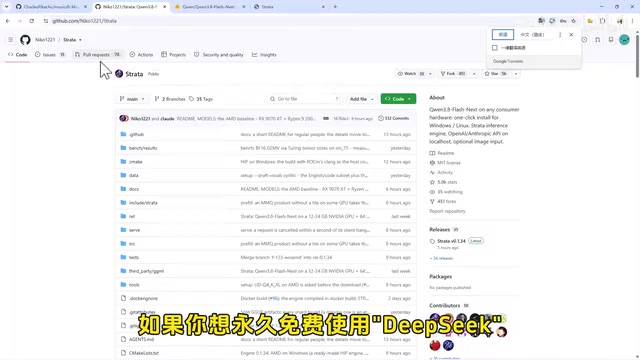
An open-source repository recently sparked considerable buzz in the community — according to a Bilibili content creator, the project surpassed 5,000 Stars within just one week of launch. Its core pitch: helping everyday users freely deploy a high-performance large language model locally, with no cloud dependency and no paid subscription. For users who have long been constrained by API costs or privacy concerns, this is undoubtedly a direction worth exploring.
It's worth noting that the model names mentioned in the original source material (e.g., "Qianwan 3.8 FlashNext") and the benchmark version ("DeepSeekAd V4.1") appear to contain clear speech-to-text transcription errors. This article will focus on the technical approach and hands-on experience, without over-interpreting specific model naming.
Core Positioning: Local and Free
The appeal of projects like this essentially comes down to two keywords — local deployment and permanently free. Unlike calling a cloud API, local deployment means the model runs entirely on your own machine. Data never leaves your device, privacy is stronger, and you're completely free from per-token billing.
According to the content creator, this model has a parameter count of 125B (125 billion parameters), described as being "like a knowledgeable university professor." This scale is already considered large among open-source models, typically requiring professional-grade GPUs to run. But the project's highlight is using quantization techniques (specifically the IQ3-series quantization scheme mentioned in the source material) to allow such a massive model to run smoothly on consumer-grade hardware.
Hardware Requirements and Runtime Experience
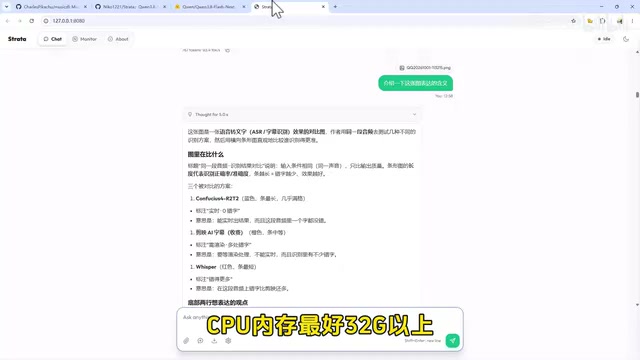
Based on the configuration requirements provided, the barrier to entry has been pushed remarkably low: a GPU with 12GB of VRAM, combined with 32GB or more of system RAM, is enough to run the IQ3-quantized version. This means many mid-to-high-end gaming GPU owners have a real shot at trying this out, without needing to invest in tens of thousands of dollars worth of professional compute cards.
Quantization is the key technology here. Simply put, quantization stores model weights at lower numerical precision (such as 3-bit), dramatically reducing VRAM usage at the cost of a slight loss in accuracy. Schemes like IQ3 are products of finding the right balance between "runnable" and "good enough."
The interface after local deployment was described as "pretty much like chatting with Doubao," supporting a deep thinking mode with manually adjustable thinking intensity. The model claims to support up to 1 million tokens of context — long enough to handle complex tasks like lengthy documents or large codebases.
Some background on the evolution of quantization techniques helps put the IQ3 scheme in context. Early quantization primarily used INT8 (8-bit integer) or FP16 (16-bit float), offering limited VRAM compression. In recent years, the GGUF format combined with the llama.cpp framework has driven more aggressive low-bit quantization practices, compressing weight precision to 4-bit, 3-bit, or even 2-bit. IQ3 belongs to the "Importance-aware Quantization" series, whose core idea is to assign different quantization precision to different weight layers based on their importance — critical layers retain higher precision while less important layers are compressed more aggressively. This preserves model performance as much as possible within an overall 3-bit VRAM footprint. Compared to naive uniform 3-bit quantization, IQ3-series schemes typically deliver noticeably better output quality at a similar VRAM cost — which is precisely why a 125B-scale model can be "good enough" on consumer hardware.
Real-World Testing: From Conversation to Generating a Desktop App
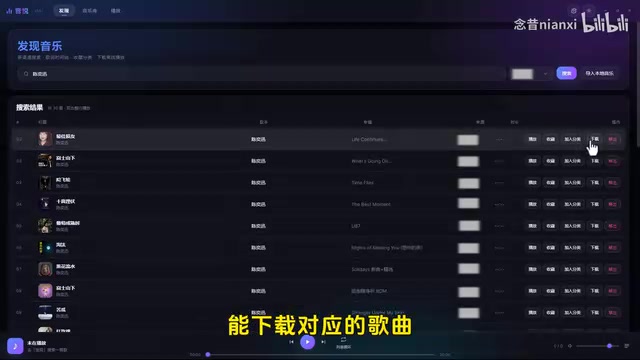
The real test of a model's capabilities comes from actual tasks. The content creator ran a fairly representative test: giving the model a GitHub URL and asking it to generate a desktop music application.
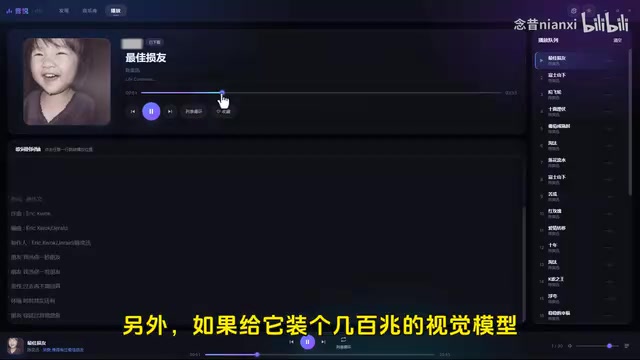
After roughly an hour of back-and-forth conversation, the model produced a first working version — a piece of software that could search for artists and download their songs. While only an initial release, the creator commented that "for a first version, this level is pretty impressive."
This kind of programming task is a comprehensive test of the model's reasoning ability, long-context memory, and code generation accuracy. Completing a functional application prototype on a locally running quantized model shows that its coding capabilities haven't severely degraded from quantization. That said, the one-hour conversation time is also a reminder: local inference speed still lags behind major cloud services — patience is required.
Multimodal Extension: Adding a Vision Model for Image Recognition
Beyond text and code, the model also supports adding a lightweight vision model (a few hundred MB in size) to gain image recognition and analysis capabilities.
The source material demonstrated a scenario where the model was shown a time-series chart depicting how large model release cycles have grown shorter over time. The model quickly returned an analysis of the chart's content. This modular approach to multimodal extension is worth noting — users can stack capabilities on demand rather than loading a bloated all-in-one model upfront, which is especially friendly for local environments with limited VRAM.
This "text backbone + lightweight visual encoder" architecture is technically often referred to as a LLaVA-style multimodal approach. The underlying principle is that a separate visual encoder (such as models from the CLIP family) converts images into vector embeddings, which are then concatenated into the language model's input sequence via a projection layer — allowing the LLM to "see" the image content. The visual encoder itself has an extremely small parameter count (typically a few hundred MB), requires no retraining of the main model, and activates image understanding simply by loading the additional weights. The advantage of this decoupled design is flexibility — users can update the vision module independently, or choose not to load it when VRAM is tight. For local deployment scenarios, stacking capabilities on demand rather than loading a fully-featured model all at once is the pragmatic choice for maximizing utility under constrained hardware resources.
A Rational Assessment: Opportunities and Caveats
Viewing this kind of project in a broader context, it reflects two clear trends in the open-source LLM ecosystem: first, aggressive quantization continuously lowering the hardware barrier, bringing large-parameter models to everyday users; second, modular and composable deployment approaches becoming increasingly mature.
That said, rationality is warranted. Claims like "on par with DeepSeek" in the source material represent the creator's subjective experience and lack standardized benchmark support. 3-bit quantization can run, but precision loss is real and objectively present — on high-precision reasoning tasks, it may be less stable than the original model. Local inference speed and the patience cost of long tasks are also things to mentally prepare for before diving in.
For users who care about data privacy, want to escape API fees, or simply enjoy tinkering with local AI, these open-source projects genuinely offer a low-cost entry path. If you're interested, it's worth first confirming whether your GPU VRAM and system RAM meet the requirements, then consulting the specific deployment documentation in the corresponding open-source repository.
When evaluating local model performance, commonly used standardized benchmarks include MMLU (measuring multi-domain knowledge comprehension), HumanEval (code generation correctness), GSM8K (mathematical reasoning), and GPQA (expert knowledge Q&A), among others. Quantized models typically see a 1–5 percentage point drop on these benchmarks compared to the original full-precision versions, with the exact magnitude depending on the quantization scheme and task type. For everyday conversation and general code generation, this loss is often imperceptible. However, in scenarios requiring precise numerical computation, strict logical deduction, or specialized domain Q&A, the impact of precision loss is amplified. Therefore, without reproducible benchmark data to support it, subjective claims of "matching some top-tier cloud model" can only serve as a reference point — not a substitute for actual testing.
Conclusion
Open-source and local deployment are making large language models increasingly accessible. Regardless of whether this specific project enjoys long-term maintenance, the direction it represents — using quantization techniques to squeeze high-performance models into consumer-grade hardware — is worth the continued attention of everyone following AI.
Related articles

Uber Deploys ChatGPT Work Company-Wide: AI in the Workplace Enters the Scaled Implementation Phase
Uber deploys ChatGPT Work to 30,000+ employees, extending it from engineering to all roles. We analyze its expert-engineer pairing, end-to-end automation, and questions of AI control and power concentration—insights for scaling AI in the workplace.

Shift at Midnight Hands-On: When "ID Verification" Becomes Alien Hunting
Shift at Midnight blends ID verification with horror survival in a four-player co-op game. We break down its inspection mechanics and chaotic humor.

Zelensky Recounts the Outbreak of War: I Need Ammunition, Not a Ride
Zelensky recalls the first day of war in a YouTube interview: farewell to family, rejecting Biden's evacuation offer with "I need ammunition, not a ride," and how Bucha shaped his stance on compromise and peace talks.