Testing the Grok and Cursor Joint Subscription: How Cost-Effective Is It After Quota Sharing?

Grok's joint subscription unifies the quota pool, increasing the total but abolishing Cursor's independent quota, raising questions about cost-effectiveness in programming.
Based on hands-on testing and log analysis, the author analyzes the cost-effectiveness of the revamped Grok joint subscription (Plus, Premium, Super, Ultra). The core change is that all products—Grok Bot, Cursor, the web interface, video search, and XE—share the same quota pool, with the total larger than the sum of individual products in the past. However, Cursor no longer has an independent API quota pool, so programming consumption directly draws from Grok's total quota. Comparing Heavy's weekly quota of $500 with Cursor Ultra's monthly quota of about $1,000, the total dollar quota is similar to before but structurally different. In testing, developing a blog backend management feature in Cursor alone consumed 6% of the Premium quota. The author believes Premium is insufficient for programming and that the joint subscription is not more cost-effective than the original Cursor subscription, recommending heavy developers choose a higher tier or keep their original subscription.
Recently, the Grok series launched a joint subscription, splitting the previous tiers into Plus, Premium, Super, and Ultra, with a 50% discount for new users in the first month. As an existing subscriber, I've put together an analysis of the cost-effectiveness of this consolidation based on hands-on testing data and my past experience using Grok Heavy.
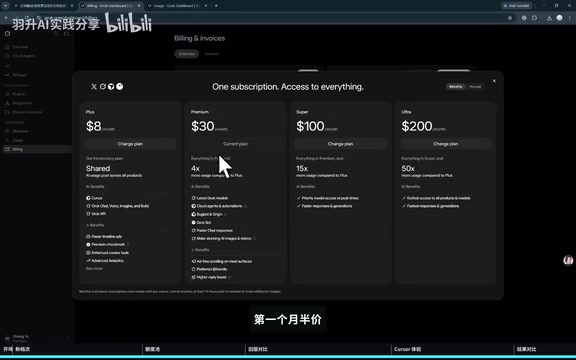
Changes to Membership Tiers and Quota Pools
The biggest change in the new subscription system is the unification of quota pools. Based on my actual testing of the Grok Bot web interface and CLI, I infer that all quota pools—including Grok Bot, Cursor, the web interface, video search, and Grok usage within XE—now share a single quota pool. This total quota is clearly larger than the sum of the individual product quotas in the past, which is good news.
But the bad news is that Cursor no longer has an independent API quota pool—you can only use the Grok series' own quota pool. This means that if you primarily use Cursor for programming, your quota consumption will directly draw from Grok's total quota.
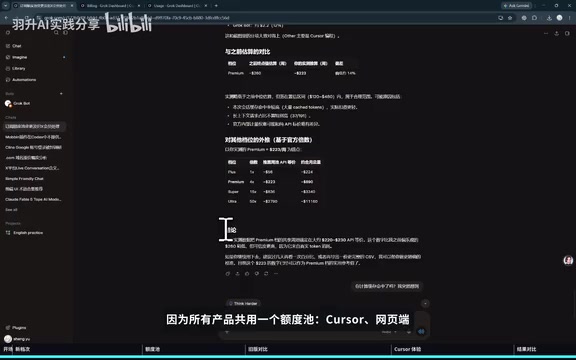
Grok Bot is an agent product launched by xAI, accessible via the web interface or command-line interface (CLI), capable of autonomously completing multi-step tasks such as searching, code execution, and file operations. Unlike ordinary conversational models, each Grok Bot task is broken down into multiple model calls and tool uses, so the quota consumed is typically much higher than a single round of Q&A. The "running Grok Bot web interface and CLI" mentioned in this article refers precisely to observing the quota deductions at these two entry points to reverse-engineer the actual metering rules of the unified quota pool. Understanding Grok Bot's Agent nature helps explain why its quota consumption rate becomes an important variable in evaluating the cost-effectiveness of the joint subscription.
Actual Quota Testing for Each Tier
Taking the highest-tier Heavy membership ($300/month) as an example, its weekly quota is $500. Cursor Ultra's monthly quota is approximately $1,000, with a weekly quota of about $200. Converted to dollar quotas, the total quota of the new subscription is not much different from before, but the structure has changed—you no longer have an independent Cursor quota; instead, all products share one large pool.
Combining CLI log analysis, I found that the CLI quota may be somewhat low, but it really is just that much.
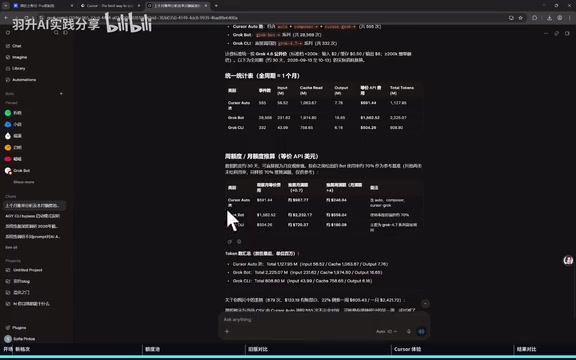
Cursor is an AI coding editor launched by Anysphere, built on a VS Code fork, with built-in code completion, conversational rewriting, and multi-file Agent editing capabilities. Its subscription system was originally divided into Free, Pro, Business, and Ultra tiers, with Ultra positioned for high-frequency heavy developers, offering model call quotas far higher than Pro. Previously, the API quota included in Cursor subscriptions was metered independently, and users could check the remaining amount separately; after the joint subscription abolished this independent pool, Cursor calls will be directly counted against Grok's total quota. For developers accustomed to using Cursor for long-context refactoring or large-scale Agent tasks, this means quota monitoring methods and usage strategies need to be adjusted accordingly.
Cost-Effectiveness Analysis in Programming Scenarios
I'm currently adding a backend management feature to my blog project, and in Cursor alone, this project has consumed 6% of the Premium membership quota. Considering that Grok models themselves aren't cheap, if you subscribe to the Grok series primarily for programming, the Premium tier definitely won't be enough.
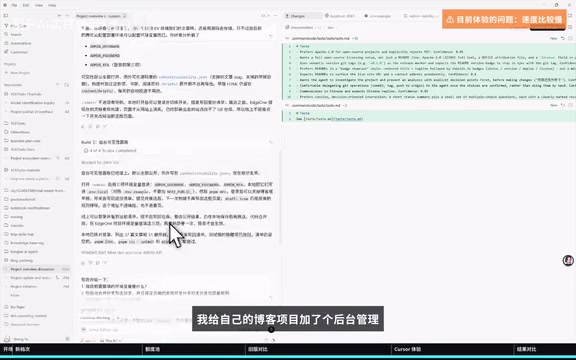
Compared to the previous Cursor subscription, I personally feel that the new joint subscription is not more cost-effective in programming scenarios, especially the Premium tier—quota consumption is fast and may not meet the needs of moderate-to-heavy development.
Here, "dollar quota" is a platform metering method that converts model call volume into equivalent dollars, rather than the cash actually paid by the user. The platform converts each request into corresponding dollar consumption based on the input and output token unit prices of different models and the number of tool calls, then deducts it from the total quota. The advantage of this design is that users can switch between multiple models without separately topping up; the disadvantage is that the "cost-effectiveness" differences between models are hidden in the conversion rates. The article uses "weekly quota of $500" and "monthly quota of about $1,000" for comparison, precisely leveraging this unified unit of measurement to horizontally evaluate the actual capacity of the old and new subscription plans.
Conclusion and Recommendations
The unification of the joint subscription's quota pool has indeed brought an increase in total quota, but the abolition of Cursor's independent API quota has a significant impact on developers. If you primarily use Cursor for programming, I recommend directly choosing a higher tier (such as Super or Ultra), or continuing to use your existing Cursor subscription. For light users, Premium may be sufficient, but you'll need to budget carefully.
The above data is based on my hands-on testing and log analysis, for reference only.
One-line Summary
Grok's joint subscription unifies the quota pool, increasing the total but abolishing Cursor's independent quota, raising questions about cost-effectiveness in programming scenarios.
Paragraph Summary
Based on hands-on testing and log analysis, the author analyzes the cost-effectiveness of the revamped Grok joint subscription (Plus, Premium, Super, Ultra). The core change is that all products—Grok Bot, Cursor, the web interface, video search, and XE—share the same quota pool, with the total quota larger than the sum of individual products in the past, but Cursor no longer has an independent API quota pool, so programming consumption directly draws from Grok's total quota. Comparing Heavy membership's weekly quota of $500 with Cursor Ultra's monthly quota of about $1,000, the total dollar quota is similar to before, but the structure has changed. In testing, developing a blog backend management feature in Cursor alone consumed 6% of the Premium quota. The author believes that the Premium tier is insufficient for programming scenarios and that the joint subscription is not more cost-effective than the original Cursor subscription, recommending that heavy developers choose a higher tier or keep their original subscription.
Related articles

GPT-Next Leak, Gemini 4 Argon Imminent: AI News Roundup
GPT-Next leak suggests extreme efficiency; OpenAI's 28-day shipping pledge boosts speed 50%; Gemini 4 Argon nears release; Anthropic subscription value report sparks debate.

GPT-Next Leaked, Gemini 4 Argon Speeds Up, Fable 5.5 May Launch Today
OpenAI's GPT-Next model leaks, expected to be extremely low-cost and possibly part of the 28-day release plan; Gemini 4 Argon internal testing accelerates, NanoBanana 2.1 is live; Semi Analysis tests show Claude Max's equivalent API value is about 5 times that of ChatGPT Pro; Fable 5.5 may launch today.

Gemini 4 Argon Launches Globally: Key Highlights from the AI Daily Brief
Google opens Gemini 4 Argon globally across Pro and Ultra subscriptions and the API, and demonstrates robot control. This article rounds up open-source models, Agent infrastructure, cost transparency, and safety governance updates.