Tev: Cracking Long-Horizon Agent Training with Dense Progress Rewards

Tev uses latent-world-first dense-reward environments and PPRS to enable cross-domain generalization in open-source long-horizon agents.
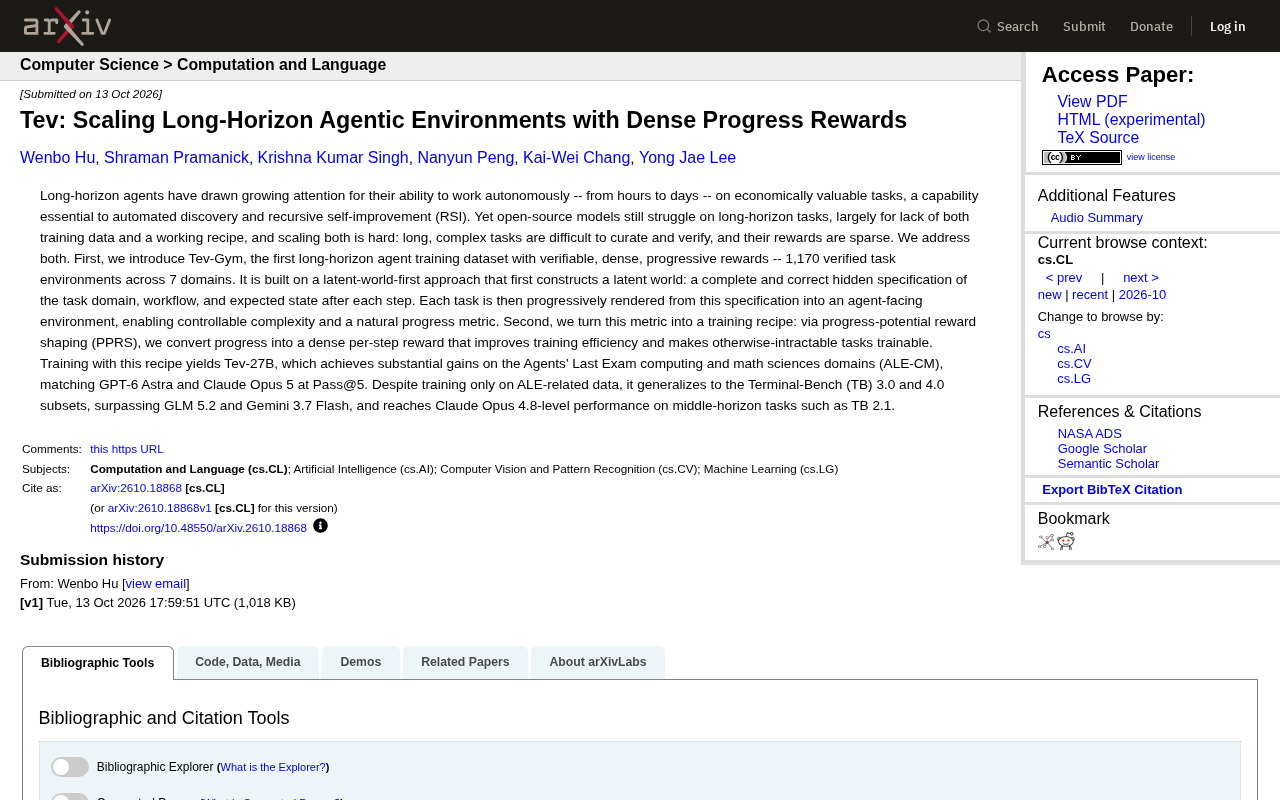
The article presents Tev, a solution for the lack of training data and methods in long-horizon agent training. It has three core parts: Tev-Gym, a latent-world-first dataset covering 7 domains and 1,170 verifiable tasks with automatic progress metrics; PPRS (Progress-Potential Reward Shaping), which turns latent-world progress into dense step rewards and makes previously untrainable tasks trainable; and Tev-27B, which matches GPT-6 Astra and Claude Opus 5 on ALE-CM at Pass@5 and generalizes to Terminal-Bench 3.0/4.0, surpassing GLM 5.2 and Gemini 3.7 Flash. The closed loop suggests domain-agnostic long-horizon capability.
Long-horizon agents are becoming one of the most closely watched directions in AI. These agents can autonomously complete economically valuable tasks over hours or even days, and are a key capability for automated scientific discovery and recursive self-improvement (RSI).
Yet open-source models have consistently underperformed in this direction. There are two core bottlenecks: a shortage of training data and a lack of training methods. Long-horizon tasks tend to be complex, hard to curate and verify, and their reward signals are extremely sparse—a model may complete an entire workflow only to receive a single success-or-failure signal, resulting in very low learning efficiency.
Tev is the solution proposed to address these two problems.
Core Idea: Build the Latent World First, Then Render It into a Training Environment
Tev's first contribution is Tev-Gym, described as the first long-horizon agent training dataset with verifiable, dense, progressive rewards, covering 7 domains and a total of 1,170 validated task environments.
Its construction follows a "latent-world-first" approach. Specifically, Tev first builds a latent world for each task—a complete and correct hidden specification of the task domain, the workflow, and the expected state after each step. Then, from this specification, the actual environment presented to the agent is progressively rendered.
This design yields two immediate benefits. First, controllable complexity: because tasks are generated from specifications, difficulty can be adjusted as needed. Second, it produces a natural progress metric: every state transition in the latent world corresponds to a quantifiable measure of progress, rather than only a final success/failure signal.
This solves a fundamental problem that has long plagued long-horizon training—tasks are hard to curate and hard to verify. By first defining "what the correct answer should look like" and then having the environment generated around it, verification becomes automated and scalable.
Latent World is a term borrowed from world model research, referring to a complete abstract representation of a task environment's internal states and state-transition rules. In traditional reinforcement learning, the environment is usually written directly as code or a physics simulator, and what the agent observes is all the information there is; in Tev's setup, however, the latent world is a "god's-eye-view" hidden specification—it fully describes the task domain, the correct workflow, and the state that should be reached after each step, but the agent cannot see it directly during interaction.
This two-layer structure of "specification first, observations rendered afterward" makes verification cheap: simply compare the agent's actual state with the expected state in the latent world to automatically determine whether it is on the correct path. This is also the precondition for Tev-Gym to provide dense rewards for 1,170 tasks—rewards need not rely on human-annotated success/failure labels, but are automatically derived from the specification.
PPRS: Turning Progress into Per-Step Rewards
With a progress metric in hand, the next question is how to turn it into a trainable signal. Tev proposes Progress-Potential Reward Shaping (PPRS), which converts progress metrics into dense step-by-step rewards.
The practical effect of this method is a significant boost in training efficiency, and it makes tasks that were previously "untrainable" due to overly sparse rewards trainable. Reward shaping is not a new concept, but what sets PPRS apart is that its potential derives from structured latent-world specifications rather than heuristic intermediate reward designs—this keeps the reward signal both dense and aligned with the task's essential objective.
The model trained with this method is Tev-27B.
Reward Shaping is a classic technique in reinforcement learning: when the environment provides only a sparse final reward, the training signal is too weak and the agent struggles to find the correct path through random exploration. Reward shaping guides learning by introducing intermediate rewards, but traditional methods rely on manually designed heuristics (such as "award points for getting closer to the goal"), which easily introduce bias and cause the agent to optimize the intermediate reward rather than the true objective.
Potential-based Reward Shaping is a theoretically guaranteed framework proposed by Ng et al. in 1999: if the intermediate reward is defined as the difference of a potential function F(s,s') = γΦ(s') - Φ(s), then the optimal policy will not change due to shaping, i.e., shaping "does not alter the essence of the task." PPRS's innovation lies in defining the potential Φ directly as the progress metric from the latent-world specification—how far each state transition advances along the specification path produces the corresponding reward. This preserves the theoretical losslessness of potential-based shaping while giving the potential a clear semantic source, avoiding the arbitrariness of heuristic design.
Training Results: Standout Cross-Domain Generalization
What is noteworthy about Tev-27B's performance is not just its absolute scores, but also its generalization characteristics.
On Agents' Last Exam's Computing and Mathematical Sciences domain (ALE-CM), Tev-27B achieves a notable improvement, matching GPT-6 Astra and Claude Opus 5 on the Pass@5 metric.
Even more convincing is cross-domain transfer. Tev-27B's training data is only related to ALE, yet it also surpasses GLM 5.2 and Gemini 3.7 Flash on the Terminal-Bench (TB) 3.0 and 4.0 subsets; on medium-horizon tasks such as TB 2.1, it reaches a Claude Opus 4.8-level performance.
This phenomenon of "training only on ALE-related data yet generalizing to Terminal-Bench" hints at an important signal: task environments built from latent-world specifications may teach some domain-agnostic long-horizon task execution capability, rather than merely memorizing solutions to specific tasks. This has practical significance for reducing the data acquisition cost of long-horizon agents—there is no need to build training data from scratch for every target scenario.
Pass@5 is a commonly used metric when evaluating agents or code generation models: generate 5 independent solutions to the same problem, and success is counted if any one of them passes verification. Compared with Pass@1, it better reflects the model's upper bound of capability, and is often used to mitigate noise caused by the randomness of a single sample. In long-horizon task evaluation, because the tasks themselves are time-consuming and have high failure rates, Pass@5 is often used to measure the boundary capability of whether a model "has the potential to solve" rather than "reliably solves" them.
Terminal-Bench is a benchmark suite for command-line agents, where tasks require the model to complete multi-step operations in a real terminal environment (such as configuring systems, debugging scripts, and handling files), evaluating its long-horizon tool use and environment interaction capabilities. Along with ALE (Agents' Last Exam), it belongs to the category of high-difficulty agent evaluations, but focuses on different skill surfaces: ALE emphasizes computing and mathematical sciences reasoning, while Terminal-Bench places more emphasis on engineering operations. Tev-27B was trained only on ALE-related data yet performs excellently on Terminal-Bench, and it is precisely this cross-skill transfer phenomenon that constitutes the argument for "domain-agnostic capability."
Why This Matters
Training long-horizon agents has long been in an awkward position: capability ceilings are highly anticipated, but there is a lack of scalable recipes in engineering. Tev's value lies in simultaneously providing data infrastructure (Tev-Gym), a training method (PPRS), and validation results (Tev-27B), forming a complete closed loop.
The latent-world-first approach is especially worth noting. It transforms "task curation" from a bottleneck dependent on manual design into a process that can be structured and generated. If this paradigm can be adopted more widely, the problem of scarce training data for long-horizon agents may be substantially alleviated—and dense progress rewards make it possible to actually put such data to use.
The gap between open-source models on long-horizon tasks may stem precisely from the lack of such infrastructure and recipes, rather than merely being a matter of model scale.
One-line Summary
Tev builds dense-reward training environments via a latent-world-first approach and the PPRS method, enabling open-source long-horizon agents to achieve cross-domain generalization.
Paragraph Summary
The article introduces the Tev solution for the shortage of training data and lack of methods in long-horizon agent training. Its core consists of three parts: first, the Tev-Gym dataset, which adopts a "latent-world-first" approach—building a hidden specification for each task first and then rendering it into an agent environment—thereby covering 7 domains and 1,170 verifiable tasks and automatically producing progress metrics; second, PPRS (Progress-Potential Reward Shaping), which converts progress metrics in the latent world into dense step-by-step rewards, making tasks that were previously untrainable due to sparse rewards trainable; and third, Tev-27B, a model trained with this method, which matches GPT-6 Astra and Claude Opus 5 on ALE-CM at Pass@5 and generalizes cross-domain to Terminal-Bench 3.0/4.0, surpassing GLM 5.2 and Gemini 3.7 Flash. The article argues that this complete closed loop suggests the model has learned domain-agnostic long-horizon task execution capability, and may substantially alleviate the data bottleneck for open-source models in this direction.
Related articles

Free Unlimited Claude Code Solution: Agnes AI + CC Switch Setup Guide
No paid subscription needed — pair the free AI platform Agnes AI with the open-source tool CC Switch to provide a backend for Claude Code, enabling unlimited free calls to text, image, and video models. This guide covers the full setup, test results, and usage boundaries.

A Complete Zero-Cost Guide to Getting Started with Claude Code for Beginners in China
A beginner's guide to Claude Code for users in China: two installation methods (command line and IDE plugin), full configuration steps for replacing the official API with the free domestic LongCat model, and a hands-on demo of building a small tool with natural language, plus tips.

When the NSA Gets Involved: The AI Supply Chain Crisis Behind Open-Source CVEs and API Key Hijacking
Multiple open-source projects disclosed severe CVEs in one day, PHP flaws alarmed the FBI, and Railway and OpenCode were breached with API keys stolen. This article breaks down the vulnerability window, AI-accelerated exploitation, and the AI supply chain crisis behind the API key black market, with a developer defense checklist.