TextMyPill: WhatsApp Medication Reminder Tool with AI Prescription Recognition for Family Health Management

TextMyPill delivers AI-powered medication reminders via WhatsApp with family management features.
TextMyPill is a lightweight medication reminder tool that sends alerts through WhatsApp instead of requiring a standalone app. It features AI-powered prescription recognition that auto-creates medication schedules from photos, and a family dashboard for caregivers to remotely manage and track medication adherence for multiple family members.
A Neglected Pain Point: Forgetting to Take Medication
In health management, the simplest problems are often the hardest to solve—taking medication on time. Whether it's chronic disease patients needing daily medication or elderly family members juggling multiple prescriptions, "forgetting to take medication" and "not remembering if you already took it" are universal struggles. According to the WHO, long-term medication adherence among chronic disease patients is only about 50% in developed countries, and even lower in developing nations. There's no shortage of medication reminder apps on the market, but they all share a common problem: users are too lazy to download, register, or open them.
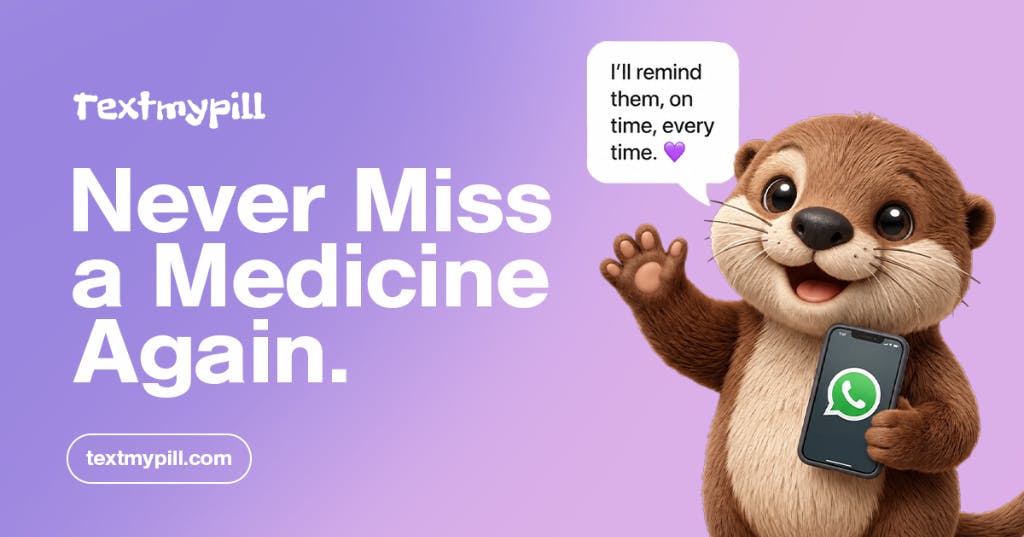
TextMyPill, a new product recently featured on Product Hunt, is trying to solve this problem with an ultra-simple approach: instead of building a standalone app, it delivers medication reminders directly through WhatsApp—the messaging app users already use every day.
TextMyPill's Core Approach: Meet Users Where They Already Are
TextMyPill's product logic is crystal clear, captured in its slogan: "WhatsApp medicine reminders. No app needed."
The core mechanism works like this: users set up medication schedules for themselves or their entire family through a unified dashboard, and an assistant named Pillo automatically sends reminders via WhatsApp. Users don't need to download any new application—reminders appear just like regular messages on their phone.
This strategy of "piggybacking" on a mature messaging platform isn't new, but it's quite clever for health reminders. WhatsApp has over 2 billion users globally, with especially high penetration in Europe, India, Latin America, and Southeast Asia. For middle-aged and elderly target users, the barrier of learning a new app is far higher than simply receiving a familiar message. TextMyPill trades "zero learning cost" for higher actual compliance rates.
This underlying logic aligns with the broader "embedded services" trend. Data shows that average smartphone users actively use no more than 10 apps per month, while 30-day retention rates for newly installed apps are generally below 5%. As "app fatigue" worsens on mobile, reaching users through mature channels like Telegram Bots, WhatsApp Business, and WeChat Mini Programs has become a mainstream acquisition strategy for lightweight tools. TextMyPill is a textbook example of this trend in the health space.
A Product Philosophy of Lowering Barriers
You might not have noticed, but the product currently offers a 7-day free trial. This "try before you pay" model, combined with the low barrier of "no app needed," further reduces the psychological cost of trying it out. In a landscape where health subscription products typically face high churn rates, converting free trial users into long-term paying customers will be the key test of this product's business model.
AI Prescription Recognition: Snap a Photo and Auto-Complete Setup
Another highlight of TextMyPill is its AI capability. The product lets users "snap a prescription" and have AI automatically read it and complete the setup.
This feature directly addresses the most tedious part of medication management—manual data entry. For patients taking multiple medications, manually entering drug names, dosages, and frequencies is not only time-consuming but error-prone. By combining OCR (Optical Character Recognition) with LLM-based information extraction, the AI can automatically parse prescription details—drug names, dosages, and schedules—and convert them into structured medication reminder plans.
From a technical implementation perspective, this type of prescription parsing typically follows a two-stage process: the first stage uses an OCR engine (such as Google Vision API, Tesseract, etc.) to convert the prescription image into raw text; the second stage uses a large language model to perform semantic understanding and structured extraction, distinguishing between drug names, dosage values, and frequency instructions (e.g., "three times daily, after meals"). Compared to traditional rule-based matching approaches, LLMs excel at handling the diversity and ambiguity of natural language expressions, such as medical abbreviations like "bid" (twice daily, from Latin) and "prn" (as needed).
This is why TextMyPill is categorized under Health & Fitness, Messaging, and Artificial Intelligence—it's essentially a combination innovation of "AI + messaging channel + health scenario." AI here isn't playing a flashy role but genuinely eliminating user friction.
Accuracy Challenges in AI Applications
Of course, prescription recognition involves medical safety with minimal margin for error. Drug name similarities (easily confused medication names), difficulty recognizing handwritten prescriptions, and parsing dosage units all demand high AI accuracy. In medical informatics, "Look-Alike Sound-Alike" (LASA) drugs have always been a major medication safety hazard—even human pharmacists need to double-check. Ideally, the product should retain a manual confirmation step after AI recognition to prevent reminder errors from misidentification. This is both a technical challenge and a matter of compliance and trust.
A Family-Oriented Medication Management Perspective
Unlike many medication reminder tools that only serve individuals, TextMyPill explicitly emphasizes the "family" dimension. Users can manage medication reminders for their "entire family" from "one dashboard" and "track who took what."
This design addresses a real need: many medication management executors aren't the patients themselves but their children or caregivers. An adult child working abroad can remotely set up medication reminders for their elderly parents living alone and verify through the dashboard whether they took their medicine on time—the product even emphasizes management from "anywhere in the world."
Upgrading from a personal tool to a "family health collaboration platform" makes TextMyPill's value proposition more compelling and stickier—once the entire family's medication data is consolidated on one platform, switching costs increase significantly.
Market Performance and Sober Observations
Based on Product Hunt data, TextMyPill currently has 10 upvotes and 7 comments, ranking 13th. This is a modest start without explosive attention. As a product built by indie developer Bhavesh, its niche positioning deserves recognition, but it faces several practical challenges:
- Platform dependency risk: The product heavily relies on WhatsApp Business API, operated by Meta. Businesses must connect through official Business Solution Providers (BSPs), with per-message pricing varying by country and message type. More critically, Meta enforces strict template review mechanisms and 24-hour conversation window rules—meaning TextMyPill's reminder message formats and sending frequencies are constrained by platform policies. Future policy or pricing changes could directly impact operating costs and user experience.
- Building trust: Health data is sensitive and prescriptions involve privacy. Whether users will upload prescription photos to a startup product requires time and reputation building. Especially as GDPR and health data regulations worldwide become increasingly strict, data compliance is an unavoidable operational threshold.
- Paid conversion: Willingness to renew after the 7-day trial will truly test the product's retention value.
Conclusion: Small but Beautiful Scenario-Based Innovation
TextMyPill isn't trying to reinvent health management. Instead, it focuses on the specific pain point of "medication reminders" and delivers a lightweight, pragmatic solution combining "WhatsApp + AI prescription recognition + family management."
It represents a growing product philosophy: rather than asking users to download yet another app, embed the service into users' existing daily habits. In today's world of app overload and scarce user attention, this "subtraction-based" product design may resonate more than feature-stuffing. For observers watching AI application scenarios, TextMyPill is a noteworthy small sample—it proves that AI's value sometimes lies not in complexity, but in solving a real, high-frequency small problem at just the right moment.
Related articles

MLOps Hands-On Project: A Complete End-to-End Breakdown of Building a Laundry Care Recognition System
A detailed walkthrough of building an end-to-end MLOps laundry care recognition system, covering automated data collection, model retraining, Docker containerization, AWS deployment, and Grafana+Prometheus monitoring.

Deep Dive into Row-Bot's Multi-Agent Orchestration Architecture: Parent-Child Agent Collaboration and Concurrency Control
Deep analysis of Row-Bot's multi-agent orchestration: parent-child Agent collaboration, Git worktree concurrency safety, state persistence, and fault recovery design for production AI Agent systems.

Unsloth Desktop Released: An All-in-One Desktop App for Local Model Inference and Training
Unsloth Desktop is an open-source cross-platform app combining model inference, fine-tuning, and deployment. Supports Mac/Windows/Linux with 2x training speed, 70% VRAM savings, and zero telemetry.