Thanksgiving Reflection: When AI Talk Drowns Out Humanity, This Scholar Chooses to Thank Students and Colleagues
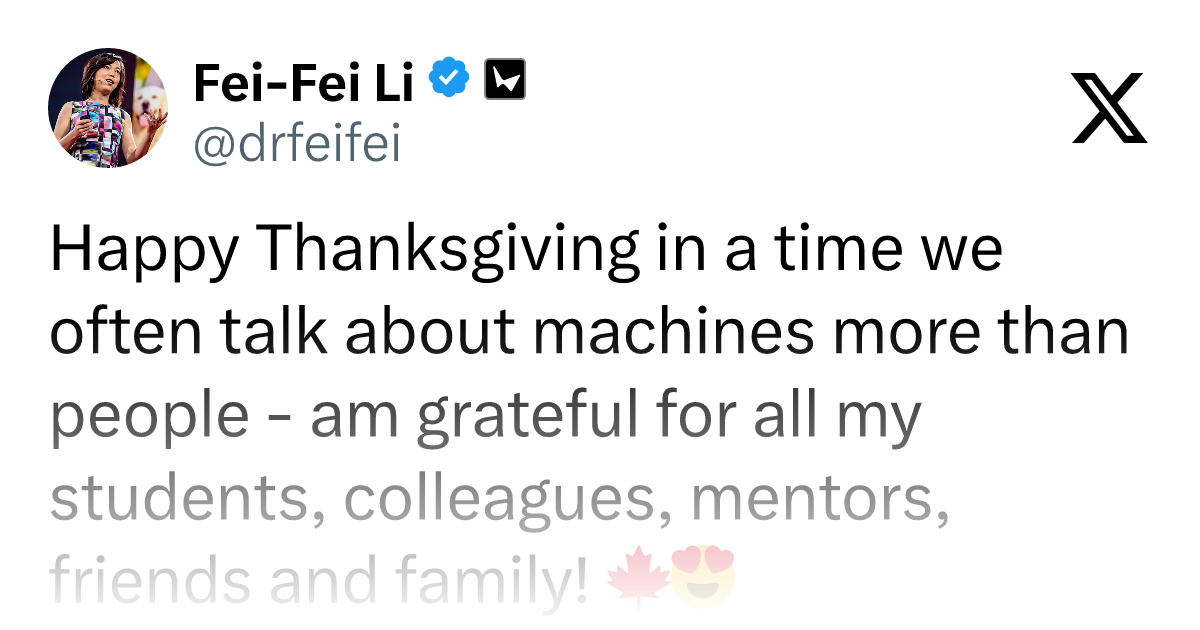
A Thanksgiving tweet reminds the AI era not to let machine narratives overshadow attention to people.
Starting from a quiet Thanksgiving tweet, the article notes that amid AI news and model parameters flooding feeds, people talk about machines far more than about people. The author argues this is not opposition to technological progress but reveals an imbalance in attention: students, colleagues, mentors, friends, and family—roles that sustain technological development—are often obscured in industry narratives. By thanking these people, the tweet brings humans back into view. The article thus proposes a stance: while chasing model progress, preserve attention to education, mentorship, and human collaboration, because machines are tools and people are the purpose.
A Tweet That Sparks Reflection
At a time when social media is flooded with AI news and model parameters, a quiet Thanksgiving tweet from Twitter stands out. The author writes: "Happy Thanksgiving in a time we often talk about machines more than people - am grateful for all my students, colleagues, mentors, friends and family!"
There are no technical details or product launches in this message, yet it points out a fact that most tech discussions overlook: we talk about machines far more often than we talk about people.
The Symptom of an Era: "Machines Over People"
Over the past few years, public discourse in AI has been almost entirely dominated by model capabilities, compute scale, and automation prospects. Tech communities and media eagerly compare parameters, benchmark scores, and deployment cases, while the human side—how students learn, how colleagues collaborate, how mentors pass on knowledge—often recedes into the background.
This scholar's tweet is not opposing technological progress but rather flagging an imbalance in attention allocation. When industry narratives habitually place "machines" at the center, the value of education, mentorship, and human connection is easily undervalued. Thanksgiving, as a cultural moment, provides a timely opportunity to pause and look back.
Students, Colleagues, and Mentors: The Roles Obscured by Tech Narratives
The tweet explicitly thanks students, colleagues, mentors, friends, and family. These roles are rarely the protagonists in AI stories, yet they are the foundation on which technology continues to develop.
Students represent the next generation's judgment and creativity, colleagues form the network of daily collaboration and peer review, and mentors carry the transmission of tacit experience. These relationships cannot be automated or easily measured by metrics. With a brief holiday greeting, the author brings these human dimensions back into view.
Mentorship, in academic and industrial research settings, typically refers to a relationship structure in which senior individuals help less experienced people grow through long-term, informal knowledge transfer and career guidance. Unlike classroom teaching, mentorship relies more on joint project participation, repeated discussion, and tacit modeling; its outcomes often manifest as improved judgment and career path choices for the mentee, rather than quantifiable immediate outputs. In AI, mentorship also carries the function of transmitting research taste, experimental ethics, and lessons from failure—content that is hard to codify in papers or code repositories. For this reason, mentorship's value is easily underestimated by metrics-driven evaluation systems, yet it plays an irreplaceable role in sustaining research culture.
Keeping a Place for People Amid the Machine Noise
The value of this tweet lies not in offering conclusions but in proposing a stance: when we talk about machines, don't forget to talk about people. For AI practitioners and content creators, this means preserving attention to education, collaboration, and human relationships while chasing model progress.
Technology will continue to evolve, but the people who drive it and the people affected by it remain the starting point and the end goal of any discussion. This Thanksgiving greeting may serve as a gentle reminder: machines are tools; people are the purpose.
Attention allocation is an analytical lens from cognitive psychology and communication studies, referring to which objects individuals or groups direct their limited information-processing capacity toward. In public tech discourse, media and communities also have limited timelines and space; high-signal events like model releases and leaderboards continually crowd out narrative space for education, collaboration, and human relationships. This imbalance may not be intentional, but through agenda-setting effects it shapes the industry's default understanding of "what is worth talking about." Recognizing that attention is a scarce resource helps practitioners proactively make room for the human dimension rather than waiting for it to return passively.
Frequently Asked Questions
What does this tweet say? The author expresses gratitude to students, colleagues, mentors, friends, and family on Thanksgiving, and notes that people currently talk about machines more than people.
Why is this tweet worth attention? It approaches the issue of attention allocation in the AI era from a humanistic perspective, reminding tech discussions not to overlook human value.
What does this suggest for AI practitioners? While focusing on models and products, value the human connections in education, mentorship, and team collaboration.
One-line Summary
A Thanksgiving tweet reminds us in the AI era not to let machine narratives overshadow attention to people.
Paragraph Summary
Starting from a quiet Thanksgiving tweet, the article notes that amid AI news and model parameters flooding feeds, people talk about machines far more than about people. The author argues this is not opposition to technological progress but reveals an imbalance in attention: students, colleagues, mentors, friends, and family—roles that sustain technological development—are often obscured in industry narratives. By thanking these people, the tweet brings humans back into view. The article thus proposes a stance: while chasing model progress, preserve attention to education, mentorship, and human collaboration, because machines are tools and people are the purpose.
Related articles

Pure-Code Video Generation Tested: Which AI Model Actually Follows Instructions?
A Bilibili creator tested three AI models' pure-code video generation with unified prompts and three revisions each: Xiaonaomao has a high ceiling but lacks stability, GPT 6.2 Extra models well but only follows half the instructions, and OPAS 5.5 remains the benchmark.

GPT-6 Six-Tier Hands-On Test: Astra Ultra Dominates but Bills Double
GPT-6 six-tier test: Astra Ultra sweeps 3:0 in 3D tasks thanks to sub-agents and runs 14% faster, but hidden backend bills make its real cost 2.6x single-threaded.

GPT-6.2 Astra vs Fable 5.2: Huge Cost-Efficiency Gap Across 12 Real-World Tests
Bilibili creator tests GPT-6.2 Astra vs Fable 5.2 across 12 real tasks: Fable wins 7-5 but costs 7.2x more and takes nearly 5x longer. Token efficiency emerges as the key selection metric.