The 15-Year Journey Behind Xbox's Disc-to-Digital Feature

Xbox's disc-to-digital feature is Microsoft's 15-year-old digital ownership vision finally landing at the right moment.
Microsoft's new Xbox disc-to-digital feature lets players transfer physical game ownership to their digital accounts, preserving collections on disc-free hardware. The concept traces back to Xbox One's controversial 2013 digital licensing plan, which was pulled after backlash — today's version drops the forced online checks and used-game restrictions while keeping the core value. The timing matters too: Sony is steadily sidelining physical media across PlayStation, and player anxiety over physical collections going obsolete is at a peak. Microsoft's gradual bridging strategy addresses that collective concern while offering the broader industry a model for smoother digital transitions.
Xbox Quietly Launches Its Disc-to-Digital Feature
Last month, Microsoft announced a clever new feature for the Xbox platform: the ability to convert physical game discs into digital versions. At first glance, it looks like a perfectly timed counterpunch to Sony's gradual move away from PlayStation discs. But zoom out, and you'll find this feature wasn't born overnight — it's the product of 15 years of iteration.
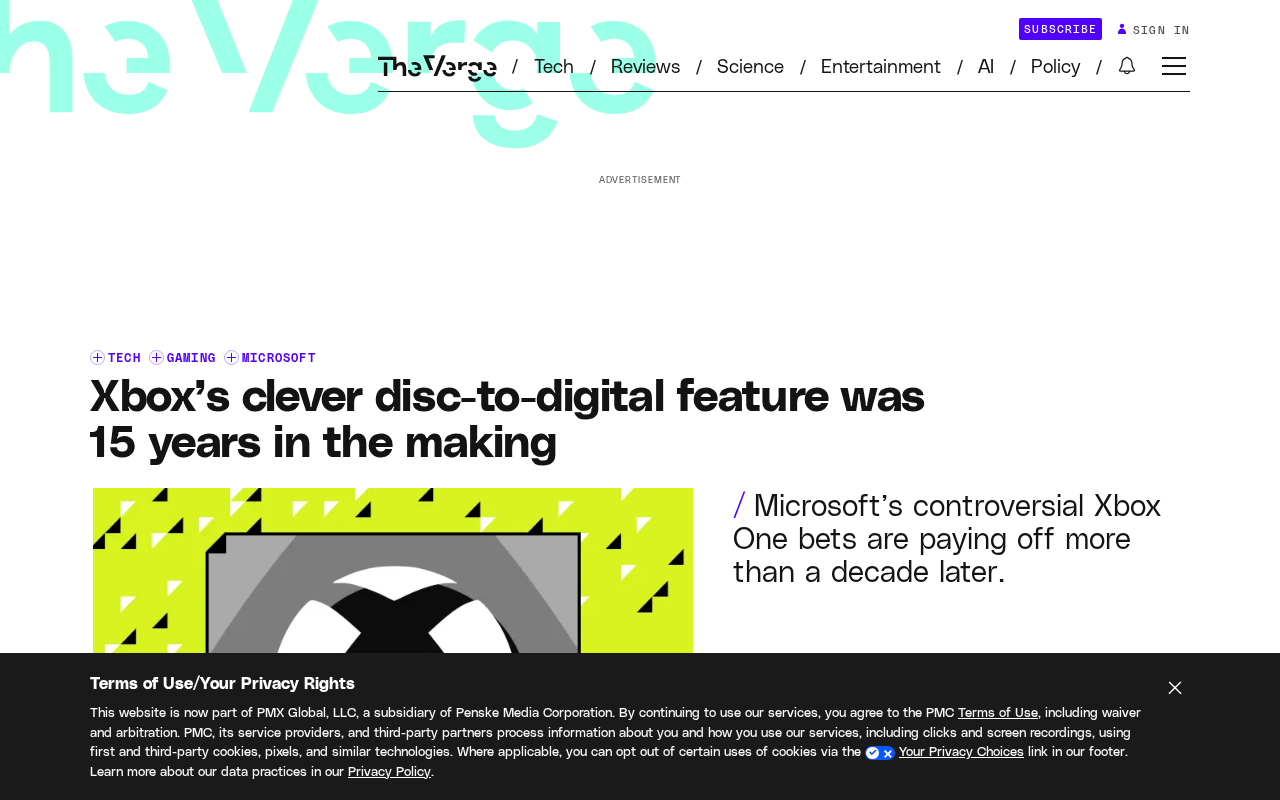
The core idea behind disc-to-digital is straightforward: players who own physical discs can transfer the corresponding game ownership to their digital account. That means no more swapping discs, and full access to an existing game library on disc-free hardware. It hits a critical pain point precisely as the console industry accelerates its shift toward all-digital.
Seeds Planted During the Xbox One Era
Microsoft's ambitions around digital ownership actually trace back to the Xbox One launch. At the time, the company envisioned an aggressive digital licensing system that would let players bind disc games to their accounts and even share them across multiple devices. That plan, however, was shelved under a wave of backlash — players feared it would undermine their rights around used games and offline play.
In other words, today's feature is essentially a softer, more palatable version of Microsoft's decade-old digital vision. It strips away the most controversial elements while preserving the genuinely valuable core: keeping a physical collection alive in a digital age. That kind of iterative thinking reflects how cautious platform holders have become when pushing digital transitions.
When Xbox One launched in 2013, Microsoft's original plan required every game disc to be authenticated online once, after which the game would be stored as a digital license in the player's account. The disc itself could be sold or transferred, but buyers of used copies would need to pay an activation fee. The system also included a mandatory online check-in every 24 hours, plus a "family sharing" feature that let household members share a game library. These policies triggered an immediate uproar at E3 2013 — players interpreted them as an assault on the used game market and a threat to offline gaming rights. Within weeks, Microsoft reversed course entirely and restored the traditional disc model. Ironically, the scrapped family sharing feature had actually generated genuine excitement among a portion of players, and many still regard it as the only truly innovative element of the original Xbox One policy.
Why the Timing Is Right
The timing of this launch is equally telling. As Sony continues to downplay physical media across the PlayStation lineup — with disc-free consoles becoming increasingly mainstream — the entire industry is moving faster toward a physical-media-free future.
In this climate, Microsoft is using disc-to-digital to reassure players who have built large physical collections but want the convenience of going digital. It's more than a feature update; it's a brand statement. Xbox is signaling: "We respect what you've already collected, and we're building you a bridge to the digital future." Compared to simply cutting disc support altogether, this gradual approach is far more likely to win over core users.
Sony's retreat from physical media has played out on multiple fronts: the PS5 launched with a cheaper disc-free Digital Edition; the 2023 PS5 Slim made the disc drive an optional, separately sold accessory; and in 2024, Sony announced it would stop selling physical game discs through PlayStation Direct stores in certain regions. Taken together, these moves send a clear signal that physical media is being actively marginalized by the platform holder. For "collector-type" players who have accumulated dozens or even hundreds of PS or Xbox discs, this raises a very real concern that years of investment in physical assets could become obsolete at any moment. Microsoft's disc-to-digital feature arrived squarely in this window of collective anxiety — its competitive intent speaks for itself.
What It Means for Players and the Industry
For players, the most immediate benefit is continuity of collection value. Years of physical game purchases won't become worthless just because a device goes disc-free — and that goes a long way toward easing anxiety about format obsolescence.
For the broader console industry, this feature offers a useful transitional model: how to push digital adoption while thoughtfully handling the massive existing inventory of physical games. It demonstrates that digital transformation doesn't have to be an all-or-nothing trade-off — a well-designed bridge can make the migration seamless. Of course, the real-world experience, the range of supported titles, and the specific licensing terms will ultimately determine whether it succeeds, and those details are worth watching closely.
Closing Thoughts
Xbox's seemingly timely new feature is actually a snapshot of a 15-year run — a long journey spanning both technology and philosophy. From the bold ambitions of the Xbox One era to today's pragmatic bridging solution, Microsoft's exploration of digital ownership has never really stopped. As the console industry steers full-speed toward an all-digital future, a design that honors both the past and the future may be exactly the kind of wisdom this transition demands.
Related articles

Apple HomeView Hands-On Review: Is the $300 Smart Home Hub Worth It?
Apple HomeView hands-on: a $300 smart home hub with facial recognition for quick account switching, but no App Store or voice recognition. Is the wall-mounted version worth it? Should you buy the first generation?

Meta Muse Wonder Launch: What It Means for Meta's Return to the Frontier AI Race
Meta releases Muse Wonder and WonderFull, benchmarks reach the frontier, community feedback is polarized. An in-depth look at Meta's return to the frontier AI race, its personal agent strategy, and Zuckerberg's different path.

Apple Home Smart Home Lineup Leaked: LG and Schneider Team Up, UWB Door Lock on Board
Apple Home ecosystem gains new LG and Schneider devices: UWB smart lock with proximity unlock, 2.5K dual-camera doorbell, privacy indoor camera, and AirPods-like seamless pairing.