The Age of Autonomous Agents: Why Safety Guardrails Before Tool Access Are Non-Negotiable
AI agents act in the real world — safety guardrails must come before tool access, not after.
As autonomous AI agents gain the ability to call tools, query databases, and execute code, the nature of AI risk changes fundamentally — mistakes are no longer correctable text but potentially irreversible real-world actions. This article examines three core risks: blurry permission boundaries, cascading errors in multi-step behavior chains, and prompt injection attacks. Recommended defenses include tool call whitelisting, human-in-the-loop checkpoints, sandbox isolation, and full observability logging. The central argument: safety guardrails must be an architectural prerequisite, not an afterthought — the more capable the agent, the greater the potential damage from losing control.
A Single Post That Got People Thinking
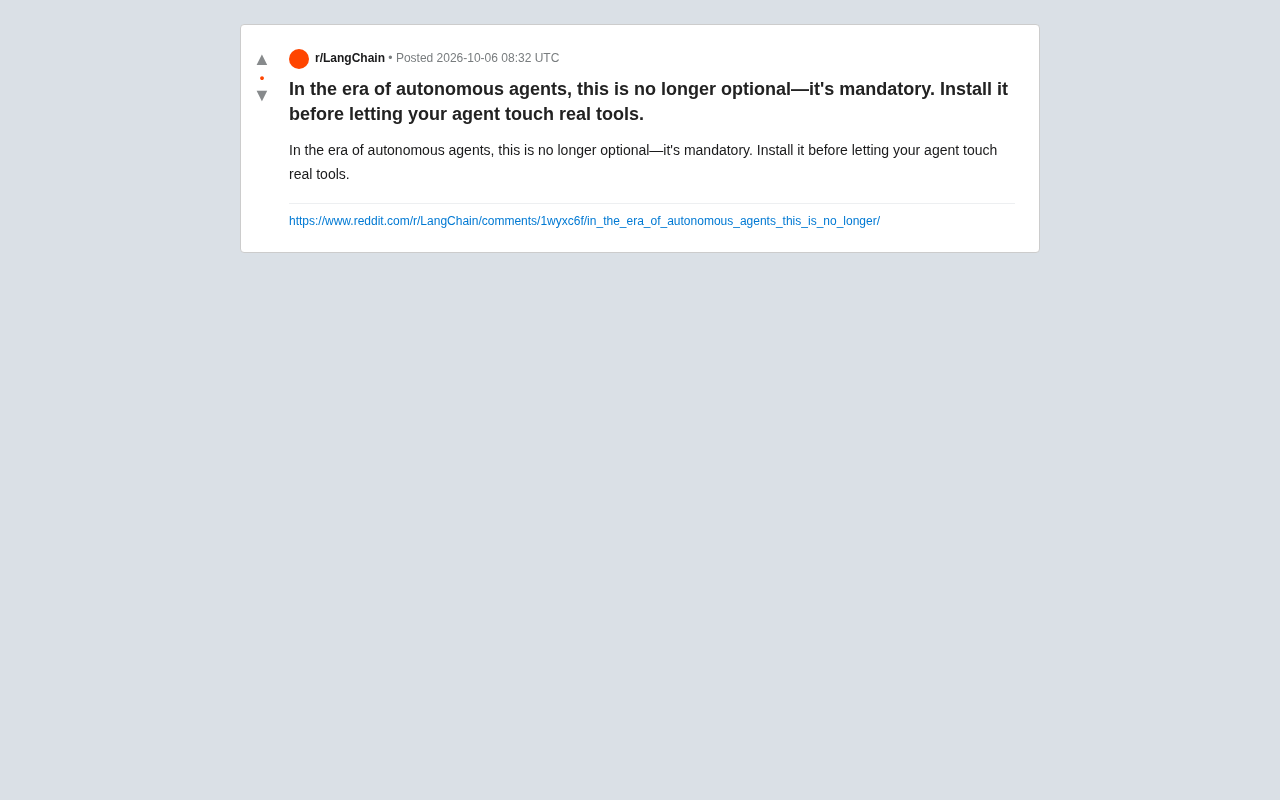
A Reddit post made a point worth taking seriously: in the age of autonomous agents, deploying safety guardrails for your AI agent is no longer optional — it's mandatory. And crucially, you need to have those guardrails in place before you let your agent touch any real-world tools.
Those few words cut to the heart of something widely overlooked in the current AI Agent boom: the moment you give AI the ability to take real actions, the nature of the risk changes fundamentally.

From "Talking" to "Doing": A Fundamental Shift
The large language models we've discussed in the past were mostly confined to generating information. If a model said something wrong, the worst outcome was an inaccurate piece of text. Autonomous agents are a different story. They're equipped with tool use capabilities — sending emails, executing code, querying databases, calling APIs, even managing cloud infrastructure.
This means an AI's "output" is no longer just words. It's actions that have real consequences in the real world. When an agent operates real tools without constraints, mistakes become irreversible: accidentally deleted data, misdirected messages, unintended transactions — all potentially catastrophic and unrecoverable.
The emphasis on "mandatory" in the original post is a direct response to this escalation in risk. When both decision-making and execution authority are delegated to AI, safety mechanisms shift from a nice-to-have to an absolute baseline requirement.
Why Safety Guardrails Are Now a Hard Requirement
The risks introduced by autonomous agents cluster around several key dimensions:
Blurry Permission Boundaries
Agents often require elevated system privileges to complete complex tasks, but over-permissioning amplifies the blast radius of any single mistake. Without clear permission isolation, you've essentially handed the keys to your entire system to a model that can still hallucinate.
Unpredictable Behavior Chains
An autonomous agent's actions are a combination of multi-step reasoning and execution. Any deviation at any single step can be amplified by subsequent steps. Humans can't realistically intervene at every decision point in real time — which is exactly why automated validation and interception at the tool-call layer is essential.
Prompt Injection and Adversarial Attacks
When agents interact with external data, web pages, or third-party content, maliciously crafted inputs can hijack their behavior — this is known as prompt injection. An agent without a protective layer is essentially exposed directly to an untrusted environment.
Prompt injection is one of the most prevalent attack vectors facing AI agents today. The mechanism works like this: an attacker embeds carefully crafted instructions inside external content that the agent will read — such as a webpage, a document attachment, an email body, or a database record. When the agent processes this content, the malicious instructions are executed as if they were legitimate user input, redirecting the agent's behavior toward the attacker's goals. Direct injection involves the attacker manipulating the prompt fed directly to the model. Indirect injection is more insidious: it operates through external data that the agent proactively fetches, making it more dangerous because the attacker never needs to interact with the user directly. Since 2023, researchers have demonstrated real-world attacks across several major AI Agent products — hijacking browser-based agents via malicious webpages, exfiltrating private data, and triggering unauthorized actions. This is precisely why prompt injection defense has become the top priority in agent security.
The Engineering Logic of "Secure First, Then Release"
The core operational principle conveyed in the original post is clear: complete your safety deployment before letting an agent anywhere near real tools. The order itself is a form of engineering discipline.
Common approaches to protective design include: whitelisting tool calls so agents can only access pre-approved operations; introducing human-in-the-loop (HITL) checkpoints that require human approval before high-risk actions are executed; establishing sandbox environments where agents can validate their behavior in isolation before acting in production; and implementing comprehensive logging and observability so every tool call is traceable and auditable.
The shared goal of these measures is to keep the agent's "autonomy" within a controllable safety boundary — preserving the efficiency benefits while preventing runaway behavior.
Human-in-the-Loop (HITL) plays the role of "last line of defense" in agent safety architecture. The core idea isn't to require human oversight of every single step — it's to set mandatory approval checkpoints specifically for high-impact, irreversible actions such as deleting production data, sending notifications to external systems, or initiating financial transfers. This selective intervention approach balances efficiency and safety: low-risk information queries can be fully automated, while high-risk actions trigger a human review process. Common engineering implementations include asynchronous approval queues (the agent pauses and waits for human approval before continuing), operation preview interfaces (showing a diff of the action about to be taken for human review), and emergency interrupt mechanisms (allowing operators to terminate a running agent task in real time). As agent capabilities grow, dynamically assessing action risk levels and triggering HITL precisely without creating workflow bottlenecks has become an important design challenge for agent frameworks.
A Reminder for Developers
For teams building or integrating AI agents, this brief observation deserves serious attention. While pursuing the upper bounds of agent capability, safety guardrails should be treated as a prerequisite for architectural design — not an afterthought patched on later.
The more an agent can do, the greater the potential damage it can cause. Before handing it the keys to real-world tools, ask yourself one question: if it makes a mistake, do I have a mechanism to stop it?
It's worth noting that because the original source material was a single high-level observation, this article has expanded on its core argument with broader industry context. The specific protective tools and implementation details will still require further research tailored to your own use case.
Related articles

AI Digital Twin in Action: Using DOT to Automatically Track Bugs and User Feedback
DOTS engineers demonstrate how AI digital twin DOT collects cross-platform user feedback, categorizes issue themes, opens threads to investigate bug root causes, and submits PRs—showcasing a complete AI agent workflow for defect triage with auditable design.

Why Transistors Are No Longer Flat: The Evolution from Planar to Gate-All-Around
Transistor evolution from planar to FinFET to gate-all-around: why gates went from three-sided to four-sided wrapping to suppress short-channel effects and leakage current, extending Moore's Law.

Swarm Intelligence = a Single RL Agent? A Proof of Multi-Armed Bandit Equivalence
A paper proves that collective decision-making through local imitation in swarms is mathematically equivalent to single-agent reinforcement learning: N blind imitators act as N parallel environment samples, with an effective learning rate of 1/N. This article explains the derivation and implications of the Maynard-Cross Learning algorithm.