The AI Agent 95% Success Rate Trap: Why a Single Wrong Booking Should Block Your Release

Why a single silent failure in AI Agent evaluation matters more than a 95% average success rate.
A 95% average success rate can hide AI Agents' most dangerous failures—silent errors where wrong actions execute without any visible signs of malfunction. This article explains why teams should shift from average-score thinking to tail-risk thinking, and shares pragmatic evaluation methods including deterministic tool call payload verification, repeated ambiguity testing, pre-execution confirmation gates, and cross-version regression testing.
A Seemingly Good Success Rate Hides Danger
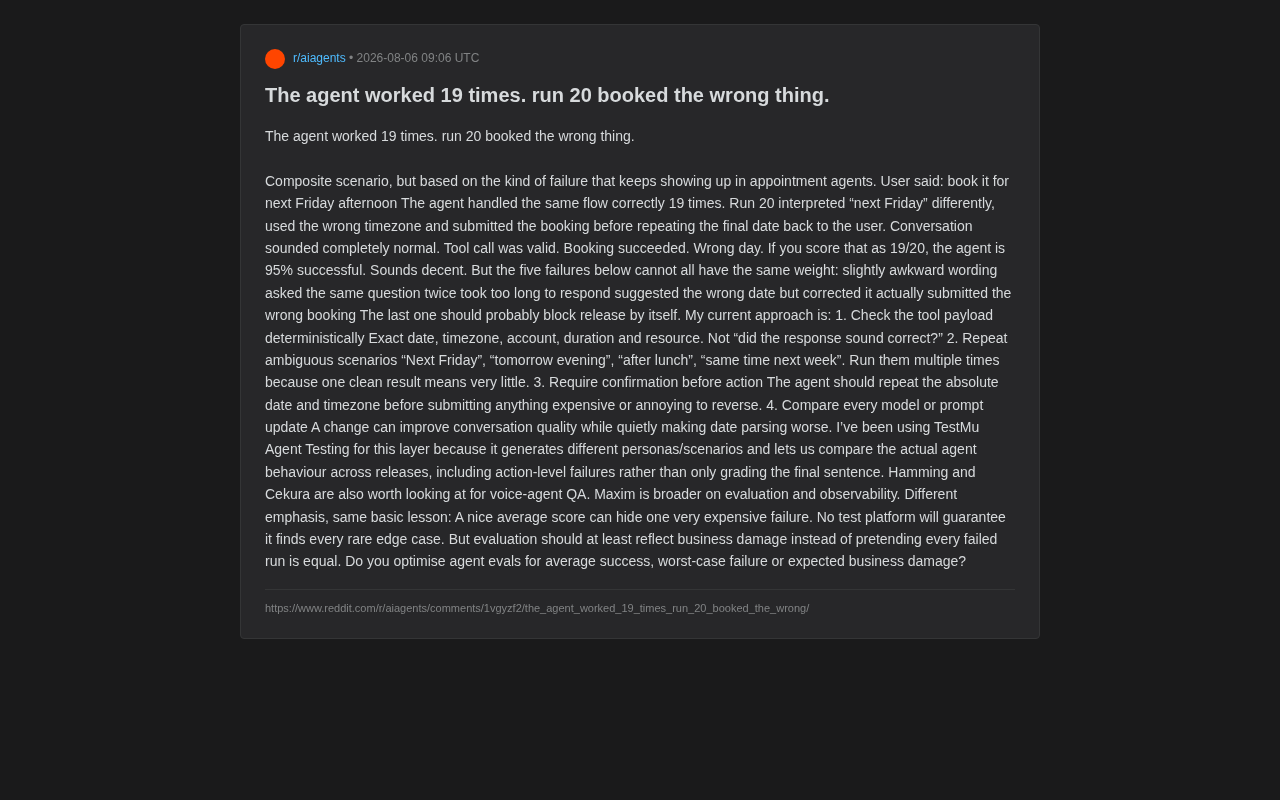
Imagine this scenario: you've deployed an AI Agent responsible for scheduling appointments. A user says "book me for next Friday afternoon," and the Agent handles this flow perfectly across the first 19 interactions. On the 20th attempt, it misinterprets "next Friday," uses the wrong timezone, and submits the booking before confirming the final date with the user.
The entire conversation sounds completely normal. The tool call parameters are valid. The booking succeeds—just on the wrong date.
If you score this as 19/20, the Agent has a 95% success rate. Sounds pretty good. But as this Reddit post that sparked discussion points out, this "average success rate" evaluation approach is precisely what hides an AI Agent's most dangerous failure modes.
Why Not All Failures Should Be Treated Equally
The author lists five typical failure scenarios with vastly different severity levels:
- Slightly awkward phrasing
- Asked the same question twice
- Response took too long
- Suggested the wrong date but self-corrected
- Actually submitted a wrong booking
The first four failures are mostly "experience blemishes"—users might find them slightly annoying, but they cause no real harm. The last one—actually submitting a wrong booking—should by itself be enough to block a release.
The core insight here is: treating every failure as an equally-weighted "point deduction" is a serious evaluation mistake. A 95% average score can mask the most expensive, most irreversible failure within that 5%. For Agents dealing with financial transactions, scheduling, or resource allocation, a single "successfully submitted but incorrect" operation causes far more business damage than ten instances of "conversation wasn't smooth enough."
This evaluation pitfall has well-known parallels in risk management. In finance, no one uses "average return" to judge whether a strategy is safe—instead, they focus on tail risk: events with low probability but catastrophic losses. Similarly, AI Agent evaluation needs to shift from "average performance" thinking to "tail risk" thinking, especially when the Agent can execute irreversible operations.
Silent Failure: The Most Dangerous Category
What's particularly alarming is that the entire wrong booking process "sounds completely normal." The conversation is fluent, the tone is natural, the tool call is valid, and the operation executes successfully. If your evaluation system only checks "does this final response sound right," these silent failures will completely evade detection.
Silent Failure is a classic problem in distributed systems and automation. In traditional software engineering, silent failure means the system throws no exceptions, logs no errors, but actually produces incorrect results. In the AI Agent context, this problem is amplified—because LLM outputs inherently possess a "looks reasonable" quality (known as fluency bias). Even when the reasoning chain goes wrong, the generated natural language remains grammatically correct and naturally toned. This renders traditional monitoring approaches based on output format or exception catching completely ineffective. The Observability field has recently expanded from infrastructure monitoring to AI systems, emphasizing a core principle: you can't just monitor whether a system "threw an error"—you need to monitor whether "behavior matches expected semantics."
This is precisely the blind spot in many current Agent evaluations: we're too easily deceived by surface-level language quality while ignoring actual correctness at the action level.
A More Pragmatic Agent Evaluation Approach
To address these issues, the original post's author shared their current evaluation framework—a methodology valuable for any team building production-grade Agents.
1. Deterministically Verify Tool Call Payloads
Don't judge whether "the response sounds right." Instead, precisely verify the actual parameters of tool calls: exact dates, timezones, accounts, durations, and resources. This is a deterministically verifiable checkpoint that targets real business outcomes rather than linguistic appearances.
In modern AI Agent architectures (such as OpenAI's Function Calling or Anthropic's Tool Use), Agents invoke external tools or APIs through structured JSON payloads. These payloads contain specific parameters like date strings, timezone identifiers (e.g., "America/New_York"), resource IDs, etc. Deterministic Verification means using precise assertions to validate these parameter values rather than relying on another LLM to "judge whether the result seems reasonable." This aligns with the unit testing philosophy in traditional software testing: for checkpoints with clearly correct answers, probabilistic judgment should not be introduced. The advantage of this approach is zero false positive rate—parameters are either correct or incorrect, with no gray area.
2. Repeatedly Test Ambiguous Scenarios
"Next Friday," "tomorrow night," "after lunch," "same time next week"—these natural language expressions are inherently ambiguous. The author emphasizes that such scenarios must be run multiple times, because a single clean result tells you virtually nothing. Only through repeated runs can you expose the model's instability in understanding temporal semantics.
Temporal expressions in natural language are a well-recognized challenge in NLP. The meaning of "next Friday" depends on what day it currently is, the user's cultural context (in some cultures "next week" refers to the week after next), and when the conversation occurs. Academia categorizes this under Temporal Expression Normalization research, with representative tools like SUTime and HeidelTime having done extensive work on rule-based parsing. However, LLMs don't rely on these rule engines when processing temporal expressions—instead, they infer based on statistical patterns in training data, leading to unpredictable behavior in edge cases. What's trickier is that the same model may parse identical temporal expressions inconsistently across different prompts, different context lengths, or even different temperature parameters—which is precisely why a single passing test is meaningless.
3. Require Confirmation Before Executing Actions
For any expensive or hard-to-reverse operation, the Agent should restate the absolute date and timezone before submission. This step seems simple, yet it intercepts the vast majority of "silent errors." It pulls users back into the decision loop, trading one confirmation for one potentially catastrophic mistake.
This design principle is known as "human-in-the-loop" in Human-Computer Interaction (HCI) and safety-critical system design. In aviation, healthcare, and nuclear industries, confirmation steps before critical operations are standard practice. For AI Agents, the confirmation step isn't just a safety net—it's an "explainability window." It forces the Agent to externalize its internal temporal reasoning into a user-verifiable format (e.g., "Confirmed: Friday, January 24, 2025, 3:00 PM Pacific Time"), giving users the opportunity to catch errors before they cause consequences.
4. Run Comparisons With Every Model or Prompt Update
This is the most easily overlooked point: an update might improve conversation quality while quietly making date parsing worse. Without a cross-version behavior comparison mechanism, this kind of regression will be introduced into production without anyone noticing.
Regression Testing is standard practice in software engineering for ensuring new versions don't reintroduce previously fixed issues. In the AI Agent domain, this concept becomes particularly complex because model updates (whether underlying LLM version upgrades or prompt fine-tuning) may improve performance on certain dimensions while causing degradation on others. This phenomenon is known as "capability trade-off" in machine learning. Traditional software regression testing relies on deterministic input-output pairs, but Agent behavior is stochastic, requiring statistically meaningful comparisons—running old and new versions multiple times on the same test set and comparing behavioral distributions rather than single-run results. In practice, this typically requires building a benchmark suite containing hundreds of test cases with statistical significance thresholds to determine whether degradation exists.
The Evaluation Tool Ecosystem
The author mentions using TestMu Agent Testing to handle this evaluation layer, as it can generate different user personas and scenarios while supporting cross-version comparison of Agent behavior at the action level—not just scoring the final response.
Several other noteworthy tools were also mentioned:
- Hamming and Cekura: suitable for voice Agent QA
- Maxim: broader coverage in evaluation and observability
These tools have different focuses but convey the same fundamental lesson: a beautiful average score can mask an extremely expensive failure.
No testing platform can guarantee finding every rare edge case. But your evaluation system should at least reflect real business harm rather than pretending every failure is equivalent.
The AI Agent evaluation tool ecosystem is evolving rapidly but remains in early stages. Unlike traditional software testing toolchains (JUnit, Selenium, Cypress) that have matured over decades, Agent testing tools face unique challenges: non-determinism in test cases (the same input may produce different but equally correct outputs), state explosion in multi-turn conversations, and how to ensure critical behavior correctness without over-constraining Agent creativity. The industry hasn't yet converged on unified standards, but the trend is moving from "score-based evaluation" (giving the Agent a score) toward "behavioral contract evaluation" (defining behavioral boundaries the Agent must respect and must never violate).
The Core Debate: What Should Your Evaluation Optimize For?
The post concludes with a question worth deep consideration by every Agent developer:
Are you optimizing your Agent evaluation for average success rate, worst-case failure, or expected business harm?
These three orientations lead to fundamentally different engineering decisions. Optimizing for average success rate drives you toward improvements that raise the overall score. Optimizing for worst-case scenarios directs resources toward preventing catastrophic failures. Optimizing for expected business harm requires assigning different weights to each failure category, focusing engineering effort where real losses occur.
The concept of Expected Business Harm borrows from the classic "Expected Loss" framework in risk management—multiplying each failure mode's probability of occurrence by its actual monetary damage. This approach has decades of mature application in financial risk management (VaR models, CVaR Conditional Value at Risk) and safety engineering (FMEA—Failure Mode and Effects Analysis). Applying it to AI Agent evaluation means: a single wrong booking causing $1,000 in customer loss, even at only 1% probability, carries a risk weight (expected loss = $10/call) far exceeding a phrasing issue that occurs 20% of the time but causes only minor inconvenience (damage value ~$0.50, expected loss = $0.10/call). This weighted evaluation method requires teams to first classify all possible failure modes, work with business stakeholders to determine a "damage coefficient" for each category, and ultimately form a risk matrix that genuinely guides engineering priorities.
For AI Agents heading to production, the answer should probably lean toward the latter two. When an Agent can truly "take action"—placing orders, booking appointments, transferring funds, sending messages—its evaluation criteria must evolve from "how well does it answer" to "how costly is a wrong action." A 95% success rate sounds great, but what's hiding in that remaining 5% is what determines success or failure.
Key Takeaways
Related articles

Can AI Really Find Vulnerabilities While You Sleep and Earn Easy Money? The Truth About SRC Bug Bounties
Deep analysis of the viral "AI autopilot bug hunting for five-figure income" narrative, examining how SRC platforms actually work, AI's real role in vulnerability discovery, and the traffic schemes behind "packaged Skills."

Getting Started with AI/Machine Learning: How to Choose Between Bundles and Classic Textbooks
Should Python developers buy Humble Bundle's AI/ML pack or O'Reilly's classic textbook? We analyze resource type, learning path, and cost-effectiveness to help you decide.

Calibra: A Detailed Guide to the Open-Source Quality Inspection Tool for Robot Learning Datasets
Calibra is an open-source quality inspection tool for robot learning datasets that detects duplicate demonstrations, frozen frames, motion jitter, calibration drift, and more.