#production AI agents
1828 related articles

·3 min
GitHub Daily · August 5: AI Agents Enter the 'Production Engineering' Era
GitHub Trending Aug 5: AI Agents shift from demos to production with new projects for state management, long-term memory, skill systems, and security.
Read more →

·3 min
MCP Session Analytics: Building Production-Grade Observability and Evaluation for AI Agents
How to build product analytics and evaluation capabilities for AI Agents at the MCP protocol layer, covering session-level tracing, tool call observability, and quality Evals.
Read more →

·3 min
Orca-Bench: Evaluating Whether AI Agents Can Handle Production Oncall Duties
Orca-Bench is a benchmark for evaluating AI agents' operational capabilities, testing LLMs on fault diagnosis, multi-tool orchestration, and risk decisions in simulated Oncall scenarios.
Read more →
·4 min
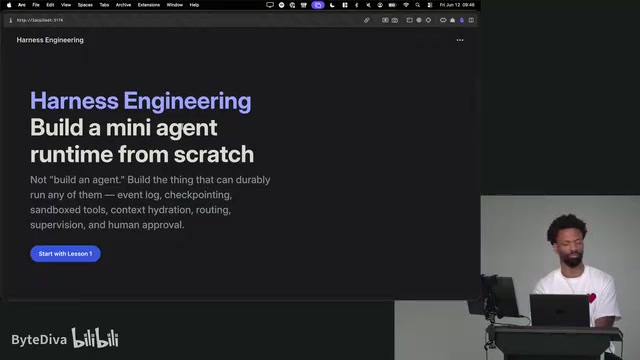
Harness Engineering: The Core Infrastructure for Taking AI Agents from Demo to Production
Deep dive into Harness Engineering: why AI Agents need memory management, durable execution, guardrails & approvals to go from demo to production.
Read more →

·4 min
Harness Engineering: The Core Infrastructure for Taking AI Agents from Demo to Production
Deep dive into Harness Engineering: why AI Agents need memory management, durable execution, guardrails & approvals to reach production. Based on Scott Moss's workshop.
Read more →

·2 min
Dependency Drift in Production AI Agents: Detection, Response, and Building Resilient Systems
AI Agents in production face systemic dependency drift risks — model updates silently change outputs and silent failures are hard to detect. Learn detection strategies, hidden costs, and engineering practices.
Read more →
Production-Grade LangGraph Template: A…
·2 min
Production-Grade LangGraph Template: A Practical Guide to Engineering AI Agents for Production
A deep dive into production-grade LangGraph templates covering state management, observability, error handling, and containerized deployment to bridge the gap from demo to production.
Read more →

·3 min
Core Iron Rules for Deploying AI Agents in Production
What are the critical runtime rules for AI Agents in production? This deep dive covers independent verification for state changes, least privilege, observability, and more.
Read more →

·3 min
How to Evaluate AI Agents in Production: Four Online Evaluation Methods Explained
Offline tests passing doesn't mean production reliability. This guide breaks down Online Evals for AI Agents: rule checks, LLM-as-a-Judge, user feedback, and human review.
Read more →

·2 min
Agent Skills: Bringing Production-Grade Engineering Capabilities to AI Coding Agents
Google engineer Addy Osmani's open-source project agent-skills (76k+ GitHub stars) injects production-grade engineering skills into AI coding agents, covering performance, security, and code quality.
Read more →

·5 min
5 Things You Must Do Before Deploying AI Agents to Production (With a Banking POC Case Study)
Over 60% of AI Agent projects die between demo and production. This article breaks down Databricks lead Sandy's five-pillar methodology and a bank POC case study to help you avoid the most common deployment pitfalls.
Read more →

·7 min
The Five Pillars of Production-Grade AI Agents: A Battle-Tested Guide from Demo to Deployment
Databricks tech lead Sandy shares a five-pillar framework for production-grade AI Agents—evaluation, observability, data foundation, orchestration, and governance—with a £85K retail banking failure case to bridge the demo-to-production gap.
Read more →

·6 min
Deploying Enterprise AI Agents to Production: The Five Pillars from Demo to Launch
A Databricks expert breaks down the complete methodology for taking AI Agents from demo to production, covering the five pillars of evaluation, observability, data foundation, multi-Agent orchestration, and AI governance, with a real eight-week banking chatbot POC case.
Read more →

·5 min
NVIDIA AI-Q Blueprint × OCI: A Practical Guide to Production Deployment of Enterprise AI Agents
Deep dive into NVIDIA AI-Q Blueprint production deployment on Oracle Cloud Infrastructure, covering NIM microservices, RAG architecture, multi-agent orchestration, and OCI GPU selection.
Read more →

·5 min
NVIDIA AI-Q Blueprint × OCI: A Practical Guide to Production Deployment of Enterprise AI Agents
Deep dive into NVIDIA AI-Q Blueprint production deployment on Oracle Cloud Infrastructure, covering NIM microservices, RAG architecture, multi-agent orchestration, and OCI GPU selection for enterprise AI agents.
Read more →

·4 min
7-Step Framework for Deploying Commercial AI Agents: From Requirements to Production
A detailed 7-step guide to building commercial AI Agents, covering requirements, platform selection (Coze/Dify/FastGPT), prompt engineering, databases, UI, testing, and deployment.
Read more →

·3 min
Getting Started with AI Agents: A Complete Learning Path from Zero to Production
A comprehensive guide to AI Agent architecture covering ReAct paradigm, multi-agent collaboration, RAG integration, and the planning-memory-tools framework, with a complete learning path from concepts to production deployment.
Read more →

·3 min
Nexent Open-Source Platform: Zero-Code Auto-Generation of Production-Grade AI Agents
Deep dive into Nexent's open-source platform for zero-code production-grade AI Agent generation, covering Harness Engineering, built-in controls, use cases, and comparisons with AutoGen and CrewAI.
Read more →
 Tutorials
·3 min
Learn AI Agents in 30 Days: A Four-Stage Learning Roadmap from Zero to Production
A systematic breakdown of the AI Agent learning roadmap covering core architecture, ReAct/CoT paradigms, multi-agent collaboration, and Prompt optimization across four stages with quality resource recommendations.
Read more →
 Tutorials
·3 min
AI Agent Practical Development: A Complete Guide from Concept to Building Production-Grade Intelligent Agents
A deep dive into AI Agent core principles and practical development paths, covering perception-decision-execution capabilities, MCP protocol tool integration, and analysis of Manus and AutoGLM.
Read more →