The AI Agent Memory Dilemma: Moving from Manual Management to Automatic Injection

What AI Agents lack isn't storage but usable memory in the moment; a three-layer automatic injection architecture may replace manual maintenance.
The article argues that AI Agents are the only tool on your machine that "remembers nothing," forcing users into human memory duty: manually maintaining CLAUDE.md, pasting project conventions, re-explaining past decisions. The author analyzes the shared failure of three existing approaches—markdown files are frozen snapshots, memory tools requiring active invocation depend on the Agent remembering to use them, and search hooks push fragments rather than structured briefings; all three deliver nothing at the critical moment the prompt arrives. Effective working memory must pass three tests: a briefing at session start, relevant records accompanying every prompt, and traceable decisions with reasons and rejected options. The solution uses a three-layer structure of "organized records + decision graph + full history" for automatic injection, with project isolation and rules that don't rot, at the cost of token consumption.
You're Doing "Human Memory" for Your Agent Every Day
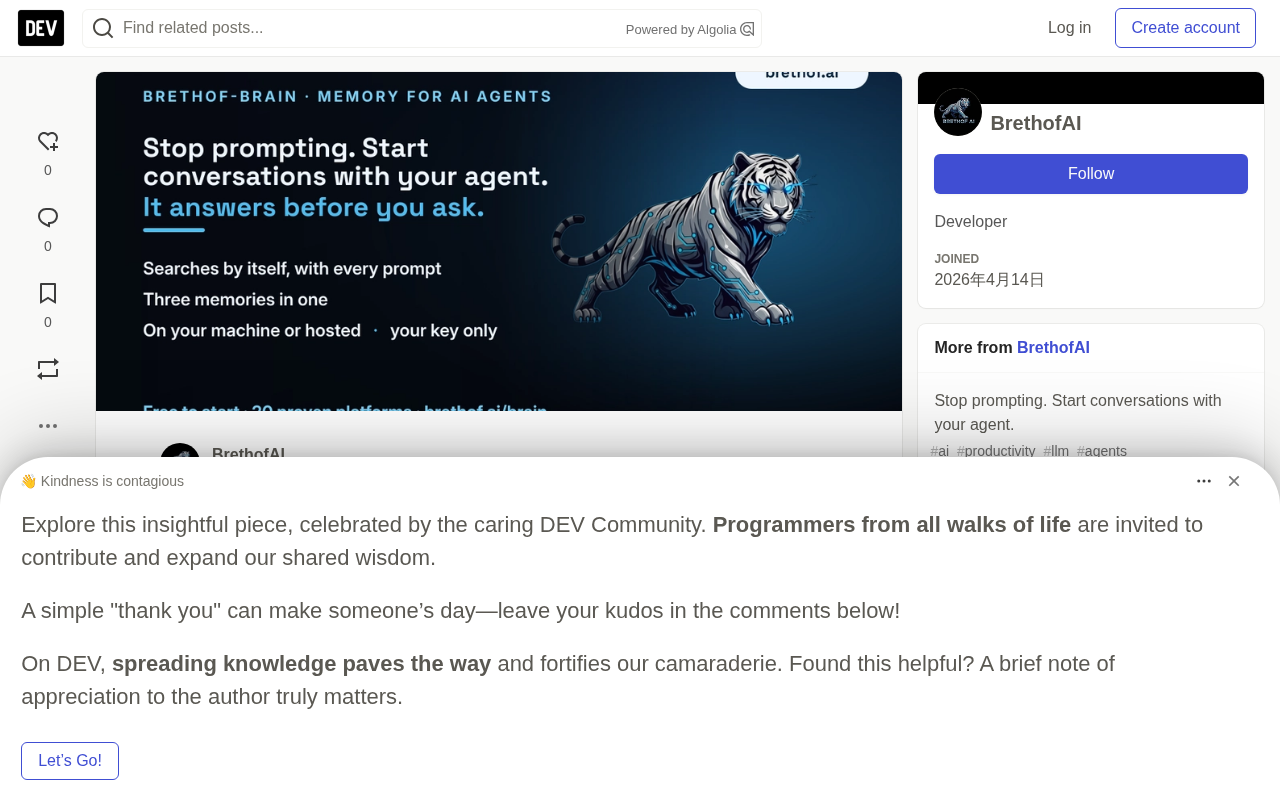
Every time you open a new session with an AI Agent, the first thing you do is almost always the same: paste in your tech stack details, project conventions, that decision from last Tuesday about the auth flow, and the approach you tried in March that didn't work. Maybe you have a CLAUDE.md file that you update manually like maintaining a Wikipedia page; maybe you keep five markdown note files that are essentially manual memory functions you perform on behalf of software.
If you use an Agent every day, this has become muscle memory—"saving context" before closing, editing rule files no one claims ownership of, gambling with "as I discussed earlier." The irony is that the smartest tool on your machine is the only one that remembers nothing. Your editor remembers your settings, your terminal remembers your command history, but the Agent—the tool that most needs to be "briefed"—starts from zero every morning.
We tried the existing solutions on the market, found they all failed the same test, and decided to build one that passes.
Why Three "Should-Have-Worked" Solutions Fail
Judging any memory tool takes just one question: When the next prompt arrives, what does the Agent actually know? Not what's stored, not what can be found, but what is in front of the model right now.
Markdown file approach (CLAUDE.md and its ilk). They load once at the start of a session, then freeze. What you wrote on Tuesday, the Agent acts on all week. No one maintains the file, because maintenance itself is the manual chore you're trying to escape. Within a month, it becomes a junk drawer: three conflicting instructions, a tech stack list from two projects ago, a self-note that no longer holds. This is a snapshot, not memory.
Memory tools the Agent must actively invoke. The storage is fine, but they wait to be asked: unless the Agent decides mid-answer to search and remembers to do it, nothing arrives before it answers. The handoff at session's end depends on the next session remembering to ask. A library you have to remember to use isn't memory.
Search hooks. The better versions do push some matching raw text snippets with each prompt. This is real injection, but still not enough—snippets are retrieval, not briefing. They find fragments, but they don't carry your standing rules, don't correct fragments with what was later decided, and don't come with reasons. The Agent gets search results, not a statement of what's true.
All three fail the same way: knowledge exists somewhere, but at the moment the prompt happens—the only moment that matters—nothing arrives.
Three Tests Working Memory Must Pass
Working memory that actually works must answer at three moments:
- Session start. A briefing before you speak: where you left off, which rules are currently in effect, what the planned next step is.
- Every prompt. Records relevant to the current prompt arrive alongside it—not all memory dumped into the context window every turn.
- "Why is it this way?" The decision itself, the date, the reason, and the option it beat—in the original words from that conversation.
That's the spec. Everything else is an implementation detail.
RAG (Retrieval-Augmented Generation) is the common paradigm behind "search hook" type solutions: split historical content into snippets, build a vector or keyword index, retrieve the most relevant snippets at question time, splice them into the prompt, then hand it to the model to generate. Its strength is handling massive knowledge and pulling it on demand, but its limitations are clear—retrieval targets "similar," not "currently true." It doesn't distinguish between old decisions that have been overturned and new ones still in effect, doesn't carry priority between rules, and won't proactively explain the context of a record. The critique of search hooks giving fragments instead of briefings is aimed precisely at this paradigm: retrieval solves "finding," while working memory must solve "what to believe right now."
A Day After Replacing "Memory" with a "Brain"
According to the developers of this solution, their own company has been running on their memory system since December 2025, archiving every conversation since April. This isn't a demo script; this is a real Tuesday.
Morning. Open the machine, start a session, say "continue." The briefing is already in place—the handoff notes from the last session, project rules, planned next steps, an index of the project's runbooks. No re-explaining, no "quick recap of the repo." The session starts executing directly from the top of the plan.
Noon. Every prompt arrives pre-briefed. Not everything—just the records relevant to that prompt, nothing else. When I ask about the rate limiter, the conversation memory about the rate limiter arrives with the question. The developer says they haven't maintained markdown files since March and don't miss them; there's no "save context" ritual, because there's nothing to save—the organizing happens during the conversation itself.
Afternoon. Two Agents work on the same project: one frontend, one backend, each with its own keys, working from the same memory. No need to tell either Agent what the other decided—once the frontend conversation is organized, the backend Agent's next prompt touching that content carries what's been settled. Later, when the frontend Agent checks memory before suggesting an approach for the settings page, the answer is already there: that option was rejected in March, here's the date, here's the reason, using the original words from that conversation. No re-litigating dead options, because no one forgot it was dead.
All of this happens by "just saying it." No need to archive anything, no need to call save tools, no need to run sync. The Agent manages memory itself, because memory appears in its context before it needs to be managed.
One honest trade-off: injection consumes context. Briefings and per-prompt records take up tokens—that's the nature of injection. What you get back is tool calls, conversation turns, and search time. According to the developer, over several months this trade-off has clearly favored them.
The Underlying Mechanism: A Three-Layer Structure
- Organized records are the current truth. Memory reads your conversation in five-turn windows, keeping what's "settled" in the dialogue—correcting old facts with new ones, silently retiring records describing things you've replaced.
- Decision graph is the process of arriving at the current state. Each decision is a line: with a date, the reason stated at the time, and the option it beat. Reversals are new lines—history is never rewritten, so "why is it this way" always has an answer.
- Full history preserves everything, searchable by keyword or semantics. Records are what's true, the graph is what happened, and the archive is the foundation for both.
Two details that matter in practice:
Projects are isolated from each other. Each project has its own records, rules, graph, and plan; unless you actively initiate a cross-project search, they don't bleed into each other. In the hosted version, scope keys let you precisely limit teammates', clients', or contractors' access to just the projects you specify—read-write, read-only, or invisible—and nothing else.
Rules don't rot into a junk drawer. Each rule has a cap, the rule pool has a cap, warnings appear at 80%, and saves that would exceed the limit are rejected with a fix provided. What you write is never silently trimmed or dropped.
On privacy, the developer emphasizes: your memory lives on your machine (a local container, nowhere else) or in an encrypted cloud. Their hub processes some content to generate memories and write briefings, but retains none of those snippets.
Context Window is the total token limit a large language model can "see" in a single inference, including system prompt, conversation history, injected memory, and current input. It defines the entire information boundary for every Agent response; once exceeded, the earliest content gets truncated or dropped. This is precisely why "injected memory" must be carefully budgeted: every briefing, every relevant record takes up real window space, squeezing what's left for code, documents, and user input.
Token is the smallest unit of text a model processes, roughly equivalent to word fragments in English or a few characters in Chinese. Both API billing and context length are measured in tokens. So the trade-off of "spending tokens to buy time" can be quantified: can the token cost of injected memory be offset by fewer tool-call turns, less re-explaining, and faster convergence on solutions? For projects with already-tight context windows—say, scenarios requiring large amounts of source code at once—this trade-off may reverse.
Multi-Source Perspectives and Use Cases
This solution comes from the Brethof team and is essentially a persistent memory layer for AI Agents. It supports mainstream Agent runtimes like Claude Code, Codex, OpenClawAd, and Hermes, installed via a one-line instruction that lets the Agent pull the client itself and configure hooks.
For developers using AI coding assistants daily, the value of this "automatic injection" memory lies in eliminating the re-briefing step. It's especially suited to multi-Agent collaboration projects—frontend and backend Agents can share the same decision memory, avoiding conflicts from information asymmetry.
Keep in mind, though, that injected memory is fundamentally trading tokens for time. If your context window is already tight, or project decisions change frequently, you need to evaluate the net benefit. For lightweight, one-off scenarios, traditional markdown files may already be sufficient.
This solution offers a free entry tier, with both local and hosted deployment modes. Local mode authorizes via on-device verification code, and the Agent never touches the key; hosted mode requires manually pasting the key and passphrase.
Agent Runtime / Harness refers to the outer framework hosting an AI Agent, responsible for managing the conversation loop, providing tool-call interfaces, injecting system prompts and hooks. The Claude Code, Codex, OpenClaw, and Hermes mentioned here all belong to this category. Different runtimes have different hook mechanisms and configuration methods, which is why memory solutions need to integrate one by one—it must insert itself into each environment's "prompt assembly" step to automatically inject briefings at session start and on every prompt, rather than relying on the Agent to actively invoke it.
Local Container and Encrypted Cloud are the two privacy boundaries this solution offers. In local mode, memory is stored in an isolated container on your device, and keys don't pass through the Agent—suited to scenarios sensitive to data egress; in hosted mode, memory is encrypted and stored in the cloud, with the provider's hub processing some content to generate summaries and briefings, but claiming not to retain original snippets. Which mode to choose depends on the team's trade-offs around compliance, collaboration convenience, and operational cost.
One-line Summary
What AI Agents lack isn't storage but usable memory in the moment; a three-layer automatic injection architecture may replace manual maintenance.
Paragraph Summary
The article points out that AI Agents are the only tool on your machine that "remembers nothing," forcing users into human memory duty every day: manually maintaining CLAUDE.md, pasting project conventions, re-explaining past decisions. The author analyzes the common failure of three existing approaches—markdown files are frozen snapshots, memory tools requiring active invocation depend on the Agent remembering to use them, and search hooks push fragments rather than structured briefings; all three deliver nothing at the critical moment the prompt arrives. Effective working memory must pass three tests: a briefing at session start, relevant records accompanying every prompt, and decision traceability to reasons and rejected options. The solution achieves automatic injection via a three-layer structure of "organized records + decision graph + full history," with project isolation and rules that don't rot, at the cost of token consumption.
Related articles

JobRunner MCP Server: AI Agents Can Now Fix Failed Java Jobs
JobRunner launches an open-source MCP server enabling AI agents to view cluster status, diagnose failures, and recover Java jobs—incident response from any cloud coding environment or existing agent.

MLAI Digital Launches 9 Security Agents: MCP Server Safeguards the Full Lifecycle of Agentic AI
MLAI Digital launches Security MCP Server with nine built-in specialized security agents covering vulnerability discovery, attack simulation, prompt injection detection, API and infrastructure assessment, and accelerated remediation—embedding security validation across the full Agentic AI lifecycle from development to production.

Running Isaac Lab on H100 GPUs: Exploring Better Approaches
Exploring optimization methods for running Isaac Lab on NVIDIA H100 GPUs, including MIG configuration, mixed precision, TensorRT acceleration, and community experience to improve robotics simulation and reinforcement learning efficiency.