The AI Agent Production Conflict Problem: Why Does the Same Order Get Refunded Repeatedly?

Multiple Agents' individually compliant decisions can compound into systemic errors, making transaction consistency a bottleneck for AI Agents.
Starting from a Reddit discussion, the article examines production challenges when multiple AI Agents process the same transaction in parallel: refunds, exchanges, and credit issuance each pass authorization checks but combined cause repeated order processing. LLM Agents decide autonomously on local information without global transaction state awareness. Workflow engines, state machines, and idempotency mechanisms only solve isolated problems; transaction coordinators, event sourcing, and pessimistic locking are proposed but distributed bottlenecks and Agent uncertainty remain.
When multiple AI Agents process the same order simultaneously, each Agent's decision may look compliant on its own, but together they can cause disastrous consequences—a single order gets refunded, exchanged, and awarded store credit all at once. This production-environment challenge, common across e-commerce, marketplaces, and fintech, is becoming a key bottleneck for AI Agent deployment.
The Nature of the Problem: How Individually Compliant Decisions Combine into Systemic Errors
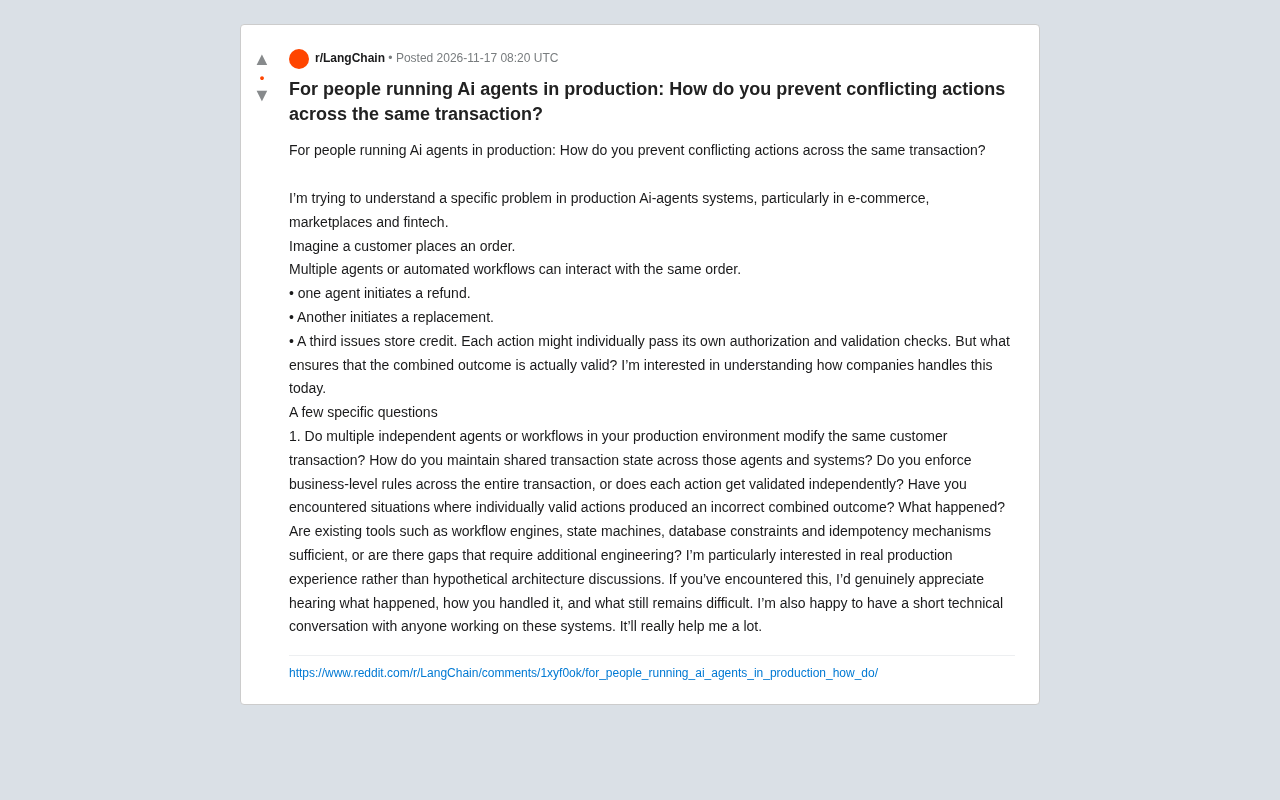
A scenario raised by a developer on Reddit is highly representative: after a customer places an order, multiple Agents or automated workflows may intervene in the transaction simultaneously. One Agent initiates a refund, another initiates an exchange, and a third issues store credit. Each action passes its own authorization and validation flow, but who determines whether the combined result of these actions is reasonable?
The root cause lies in the decision-making model of AI Agents. Unlike traditional software workflows, LLM-driven Agents are autonomous and non-deterministic—each makes optimal judgments based on local information but lacks a unified understanding of the global transaction state. When multiple Agents work in parallel, transaction integrity and consistency face severe challenges.
The Real Dilemma in Production: Shared State and Business Rules
The original post raises a series of pointed questions: In a production environment, should multiple independent Agents be allowed to modify the same customer transaction? How should shared transaction state be maintained across these Agents and systems? Do business rules apply to the entire transaction, or is each action validated independently?
According to feedback from multiple practitioners in the discussion, most teams currently adopt a "validate individually + audit afterward" model, but this clearly cannot fundamentally prevent conflicts. More troubling is that when individually valid actions combine to produce erroneous results, both diagnosis and rollback are extremely difficult—because each Agent believes it did the right thing.
Transaction and ACID: In the context of databases and distributed systems, a transaction refers to a sequence of operations that either all succeed or all roll back, with core properties commonly summarized as ACID—Atomicity, Consistency, Isolation, and Durability. The dilemma discussed in this article stems precisely from this: a single Agent's refund, exchange, or credit issuance is atomic as an individual transaction, but the "business transaction" formed by combining the three lacks a unified atomic boundary. Traditional databases use locks, MVCC (Multi-Version Concurrency Control), and two-phase commit to guarantee isolation of concurrent transactions, but these mechanisms assume deterministic, enumerable participant behavior. When the participants are LLM-driven Agents, the set of operations itself is dynamically generated, and isolation levels and conflict detection rules are difficult to define in advance. This is why simply stacking database capabilities cannot resolve cross-Agent semantic conflicts.
Idempotency: Idempotency means that executing the same operation once or multiple times has the same effect on system state. A common implementation has the client carry a unique request ID, with the server recording processed IDs and rejecting duplicate submissions. It is used in payment, refund, and similar scenarios to prevent duplicate charges caused by network retries. However, idempotency's protection scope is limited to "the same operation being executed repeatedly" and does not cover "different operations acting on the same object." The refund-versus-exchange conflict highlighted in the article is precisely a blind spot of idempotency mechanisms: both are individually idempotent but semantically mutually exclusive, requiring higher-level composite rules to adjudicate.
Are Existing Tools Sufficient? The Boundaries of Workflow Engines and Idempotency Mechanisms
The original poster asked whether workflow engines, state machines, database constraints, and idempotency mechanisms are sufficient. Based on community discussion, these tools can solve isolated problems but have obvious gaps.
State machines can constrain the state transitions of a single transaction but struggle to coordinate concurrent operations by multiple Agents on the same state. Idempotency mechanisms can prevent duplicate execution but cannot prevent conflicts between different semantic actions—refund and exchange are two different operations, each idempotent, but combined they are a disaster. Database constraints excel at data-level consistency but fall short on business-level composite rules.
Some practitioners point out that what is truly needed is a transaction-level business rules engine capable of performing global composite validation before actions are committed. This often requires additional engineering investment, and existing general-purpose tools are difficult to use out of the box.
Event Sourcing: Event Sourcing is an architectural pattern that uses a "sequence of state-change events" rather than a "current state snapshot" as the single source of truth. The system does not directly overwrite data; instead, it appends each action (such as "initiate refund" or "approve exchange") as an immutable event to an event log, and the current state is computed by replaying events. For multi-Agent scenarios, its value lies in the fact that all Agents' actions on the same transaction enter the same ordered event stream, conflict detection can be based on complete history rather than instantaneous state, and auditing and rollback are traceable. The cost is that queries require projection support, event schema evolution requires version management, and event log growth places demands on storage and replay performance. It is often used in conjunction with CQRS (Command Query Responsibility Segregation).
Transaction Coordinator: A coordinator is an independent component responsible for collecting intents before multiple participants commit actions, executing global rules, and deciding to commit or abort—similar to a two-phase commit coordinator in distributed transactions. In Agent scenarios, it serves as the "single adjudication point for business rules," preventing each Agent from acting independently. Its engineering challenges include high availability of the coordinator itself (avoiding single points of failure), the trade-off between lock-holding time and throughput during coordination, and the expressiveness of the rules engine—the more complex the composite rules, the higher the maintenance cost.
Viable Engineering Directions and Unsolved Challenges
Drawing on experience from the discussion, several directions merit attention. First, introduce a Transaction Coordinator to uniformly check other actions already taken on the transaction before an Agent's action is committed, enforcing composite business rules. Second, adopt Event Sourcing to record the full sequence of actions on a transaction, facilitating conflict detection and audit traceability. Third, design a "pessimistic lock"-style operation reservation mechanism for Agents, serializing write operations on the same transaction.
But challenges remain: the coordinator's single-point bottleneck in distributed environments, the complexity and maintainability of composite rules, and new variables introduced by the decision uncertainty of LLM Agents—traditional transaction systems assume deterministic operations, but AI Agents are not.
This discussion reveals an underestimated reality: productionizing AI Agents is not just a matter of model capability but also a distributed systems engineering problem. As Agents move from demos to real transactions, transaction consistency will become an unavoidable infrastructure topic.
One-line Summary
Multiple Agents' individually compliant decisions can compound into systemic errors, making transaction consistency a bottleneck for AI Agent deployment.
Paragraph Summary
Starting from a developer discussion on Reddit, this article analyzes the production-environment challenges that arise when multiple AI Agents process the same transaction in parallel: refunds, exchanges, and credit issuance each pass their own authorization checks, yet combined they cause the catastrophic result of an order being processed multiple times. The root cause is that LLM-driven Agents make autonomous decisions based on local information and lack a unified understanding of the global transaction state. The article evaluates the applicable boundaries of workflow engines, state machines, idempotency mechanisms, and database constraints, noting that they can only solve isolated problems and struggle to coordinate cross-Agent semantic conflicts. Viable directions proposed by the community include transaction coordinators, event sourcing, and pessimistic-lock-style operation reservation, but distributed coordination bottlenecks, the maintenance cost of composite rules, and the decision uncertainty of Agents remain unsolved challenges.
Related articles

OMLX 0.7.1 Integrates Splash: Major Speedup for MLX Model Inference on Mac
OMLX 0.7.1 adds Splash as an external engine, letting standard MLX models (Qwen 3.6 35B) match Splash custom setups at 92.8 tokens/s. Setup, D-Flash2 requirements, and M1/M2 compatibility explained.

Running Uncensored AI Locally on Your Phone: LFM3 Hands-On Test and Guide
Learn how to run Liquid AI's LFM3 1.7B uncensored model locally on iPhone and Android—no GPU or network needed. Includes On Device LLM and Layla steps, speed tests, and privacy benefits.

Claude Launches Collaborative Sheets and Whiteboards, Taking On Microsoft and Google Directly
Anthropic rolls out beta Claude Sheets and Whiteboards to paid users, enabling one-prompt spreadsheets with formulas and turning verbal plans into collaborative boards—taking on Microsoft and Google directly.