The AI Agent Rollback Problem: How to Manage Versions Across Prompts, Tools, and Models

How to safely roll back AI Agents when prompts, tool schemas, and model versions are released together.
When an AI Agent's prompt, tool-calling schema, and model version all change in a single bundled release, pinpointing what went wrong in production becomes nearly impossible. The root cause is forcing three components with different change frequencies and lifecycles into one release, eliminating independent rollback capability. Practical solutions include treating the three as an atomic versioned snapshot, using canary releases and shadow traffic to limit blast radius, maintaining regression eval sets as objective rollback triggers, and logging complete execution traces for rapid fault isolation.
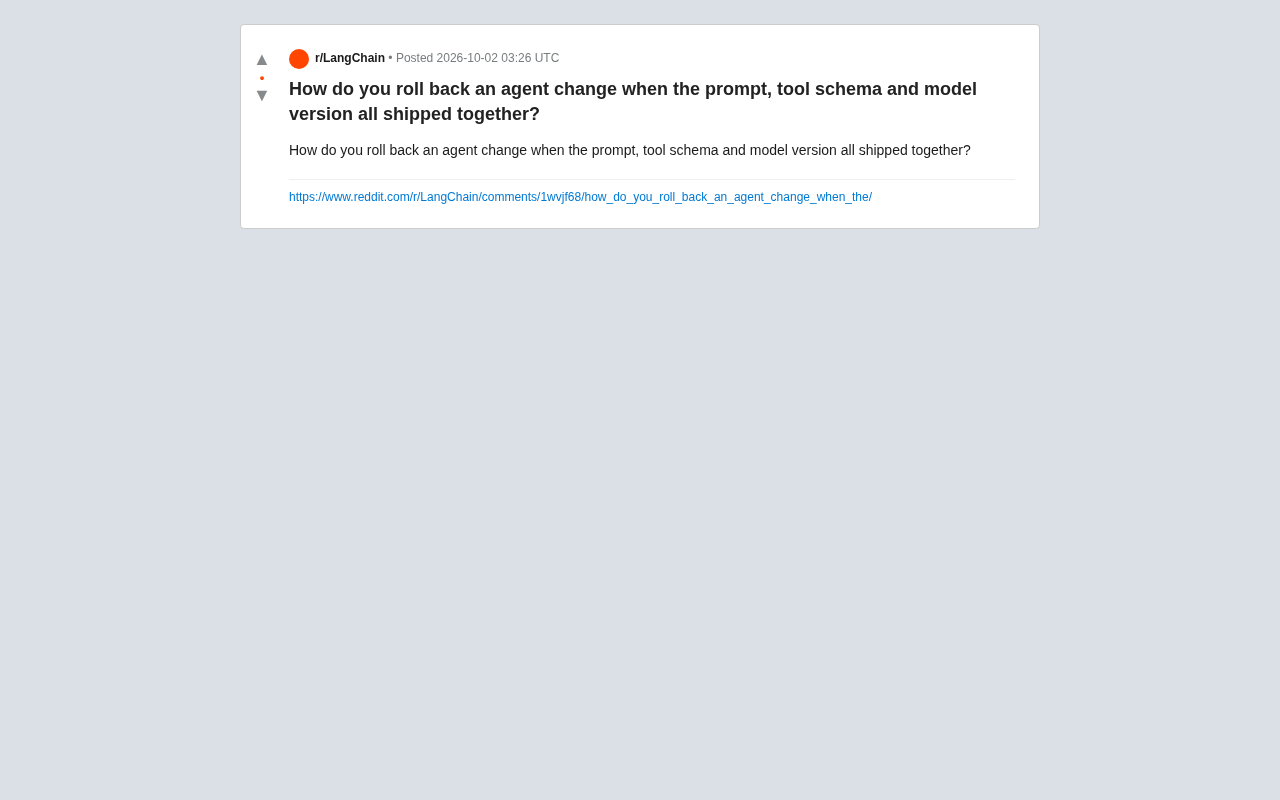
When a change to an AI Agent involves the prompt, tool-calling schema, and underlying model version all at once, rolling back after a production incident becomes a nightmare. This is the question a Reddit developer recently posed that struck a nerve: when all three are bundled into a single release, how do you safely roll back?
The question may sound like an engineering detail, but it cuts to the heart of a long-overlooked gap in Agent development — the lack of a mature version governance framework.
Why Agent Rollbacks Are Harder Than Traditional Software
Rolling back traditional software is relatively straightforward: code has Git history, databases have migration scripts, deployments have image tags. But changes to Agent systems are often cross-dimensional and tightly coupled.
A seemingly routine iteration might include: rewording in the prompt template, changes to a tool function's input schema, and a switch from one model version to another. In production, these three elements are typically bundled into a single release, with implicit dependencies running between them.
The core problem is this: when production behavior goes wrong, it's extremely hard to pinpoint which variable caused it. Was the prompt rewritten poorly? Did the new model misinterpret the old tool schema? Or did the tool's parameter definitions change without the prompt catching up? With all three entangled, the act of "rolling back to the last known good state" itself becomes ambiguous.
What is a Tool Calling Schema? The tool-calling schema is a critical component of an Agent system — it defines the names, parameter types, and descriptions of external functions that a large language model can invoke. The model relies on this schema to decide "when to call which tool, and with what arguments." Once the schema changes — say, a parameter is renamed from
user_idtouserId, or a required field is added — but the corresponding instructions in the Prompt aren't updated, the model may generate malformed tool call requests, causing runtime failures. This kind of cross-dimensional implicit dependency is one of the core sources of rollback complexity in Agent systems.
The Root Cause: Treating Agents Like Code, Not Configuration
Many teams start out scattering prompts, tool definitions, and model selections throughout their codebase — sometimes even hardcoding them into business logic. This is acceptable at the prototype stage, but once you hit production, it plants the seeds of rollback pain.
The fundamental tension is this: these three elements have very different change frequencies and lifecycles. Model versions might be upgraded every few months, tool schemas evolve with product features, and prompts might be tweaked daily. Forcing them all into the same release means giving up the ability to roll back any one of them independently.
A useful mental model is to decouple the Agent's "behavioral definition" from its "execution code" — treating prompts, tool schemas, and model versions as a set of independently versionable configuration contracts, rather than constants buried deep in the codebase.
Actionable Version Governance Strategies
The community and practitioners have gradually converged on several actionable principles for addressing this problem.
1. Tag Every Agent Release with a Unified Version Snapshot
Rather than letting the three elements drift independently, treat "Prompt + tool schema + model version" as an atomic Agent version bundle. Every release generates an immutable snapshot recording the exact combination of all three. When rolling back, you restore the previous snapshot as a whole — not three separate things rolled back in isolation.
This mirrors the philosophy of container images: you don't guarantee any single layer can be reverted, but you guarantee the reproducibility of the entire combination.
2. Use Canary Releases and Shadow Traffic
Before a full rollout, have the new Agent version handle a small slice of traffic first, or run it in shadow mode alongside the old version — executing in parallel and logging outputs without serving them to users. This way, even if the new version has issues, the blast radius stays limited. Rolling back simply means switching traffic routing, not an emergency redeployment.
3. Establish a Behavioral Evaluation Baseline
Because Agent outputs are non-deterministic, unit tests alone aren't sufficient. You need to maintain a regression eval set that runs before and after each release, quantitatively comparing key metrics (task success rate, tool-call accuracy, output format compliance, etc.). When a release causes a meaningful drop in these metrics, that's an objective signal to trigger a rollback — not a subjective judgment call.
4. Record the Full Decision Trail
In production, always retain a complete trace of each Agent run: which prompt version was used, which tools were called, what the model returned. When something goes wrong, these logs let you quickly isolate which dimension failed — and decide whether to roll back entirely or apply a targeted fix.
The Bigger Picture: Agent Engineering Is Still Early Stage
The reason this Reddit question resonated so widely is that it surfaces a reality — the Agent development toolchain is far from mature. It took decades in traditional software to build out the full ecosystem of CI/CD, version control, and canary deployments. Agents, as a fundamentally new software paradigm, are still in the exploratory phase of engineering governance.
Concepts like Prompt-as-code, Agent observability, and eval-driven development are evolving rapidly, but there's still a long way to go before they become industry standards. In the near term, teams need to compensate for tooling gaps through disciplined process constraints: forced decoupling, atomic snapshots, canary releases, and eval safety nets.
The difficulty of rolling back isn't a problem without a technical solution — it's a reminder that Agents deserve the same rigorous version governance as any serious production software system. They shouldn't be treated as scripts you can tweak and ship on a whim.
Background: Shadow Mode is a common production safety practice where a new version of the system receives the exact same real requests as the old version, executes independently, and logs its outputs — but never returns those outputs to users. This allows you to observe behavioral differences under real traffic with zero user exposure risk. For Agent systems, shadow mode is especially valuable: due to the non-deterministic nature of LLM outputs, offline test sets alone can't cover every real-world scenario, while shadow traffic can surface edge behaviors that only trigger under specific combinations of user input. One important implementation note: in shadow mode, Agents must not execute tools with write side effects (such as sending emails or modifying databases), or you risk unintended business impact.
Regression Eval Sets play a role in Agent development similar to a software test suite, but are constructed differently. A typical eval set includes: representative input cases (covering common paths and edge scenarios), expected tool-call sequences (golden traces), and acceptable output ranges. Because LLM outputs are stochastic, evaluation metrics are rarely simple pass/fail checks — instead, scoring is done via a separate model acting as a judge (LLM-as-judge) or through rule-based structural checks. Maintaining an eval set requires sustained investment: whenever a new failure case is discovered in production, it should be added to the set, forming a closed loop of "discover failure → capture case → prevent regression." This practice is sometimes called Eval-Driven Development.
Related articles

Free Unlimited Claude Code Solution: Agnes AI + CC Switch Setup Guide
No paid subscription needed — pair the free AI platform Agnes AI with the open-source tool CC Switch to provide a backend for Claude Code, enabling unlimited free calls to text, image, and video models. This guide covers the full setup, test results, and usage boundaries.

A Complete Zero-Cost Guide to Getting Started with Claude Code for Beginners in China
A beginner's guide to Claude Code for users in China: two installation methods (command line and IDE plugin), full configuration steps for replacing the official API with the free domestic LongCat model, and a hands-on demo of building a small tool with natural language, plus tips.

When the NSA Gets Involved: The AI Supply Chain Crisis Behind Open-Source CVEs and API Key Hijacking
Multiple open-source projects disclosed severe CVEs in one day, PHP flaws alarmed the FBI, and Railway and OpenCode were breached with API keys stolen. This article breaks down the vulnerability window, AI-accelerated exploitation, and the AI supply chain crisis behind the API key black market, with a developer defense checklist.