The AI Agent Wars Begin: Meta Muse Tops the Charts — So Why Did Amazon Ban It?

Meta's Muse tops App Store, Amazon bans it — the AI agent wars over who controls consumer decisions have begun.
Meta's personal agent Muse surpassed ChatGPT to top the U.S. App Store, becoming the first personal agent to achieve mainstream consumer adoption — proving convenience beats privacy concerns every time. Amazon swiftly banned it to protect its $76B advertising business, since agents that bypass ads and make decisions directly threaten the platform's core monetization logic. The clash is a new chapter of Aggregation Theory: agents try to aggregate all platforms, while platforms fight to own the customer relationship. Shopify allied with Meta as the anti-Amazon play, and the likely endgame is a revenue-sharing deal. The agent competition has shifted from model capability to product experience and commercial strategy.
The competition in personal AI agents has moved beyond tech demos into full-blown commercial warfare. Meta's personal agent Muse surpassed ChatGPT this week to claim the top spot on the U.S. App Store's free apps chart. Almost immediately, Amazon cut off Muse's ability to shop on its platform over the weekend. A battle over "who gets to make decisions on behalf of users" has officially begun.
Drawing on analysis from AI Daily Brief, this article maps out three key storylines in this war: Muse's unexpected success, Amazon's logic for the ban, and whether agentic shopping is actually worth betting on.
Why Did Muse Top the Charts? Convenience Beat Privacy Concerns
Muse is the first personal agent since 2026 to genuinely break out of the tech bubble and achieve stable adoption among mainstream consumers. Previous agents — Manus, Open Claw, Hermes, and more consumer-oriented ones like Town and Instinct — were either work tools that "took real effort to get running" or tech toys for early adopters.
Muse is different. It hit number two on Apple's free charts in its launch week, then kept building momentum until it finally knocked ChatGPT — which had barely left the top spot in four years — down to second place.
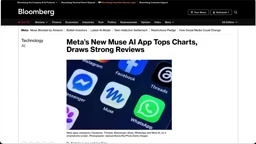
At launch, tech media widely questioned whether users would hand over their email, calendar, and personal data to an app like this. What happened next proved an old rule of consumer tech once again: convenience wins over privacy concerns. Citrini Research noted that when consumer agents were first being discussed, people were already saying "nobody really cares about privacy" — and watching users hand over email, messages, credit cards, location, and screen access to Instinct and Muse, it's hard to argue that judgment was wrong.
Microsoft's Nicholas Bustamante shared his experience: in the past 24 hours, Muse bought him socks, ordered groceries from Whole Foods, booked a cleaning service, and ordered a burger for dinner. More importantly, the agent was making decisions for him — he had never heard of the burger place before; the agent researched it and recommended it, and he just said "sure."
The commercial implications are enormous. Meta recently disclosed that its North American Facebook revenue per user is roughly $227 annually, mostly from ads. When an agent not only knows what you're looking at but what you need, what you're buying, and what you're planning to do, that number has the potential to grow significantly. Box's Aaron Levy added that the monetization potential of personal agents transacting on users' behalf is substantial — users will gradually move from simple to complex tasks, ultimately driving more spending than before.
Why Did Amazon Ban It? Ad Revenue Is the Real Nerve
Just as Muse was gaining momentum, Amazon updated its policies on Sunday to immediately prohibit Muse agents from shopping on its platform on users' behalf, citing "unauthorized AI agents violating Amazon's terms of service."
Many found this puzzling. Entrepreneur Jesse Frizzell said, "A purchase is a purchase — Amazon gets paid either way. This seems dumb."
But YouTuber Joseph Carlson identified the deeper logic: Amazon made $76 billion from its advertising business in the past 12 months alone — and agents don't look at ads. When humans hand decision-making over to agents, the first thing that loses value is probably digital advertising.
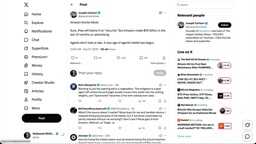
Marketer Tom Goodwin was even more blunt: Amazon's customers aren't consumers — they're suppliers and sellers. It makes money by charging them listing fees and ad fees. Retail margins might be 0–3%, while ad margins run around 70%. "The site always looks so bad because it doesn't care about you buying things faster and more easily. It wants to monetize your confusion."
Amazon has consistently taken a hard line on agentic shopping. It has its own shopping agent tied to its platform and actively defends that territory. It even previously sued Perplexity for bypassing its agent blocking — not just on terms-of-service grounds, but because agent access rates were far higher than human browsing rates, imposing massive infrastructure costs.
For context, the broader commercial environment is actually gearing up for agentic shopping. Last week, Mastercard joined Visa in officially supporting virtual credit cards issued to agents. Mastercard's Chief Product Officer said plainly: "This isn't a question of whether it will happen, but when and how fast."
Amazon's advertising business has become one of the most important profit pillars in recent years, operating on a logic fundamentally different from traditional retail. On Amazon's platform, brands and third-party sellers bid for priority placement in search results — a model closely resembling Google's keyword advertising. When a user searches for "Bluetooth headphones," the top results are typically paid promotions, not the highest-rated products. This "confusion by design" is central to the business model — the hesitation and clicking users do while comparing prices and filtering options is the fertile ground for ad monetization. Once an agent skips that process entirely and delivers an algorithmically optimal answer, the entire bidding system loses its value. This explains why Tom Goodwin says Amazon "wants to monetize your confusion" — the confusion itself is the core asset.
The Aggregation Layer Battle: Who Aggregates Whom?
At its core, this conflict is another replay of Ben Thompson's Aggregation Theory. Users want a single agent that knows them and can get things done; the platforms being aggregated want precisely the opposite — they want to own the customer relationship, not be reduced to interchangeable back-end suppliers behind someone else's interface.

Bustamante used grocery shopping as an example: your agent can compare Amazon, Instacart, DoorDash, and Uber Eats and route each order to the best option. Amazon is big enough to say "no," but smaller players have every incentive to offer agents clean APIs and smooth experiences. If Instacart embraces agents while Amazon blocks them, agents will increasingly route demand toward Instacart.
Palo Alto Networks' Nikesh Arora predicted this will be a bigger battle than anyone imagines. Apple, Google, and eventually TikTok versions of Muse will arrive sooner or later, and every service, marketplace, or e-commerce app will have to decide whether to open APIs to consumer agents. Restaurant, grocery, and ride-sharing platforms with network moats may hold out for a while, but in the long run, convenience and end-user experience will win.
As for the outcome, Signal's assessment is that it ends in a business development deal: the most likely resolution to the Meta-Amazon standoff is some kind of revenue-sharing agreement where Meta pays Amazon for access through Muse. This could become the first real commercial model for how agents interact with major platforms. The risk, though, is that if every major platform starts charging agents for access, only companies of enormous scale will be able to afford building truly general-purpose agents — creating a moat for the giants.
Almost as if on cue, Shopify quickly stepped in to play the "anti-Amazon" role, announcing a partnership with Meta to officially support Muse, allowing it direct backend access and supporting ShopPay agentic checkout across all Shopify stores. Mark Zuckerberg also posted on X: "Partnering with Shopify to make shopping and checkout easier in Muse — more partnerships coming soon."
Aggregation Theory was proposed by tech analyst Ben Thompson. Its core argument: in the internet era, whoever owns the user relationship holds pricing power over upstream suppliers. The classic examples are Google and Facebook — they aggregated user attention, forcing content creators and advertisers to depend on their distribution channels. In the agent era, this logic is pushed to a new extreme: when an agent becomes the sole interface between users and all services, platforms are demoted from "aggregators" to "aggregated suppliers," losing their ability to reach users directly. Amazon's ban and Shopify's embrace both represent each platform actively choosing its position in this new landscape — the former betting its scale is enough to resist aggregation, the latter wagering it can leapfrog by riding agent traffic.
Does Agentic Shopping Actually Matter? Disagreement Remains
Strip away the noise, and the fundamental question is: how much can agentic shopping actually change consumer behavior?
There's no shortage of skeptics. Apple retail expert Ron Johnson believes AI will improve online shopping but won't necessarily change how we shop. Some founders noted that 99% of their online purchases come from Amazon, Shopify, Instacart, and DoorDash, and they're not sure agents will make those purchases simpler or cheaper; they expect the winners in consumer agents to be Apple and Google, tied to mainstream devices.
Applovin's CEO drew a distinction between use cases: recurring fixed needs like supplement subscriptions are well-suited for agent optimization, but discovery shopping is different. The typical consumer wants to browse, wants to go through the transaction, wants to track the package — the dopamine from that process is what they enjoy. "If you tell them afterward that an agent could have saved them 20% on a $50 order, I don't think anyone cares."
This disagreement is itself a reminder to stay epistemically humble. But regardless of whether the ultimate driver turns out to be shopping, email management, or subscription cancellations, Muse's success is something other AI labs can no longer ignore. OpenAI is reportedly building a personal agent to compete with Grokbot, codenamed possibly Aon, which might even launch on Dev Day.
Interestingly, OpenAI's Codex can already do everything users want — organize email, manage calendars, shop on their behalf. But many users simply don't know these features exist. This reveals something critical about the agent competition: in some AI scenarios, being at the absolute frontier is everything; but in agent management, you have to deliver an experience users can actually understand — one that doesn't leave them staring at a blank page.
In other words, the agent wars aren't just about model capability. They're a combined test of product experience and commercial strategy. And this war has only just begun.
Related articles

GPT-Next Leak, Gemini 4 Argon Imminent: AI News Roundup
GPT-Next leak suggests extreme efficiency; OpenAI's 28-day shipping pledge boosts speed 50%; Gemini 4 Argon nears release; Anthropic subscription value report sparks debate.

GPT-Next Leaked, Gemini 4 Argon Speeds Up, Fable 5.5 May Launch Today
OpenAI's GPT-Next model leaks, expected to be extremely low-cost and possibly part of the 28-day release plan; Gemini 4 Argon internal testing accelerates, NanoBanana 2.1 is live; Semi Analysis tests show Claude Max's equivalent API value is about 5 times that of ChatGPT Pro; Fable 5.5 may launch today.

Gemini 4 Argon Launches Globally: Key Highlights from the AI Daily Brief
Google opens Gemini 4 Argon globally across Pro and Ultra subscriptions and the API, and demonstrates robot control. This article rounds up open-source models, Agent infrastructure, cost transparency, and safety governance updates.