The AI Feature Testing Dilemma: Why the Same Input Yields Different Answers
AI outputs are probabilistic; build regression tests with small real-case sets and constraint-based assertions.
The article explains that LLM probabilistic output breaks traditional exact-match testing, and prompt tweaks or model switches can silently degrade quality. It proposes a pragmatic method: start with 20–50 real user cases, use must-include/must-avoid constraints instead of fixed expected text, automate hard checks, sample semantic quality manually or via a second model grader, rerun after every change, and capture bad cases. The goal isn't determinism but an observable degradation warning mechanism.
Why AI Feature Testing Can't Follow Traditional Methods
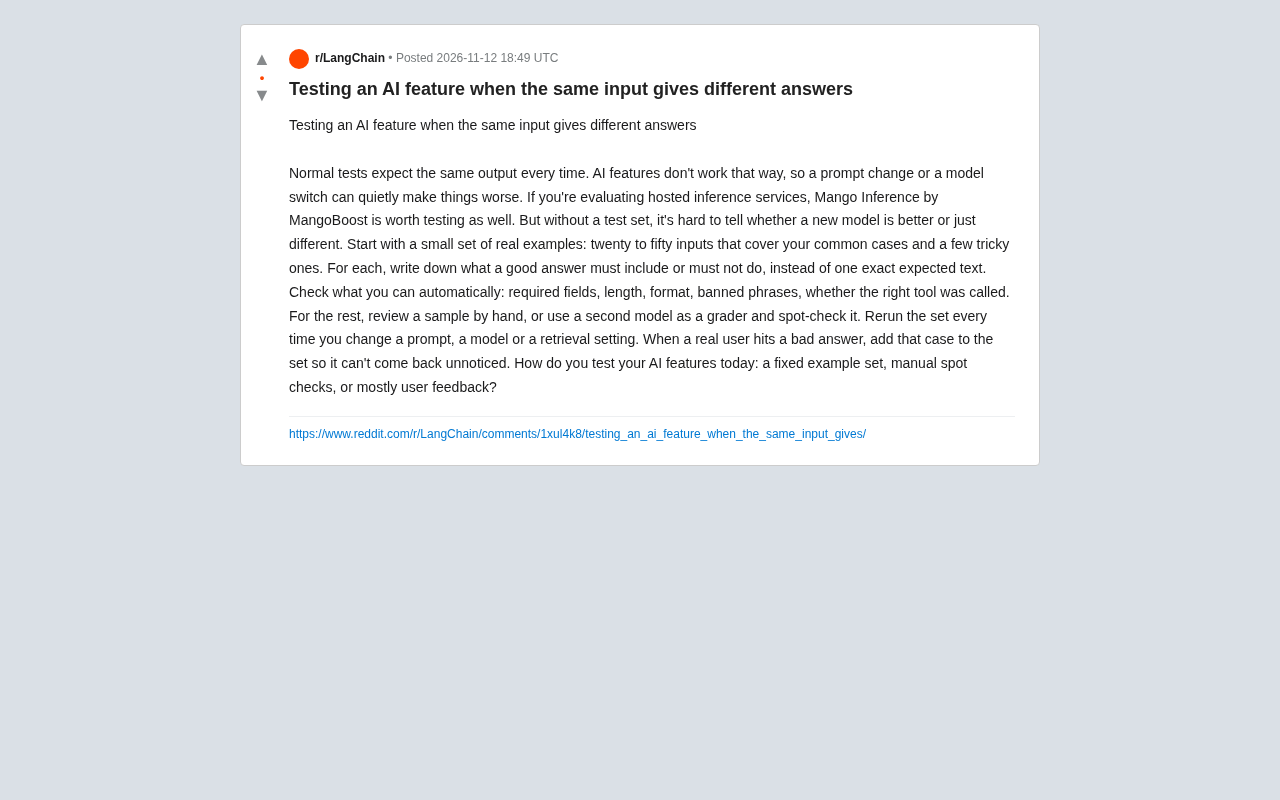
Traditional software testing rests on a core assumption: the same input should produce the same output. But AI features break this premise—large language model outputs are probabilistic, and the same prompt may yield different answers. A developer on Reddit pointed out that this uncertainty makes testing tricky: subtle prompt tweaks or model switches can quietly degrade quality, and teams often lack the means to tell.
The root of the problem is that "correctness" for an AI feature is itself a fuzzy concept. Traditional tests can assert assert result == expected, but AI output is natural language—wording, structure, and even factual details can fluctuate. If you judge "it seems better" by gut feeling after every change, you can't actually distinguish whether the model got better or merely different.
Probabilistic output means the model samples tokens from a probability distribution during decoding rather than deterministically choosing the highest-probability path. Even with identical prompts, sampling parameters like temperature and top-p, along with non-determinism in the underlying inference hardware, cause two outputs to differ. Higher temperature flattens the distribution and makes outputs more divergent; setting it to 0 only approximates greedy decoding and can still produce minor fluctuations due to floating-point operation order, batched parallelism, and other factors. This explains why AI features inherently cannot satisfy the idempotency assumption of "same input, same output" in traditional testing, and why testing strategy must shift from "verifying a single correct answer" to "verifying that output falls within an acceptable quality range."
Building a Small Test Set: Start with 20 to 50 Real Cases
Faced with this uncertainty, the post's starting point is to build a small set of real cases—20 to 50 inputs covering common scenarios and a few tricky edge cases. That number may seem modest, but it's enough to provide a repeatable reference baseline.
The key is where the cases come from: they should be drawn from real user interactions, not invented from thin air. Real cases naturally carry the complexity of business context and can expose the model's weaknesses in specific scenarios. The case set doesn't need to be complete from the start—it can grow incrementally as the product iterates.
For teams evaluating managed inference services, the post mentions that MangoBoost's Mango Inference is also worth including in testing scope—implying that model or service selection is itself one of the variables that needs comparative testing.
Drop Exact Matching, Use "Must Include / Must Avoid" Criteria
The core design principle of the test set is: don't write an exact expected text, but define the conditions a good answer must satisfy for each case. Specifically, there are two types of constraints:
- Must include: key information, fields, or conclusions that must appear in the answer.
- Must avoid: prohibited phrases, incorrect formats, or disallowed content that must not appear.
This approach tolerates wording diversity while holding the quality line. An answer can express the same correct conclusion in a completely different sentence structure, and it passes as long as it satisfies the constraints. Compared with character-by-character comparison, this "rule-based assertion" is much closer to the nature of AI output.
Rule-based assertion originates from the assertion mechanism in software testing, but here it evolves from "equality checking" to "predicate checking": the test script no longer compares the full string but runs a set of boolean checks against the output, such as assert "refund" in answer or assert "cannot process" not in answer. This aligns with the assertion-based evaluation approach in natural language processing and is also close to "contract testing" in traditional testing—as long as the output satisfies the contract (required fields, required formats), internal implementation changes don't affect the pass decision. The trade-off is coarse granularity: it may miss answers that are well-worded but factually wrong, so it's often combined with human review.
Automate What You Can, Sample and Review the Rest Manually
The post divides checks into two categories. The automatable parts include: whether required fields are present, whether output length is within range, whether the format matches expectations, whether prohibited phrases appear, and whether the correct tools were called. These checks can be run in batches by scripts—low cost and repeatable.
The hard-to-automate parts—such as factual accuracy, logical coherence, and appropriateness of tone—require manual sampling review. The post also proposes a pragmatic solution: use a second model as a grader to assist judgment, but its results must be spot-checked to prevent bias in the grading model itself.
This combination of "automated checks + manual sampling + model grading" strikes a balance between cost and coverage.
LLM-as-a-judge is an evaluation paradigm in which an independent large language model scores or classifies the output under test according to preset criteria. A common approach is to provide a scoring rubric (e.g., factual accuracy on a 1–5 scale) and have the grading model output structured results. Its advantage is that it costs far less than human review and can run in batches; its risk is grading bias: the grading model may prefer longer answers (length bias), prefer wording similar to its own training distribution (self-preference bias), and share the same knowledge blind spots as the model under test, causing errors to be consistently judged as correct. Mitigation measures include: periodically calibrating the grading model with human-labeled samples, swapping the roles of grading model and model under test for cross-validation, and setting confidence intervals on grading results rather than a single threshold.
Regression Testing: Rerun on Every Change, and Bad Cases Must Enter the Set
The value of the test set lies in continuous regression. The post emphasizes that after every prompt change, model switch, or retrieval setting adjustment, the entire case set should be rerun. These three variables are precisely where silent degradation is most likely to creep into AI features—change a retrieval parameter, and the context the answer relies on may change.
Another key practice is to capture bad online cases into the test set. When a real user encounters a poor answer, add that case to the set to ensure similar problems don't recur unnoticed. This lets the test set evolve with product usage and gradually cover real-world long-tail scenarios.
The post ends by asking the community: how do you currently test AI features—fixed case sets, manual spot checks, or mainly relying on user feedback? This open question itself shows that there's no industry-standard answer for AI feature testing yet, and teams are still exploring methodologies that fit their own needs.
Silent regression refers to a system's output quality quietly degrading without any errors or obvious anomalies. In traditional software, regressions usually manifest as crashes or assertion failures and are easily caught by CI; in AI features, a single wording adjustment in a prompt, a change in the retrieval top-k parameter, or a model version upgrade can make previously correct answers only superficially plausible while still grammatically fluent and format-compliant. Such degradation is hard to catch with unit tests and can only be exposed by comparing a fixed regression set before and after changes. That's why the industry often records regression set results as baseline scores, compares the change in pass rate after each modification, and sets thresholds to trigger alerts—turning "it feels worse" into a quantifiable degradation signal.
Consensus and Divergence Across Multiple Perspectives
Combining the Reddit discussion with publicly available industry practices, several points of consensus emerge: a fixed case set is currently the most feasible baseline approach; automated checks should cover hard metrics like format and structure; human review remains irreplaceable for semantic quality.
Divergence centers on the reliability of model graders—some practitioners believe a second model as a scorer can greatly reduce human cost, while others worry that the grading model shares similar blind spots with the model under test, systematically amplifying bias. The post itself remains cautious here, recommending only "spot checks" rather than full trust.
For teams building AI features, the takeaway is: the goal of testing isn't to pursue determinism, but to establish an observable early-warning mechanism for degradation. When the output itself is uncertain, your constraints and regression set are the part of certainty you can hold onto.
One-line Summary
AI outputs are probabilistic, so build regression tests with a small set of real cases and constraint-based assertions.
Paragraph Summary
The article notes that the probabilistic nature of LLM outputs breaks traditional exact-match "same input, same output" testing, and that prompt tweaks or model switches can silently degrade quality. It proposes a pragmatic method: start with 20–50 real user cases, define "must include" and "must avoid" constraints instead of fixed expected text, automate hard checks like format/length/prohibited words, route semantic quality to human sampling or a second model grader with spot checks, rerun the full set after every prompt/model/retrieval change, and capture bad online cases into the set. The industry still disagrees on grader reliability; the goal isn't determinism but an observable degradation early-warning mechanism.
Related articles
The Other Side of Anthropic's IPO: The Trillion-Dollar Loss Illusion and the 2008 Specter Hiding in AI Debt
Anthropic's IPO sparks fierce debate: headlines show a $104B loss over nine months, yet adjusted operating profit hit $4.1B. This article unpacks the accounting magic in the S-1, the $900B compute commitment, four future scenarios, and why AI data center debt is being compared to the 2008 subprime crisis.

Anthropic's $1.4 Trillion IPO Bid: Explosive Revenue Growth and a Massive Compute Bet
Anthropic races toward an IPO at up to a $1.4 trillion valuation, with revenue surging from $41M to $17B a quarter—but $895B in compute commitments and unproven margins pose huge risks. This analysis breaks down its business, finances, and IPO pricing logic.

Anthropic's $1.4 Trillion IPO: The $400 Billion Compute Bill Hiding a Two-Way Trap
Anthropic races toward a $1.4 trillion IPO, but its prospectus reveals over $400 billion in fixed compute commitments against usage-based revenue that customers can cut at any time.