The AI-Led Testing Era: A Hands-On Introduction to DeepSeek Harness and Agents
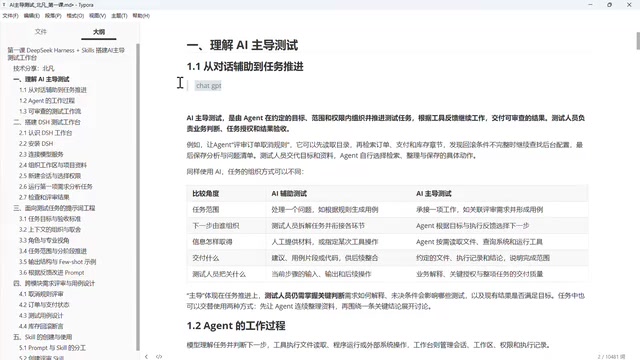
AI upgrades from assisted Q&A to autonomous Agent execution, and testers shift to task definition and result acceptance.
The article discusses the paradigm shift of AI in software testing from an assisted tool to a leading Agent. In the past, AI only answered questions or generated content and humans connected the steps; now Agents receive complete tasks, autonomously plan, invoke tools, check results, and iterate. The human role shifts from middleman to boundary controller. Using DeepSeek Harness as an example, it explains how Agent software integrates models, tools, and prompts as a testing workbench, with three training sessions covering functional, Web, and API testing. The author stresses that Agents' "correct" judgments still need human acceptance and correction, and testers' core value lies in task definition, reviewing AI output, and revising tasks—those who embrace AI are more competitive.
AI is spreading from development roles into testing roles. Microsoft's Playwright has fully embraced AI, offering capabilities like MCP to support automated testing. Behind this lies a paradigm shift as AI moves from "conversation" to "tasks"—testers need to reunderstand the boundaries of their own work.
From AI-Assisted to AI-Led: The Shift in the Testing Paradigm
When we used to talk about AI-assisted testing, AI mostly answered a question or generated a piece of content, and testers had to connect the various steps themselves: whether to do it, how to do it, and how to use the results. Now it's different. An Agent can receive a complete task, autonomously plan the steps, invoke tools, check results, and iterate forward.
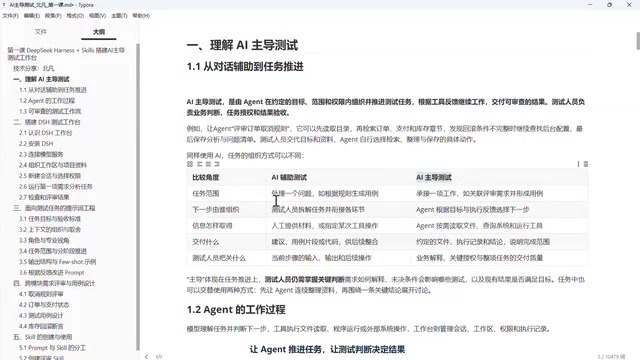
The speaker used a comparison table to illustrate this change: in the AI-assisted stage, people were responsible for breaking down and passing along information; in the AI-led stage, people only need to control the boundaries and accept the results. The tester's position shifts from "middleman who passes things along" to "boundary controller." This doesn't mean AI calls the shots—key judgments are still the responsibility of humans.
Why Agents Can "Lead": Tools, Loops, and Autonomy
The reason an Agent can take on a leading role comes down to its ability to use tools. The academic definition of an Agent has existed for a long time, and current large AI models basically satisfy these conditions: receiving a task, planning the next step, invoking tools to execute, and adjusting based on results.
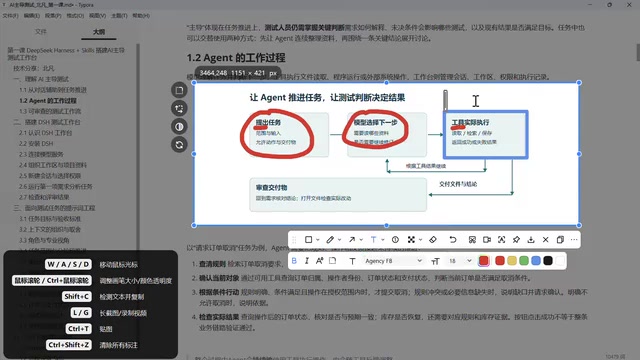
In terms of process, the Agent first determines whether the task requires querying a database, searching the web, or writing code to verify, and then actually performs the operation—for example, reading files, querying databases, or rolling back when an error occurs. This is fundamentally different from a chatbot: a chatbot is a back-and-forth Q&A, while an Agent continuously and autonomously pushes forward until it believes the result is correct before delivering it.
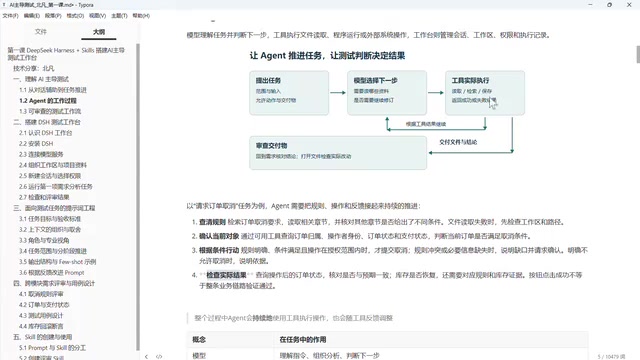
Here's a key question: is the "correct" that the Agent believes in actually correct? This is precisely where the tester's value lies—a human accepts the final result and corrects course along the way. The speaker used an analogy to intelligent driving: when a human judges that the car should brake, that takes priority over the AI's decision to accelerate.
The ReAct pattern is currently the mainstream paradigm for Agents to implement the "plan-execute-feedback" loop, short for Reasoning and Acting. Its core idea is to have the large model alternately produce "reasoning traces" and "action instructions": the model first outputs a stretch of internal thinking (for example, determining whether the current task requires querying a database or retrieving a web page), then outputs a tool-call action; after the tool returns a result, that result is stitched back into the context, and the model continues reasoning about the next step based on it. This closed loop of "think → act → observe → think again" is exactly the mechanism basis described in the article for why an Agent can continuously and autonomously push forward until it judges its own result correct. Compared with one-shot generation, the ReAct pattern brings real feedback from the external environment into the decision-making process, significantly reducing the probability of the model making things up, but it also brings problems such as runaway loop counts and error accumulation, so maximum step counts and human acceptance checkpoints need to be set.
Tool Calling / Function Calling is the technical interface through which large models interact with the outside world. The model itself can only generate text and cannot actually read files or query databases; the tool-calling mechanism lets the model structurally declare in its output "I want to call a certain function, and here are the parameters," and the runtime environment actually executes it and returns the result to the model. This makes possible the "actually performing operations—reading files, querying databases, rolling back on errors" mentioned in the article. The reliability of tool calling depends on two things: first, whether the tool descriptions are clear and the parameter schemas strict, otherwise the model easily picks the wrong tool or passes the wrong parameters; second, whether the execution results are faithfully returned for the model to judge the next step. When using Agents, testers who understand the boundaries of tool calling can design clearer task instructions and, when results are abnormal, quickly locate whether it's a model decision problem or a tool implementation problem.
DeepSeek Harness: Positioning as a Testing Workbench
DeepSeekAd Harness (DSH) is the Agent software used in this training camp, serving as the workbench for the entire AI-led testing process. It integrates elements such as large models, tools, and prompts into one environment, allowing testing tasks to be carried out end to end within it.
The training camp arranged three sessions: the first session builds the conceptual foundation, the second session performs Web-side testing with a mall project, and the third session performs API testing. The three sessions correspond to functional testing, Web testing, and API testing, covering most of the daily work of testing roles.
MCP (Model Context Protocol) is an open protocol proposed by Anthropic and increasingly adopted by the industry, used to standardize how large-model applications connect with external tools and data sources. Before MCP, each integration of a tool (database, browser, file system, internal testing platform) often required writing separate adapter code for a specific model; MCP abstracts these capabilities into a unified "server," and the model side acts as a "client" that discovers and invokes tools according to the protocol, achieving integration once and reuse in many places. For testing scenarios, this means testing tools like Playwright can expose browser operations, assertions, screenshots, and other capabilities to Agents in the form of MCP services, and the Agent can orchestrate test steps without understanding the underlying implementation. Protocol-level standardization is one of the key pieces of infrastructure for AI to move smoothly from "conversation" to "task execution."
The Tester's New Competitiveness: Controlling Boundaries, Not Being Replaced
A realistic question cannot be avoided: AI can do more and more, so are people still needed in testing roles? The speaker's answer is yes, but a premise must be accepted—testing may not need that many people anymore.
The core value of testers shifts to three things: providing clear tasks and rationale, reviewing the results delivered by AI, and revising tasks based on feedback. AI handles pushing forward the details, while humans handle goals and acceptance. This means testers who embrace AI ways of working will be more competitive, while those who refuse to adapt will face an efficiency gap.
Interview questions like "Have you used AI in your work, how did you use it, and what help did it bring?" are already starting to appear. For testing practitioners, understanding how Agents work and mastering tools like DSH is changing from a bonus to a basic requirement.
One-line Summary
AI upgrades from assisted Q&A to autonomous Agent execution, and testers shift to task definition and result acceptance.
Paragraph Summary
The article discusses the paradigm shift of AI in software testing from an assisted tool to a leading Agent. In the past, AI only answered questions or generated content, and connecting the steps depended on humans; now an Agent can receive a complete task, autonomously plan steps, invoke tools, check results, and iterate forward, and the human role shifts from middleman to boundary controller. Using DeepSeek Harness as an example, the article explains how Agent software integrates models, tools, and prompts to serve as a testing workbench, and introduces how the training camp's three sessions cover functional testing, Web testing, and API testing. The author emphasizes that the Agent's "correct" judgments still require human acceptance and correction, and that the core value of testers shifts to providing clear tasks and rationale, reviewing AI-delivered results, and revising tasks based on feedback—those who embrace AI are more competitive.
Related articles

MIT PhD Takes You from Scratch to Build DeepSeek: A 25-Hour Hardcore Course
MIT PhD Raj Dandekar launches a 25+ hour Bilibili course building DeepSeek from scratch—MoE, MLA, GRPO, hand-written code plus math derivations, aiming to reproduce mini R1.
DeepSeek Harness in Practice: From Installation to Plugin Ecosystem, Building a Fully Automated AI Workflow
Based on a hardcore Bilibili tutorial, this guide systematically covers DeepSeek Harness installation, three plugin installation methods, and real-world use cases to help developers quickly build customizable AI Agent workflows.
DeepSeek Harness in Practice: From Installation to Automated Workflows
Hands-on DeepSeek Harness tutorial covering Mac/Windows installation, login, workspace binding, model & permission setup, and minimal closed-loop verification for AI automation workflows.