The AI Memory Silo Problem: Breaking Down the 5 Mechanisms Behind 8,120-Star Open Source Tool ai-memory

ai-memory uses Markdown files as the memory source of truth to eliminate context loss when switching AI coding tools.
AI coding assistants each silo their memory — switch tools or machines and your context vanishes. ai-memory is a Rust-based open source project with 8,120 stars in four months, tackling this with five mechanisms: lifecycle-hook silent recording, Markdown files as the memory source of truth (database as index only), zero-cost retrieval requiring no API key, layered reversible forgetting, and protocol-based task handoff for seamless cross-tool switching. It supports 30+ coding Agents and self-hosted team collaboration. Unlike tools chasing semantic intelligence, ai-memory prioritizes retrievability — making it ideal for long-running, multi-tool projects.
Switching Tools Means Starting Over: The AI Coding Memory Silo
Developers who juggle multiple coding assistants every day have probably felt the same frustration: three days of architectural decisions and hard-won lessons worked out in Claude Code — gone the moment you switch to Cursor. Change machines, and the entire project context vanishes completely.
The problem is on the product side. Every vendor stores memory in their own directories and proprietary formats, with no interoperability — Claude Code's notes are locked inside Claude Code, Cursor's memory is locked inside Cursor, and nothing moves between them. Every company is building its own wall.
According to an analysis by Bilibili creator "1024 Engineering Notes," DeepSeekAd's Harness officially left memory features as a deliberate blank — an open space for the community to fill. The project filling that gap is a Rust repository created just four months ago that has already reached 8,120 stars and continues climbing at over a hundred stars per day: ai-memory.
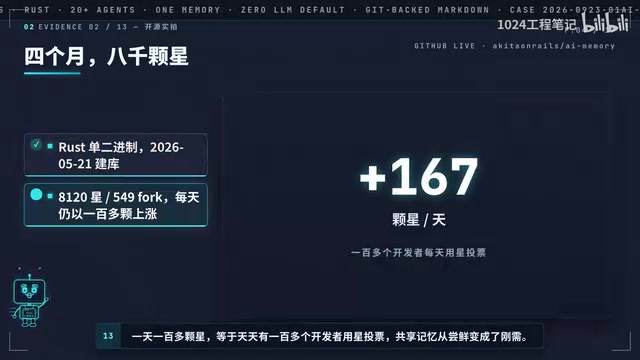
A hundred-plus stars per day means a hundred-plus developers validating it through real usage, every single day. Shared memory is shifting from a nice-to-have long-term feature to an immediate necessity.
Five Mechanisms: Making Memory Truly Yours
Mechanism 1: Silent Recording — No Commands Required
Most memory tools on the market require you to explicitly issue a "remember this" command. ai-memory takes a different approach — it hooks into the Agent's lifecycle. Every step the Agent executes automatically triggers this hook. Everything you've said, every tool called, every interrupted session — all of it is automatically stored without you saying a word.
A lifecycle hook is a common extension pattern in software engineering: a callback interface pre-wired at specific points in a workflow, letting external code embed logic non-invasively. Agent frameworks typically expose these hooks at points like "instruction received," "before tool call," "after tool returns," and "session ended." By attaching to these hooks, ai-memory requires no modifications to the Agent's core code and no changes to the user's workflow — the entire recording process is completely transparent. This stands in contrast to the traditional "user manually triggers save" model: the latter depends on human discipline, while the former hands reliability to the mechanism itself.
Mechanism 2: Files Are the Source of Truth — the Index Is Just a Table of Contents
This is widely considered the cleverest part of the entire design. The memory itself lives as Markdown files in a Git repository — they can be grep'd, opened in Obsidian, edited by hand, and synced to other machines. The database serves only as an index. Even if the index is completely wiped, everything can be rebuilt from the original files.
The priority is clear: files are the source text, the index is the table of contents. If the table of contents disappears, you rebuild it from the source. Memory you can export truly belongs to you. Memory locked in a proprietary format is effectively held hostage.
Mechanism 3: Zero Cost by Default — No LLM Required
On the default path, recording, retrieval, and handoff all require no API key. The logic is straightforward: the hooks are capturing plain text to begin with, and retrieval uses keyword and link matching — no LLM involved at any point. You can optionally have a model organize your notes, but it's just that — optional. The system is fully functional without it.
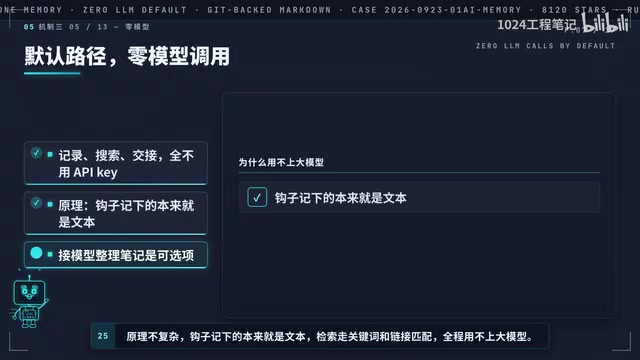
For cost-conscious developers, this means a memory system that doesn't charge you per retrieval.
Mechanism 4: Forgetting Is Built In — and Reversible
An easy-to-overlook detail: it actively forgets, and does so in layers. Frequently accessed memory decays slowly; rarely touched notes get compressed into a few summary lines. But here's the key: even notes for approaches later deemed dead ends are never deleted — the original records remain in Git's version history and can be restored with a single command.
Forgetting is reversible from start to finish. Both remembering and forgetting are reliable — which matters enormously in long-running projects.
Mechanism 5: Protocol-Based Handoff — No Context Lost When Switching Tools
Stop halfway through something in Claude Code? Don't change any directories — just open Codex and pick up right where you left off. The handoff is specific: where things stand, which paths have been ruled out, which questions are still open.
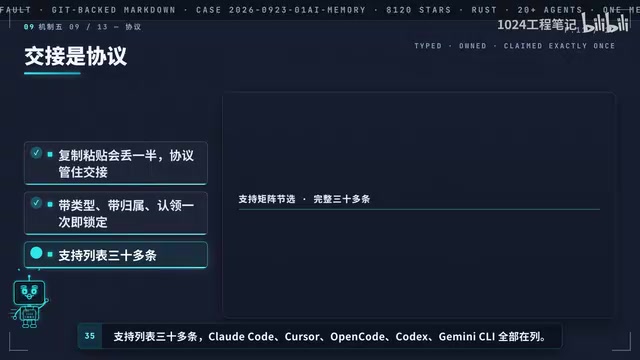
Relying on copy-paste alone still loses half the context when you switch tools. Protocol-based handoff manages the work itself — tasks carry types and ownership, claiming a task locks it atomically, and two Agents reaching for the same task simultaneously can't both grab it. The supported tool list exceeds thirty entries, including Claude Code, Cursor, Open Code, Codex, Gemini CLI, and more.
"Protocol-based" here refers to the structured representation of task state: each task isn't just a block of text, but a structured record with fields for type (e.g., bug, feature, refactor), ownership (which Agent claimed it), and status (pending, in progress, blocked, complete). This design borrows the idempotent lock concept from distributed systems — the claim operation is atomic. When two Agents concurrently read the same task, only one can successfully write "claimed" status; the other reads the lock flag and skips it. This solves the classic race condition in multi-Agent parallel work, and gives cross-tool task handoffs machine-readable, unambiguous semantics — rather than relying on free text that only humans can interpret.
Advanced Scenarios: Cross-Machine and Team Collaboration
Host the service on your own machine, and a job started on your desktop can be continued on your laptop. When a team points to the same service, a pitfall one person hits becomes queryable by every Agent on the team. Multi-user permissions and audit logs are all built in.

The creator shared their own real-world scenario: primarily using Claude Code, with Open Code and Codex for testing — and spending ten minutes re-explaining context every time they switched tools. Switching two or three times a day between primary and testing tools adds up to half a day wasted per month. The true cost of switching tools comes down to one thing: context reset.
Install or Skip: Three Questions to Find Your Answer
Whether it's worth the setup effort comes down to three questions:
- Are you switching between multiple Agents regularly?
- Does your project need to run across multiple machines?
- Are you willing to self-host a service?
If two or more apply, install it. If none apply, don't bother — the built-in memory of individual tools is probably sufficient.
How It Differs from Similar Tools
There's no shortage of comparable tools out there — sentence-level fact extraction, timelines, knowledge graphs, hosted services — each taking its own approach. What they all share is the goal of "remembering smarter."
ai-memory chose a different path: files as source of truth, index as target. It prioritizes retrievability first, and smartness second. For developers working on projects long-term, getting your data back matters more than clever recall.
Looking back at the five mechanisms — silent recording, Markdown as the memory source, optional LLM involvement, layered reversible forgetting, and protocol-based handoff — ai-memory fills the blank that DeepSeek Harness left open. Whether the built-in memory of your current coding Agent is good enough depends entirely on how you answered those three questions.
The "knowledge graph" approach mentioned above is exemplified by tools like Mem0 and Zep. Their core idea is to structure entities (people, projects, decisions) and relationships (dependencies, conflicts, alternatives) from conversations into graph nodes and edges, then traverse the graph during retrieval to surface associated memories. "Sentence-level fact extraction" is closer to the preprocessing stage of RAG (Retrieval-Augmented Generation) — slicing long conversations into atomic facts and storing them as vectors. Both approaches depend heavily on model calls for both writing and querying. ai-memory's choice of keyword and link matching sacrifices some semantic recall capability in exchange for full offline availability, zero API costs, and portability that's natively compatible with the Git toolchain.
Related articles

Free Unlimited Claude Code Solution: Agnes AI + CC Switch Setup Guide
No paid subscription needed — pair the free AI platform Agnes AI with the open-source tool CC Switch to provide a backend for Claude Code, enabling unlimited free calls to text, image, and video models. This guide covers the full setup, test results, and usage boundaries.

A Complete Zero-Cost Guide to Getting Started with Claude Code for Beginners in China
A beginner's guide to Claude Code for users in China: two installation methods (command line and IDE plugin), full configuration steps for replacing the official API with the free domestic LongCat model, and a hands-on demo of building a small tool with natural language, plus tips.

When the NSA Gets Involved: The AI Supply Chain Crisis Behind Open-Source CVEs and API Key Hijacking
Multiple open-source projects disclosed severe CVEs in one day, PHP flaws alarmed the FBI, and Railway and OpenCode were breached with API keys stolen. This article breaks down the vulnerability window, AI-accelerated exploitation, and the AI supply chain crisis behind the API key black market, with a developer defense checklist.