The AI Model Value-for-Money Battle: How to Rationally Choose the Right LLM for You

A guide to rationally choosing LLMs when model capabilities converge and cost-effectiveness becomes king.
As LLM capabilities converge across providers, cost-effectiveness has emerged as the decisive factor in model selection. This article examines why price-performance ratio matters more than ever, how to avoid being swayed by subjective social media opinions, and provides a framework for evaluating models based on task scenarios, quantifiable metrics, and actual business needs rather than benchmark rankings alone.
A Tweet That Sparked a Model Value Discussion
Recently, a brief comment on Twitter caught the attention of the AI community. The poster bluntly expressed their comparative view of two AI models: "Luna now has incredible value, while Terra is completely useless just like Sonnet—I don't understand why anyone would still use them."
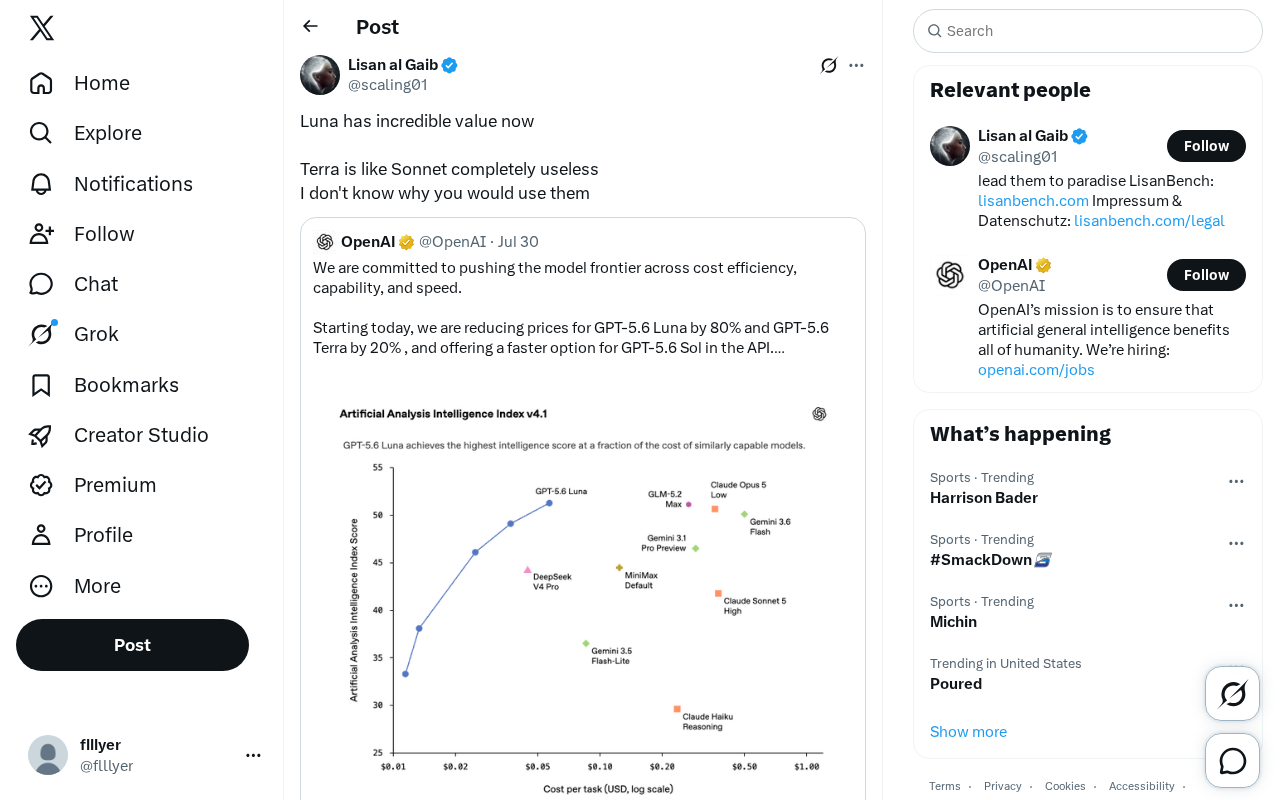
While the comment is subjective and strongly opinionated, it reflects an increasingly prominent core issue in today's AI model market—cost-effectiveness is becoming the key decision factor for users choosing large language models. As model capabilities gradually converge, the ratio of price, response speed, and actual output often influences real-world choices more than raw capability benchmark rankings.
Why Cost-Effectiveness Has Become the New AI Model Battleground
Differentiation Pressure Amid Converging Capabilities
In the early stages of LLM development, capability gaps between models were stark, and users had little choice but to pick the most powerful option. However, as technology rapidly iterates, the performance gap between mainstream models on general tasks is narrowing. When multiple models can handle everyday work, users naturally shift their attention to the cost dimension.
This convergence has deep technical roots. On one hand, the Scaling Law that underpins model capability improvements (i.e., improving performance by scaling up model parameters, data volume, and compute) is facing diminishing marginal returns. The performance gap between leading models has shrunk from what was once a "generational difference" to a "percentage difference." On the other hand, the rapid rise of open-source model ecosystems (such as Meta's Llama series, Mistral, etc.) means that capability levels once exclusive to closed-source commercial models are now accessible to more competitors. This dual pressure has forced model providers into fierce pricing competition—since 2024, multiple vendors have undergone several rounds of significant API price cuts, creating a de facto "price war."
The poster's use of "incredible value" to describe Luna likely refers not to raw capability alone, but to the comprehensive ratio of capability to cost. Even if a model isn't first on every benchmark, as long as it delivers good enough results at a lower price, it can win over developers and enterprise users who prioritize practicality.
The Real Context Behind "Completely Useless"
The claim that Terra is "completely useless like Sonnet" needs to be viewed critically. Sonnet, as the mid-tier model in Anthropic's Claude series, actually has a quite solid user base in the industry and is widely used for code generation, long-text processing, and other scenarios.
To understand the context of this evaluation, one needs to understand the product line design logic at Anthropic. The Claude series is divided into three tiers by capability and cost: Haiku (lightweight and fast, suitable for simple tasks), Sonnet (mid-tier balanced, suitable for most daily scenarios), and Opus (flagship, suitable for complex reasoning). Sonnet plays the role of the "workhorse" in this system—it doesn't aim to top every benchmark but seeks the optimal balance between speed, cost, and capability. In fact, a large number of developers choose Sonnet-level models over flagship models in production environments, because for over 80% of real-world use cases, mid-tier model capabilities are sufficient, and their lower latency and cost deliver significant business advantages.
The poster's negative assessment more likely reflects a personal experience within a specific use case or price tier, rather than an objective and comprehensive evaluation of model capabilities. For example, if a user primarily engages in creative writing or open-ended conversation, the performance differences between models will be more pronounced than in structured data processing tasks, and personal preference will play a larger role.
This also reminds us that extreme evaluations of AI models on social media often carry strong subjectivity and need to be understood in the context of specific use cases.
How to Rationally Compare and Evaluate AI Models
Beware of Subjective Claims from a Single Source
This tweet is essentially a single-source, data-unsupported subjective comment. While it reflects the genuine feelings of some users, absolutist expressions like "completely useless" are hard to rely on for technical decisions. Truly valuable model evaluation should be built on several dimensions:
- Clear task scenarios: Coding, writing, reasoning, multimodal tasks, etc. have vastly different model requirements
- Quantifiable performance metrics: Latency, throughput, cost per million tokens, accuracy, etc.
- Actual business needs alignment: Not every scenario requires the strongest model—"good enough and cheap" is often the optimal solution
The industry has developed multiple systematic model evaluation frameworks to help users make more rational choices. MMLU (Massive Multitask Language Understanding) tests a model's knowledge breadth across 57 subject areas; HumanEval evaluates code generation capability; MT-Bench measures instruction following and reasoning coherence through multi-turn dialogues; and Chatbot Arena provides rankings closer to real user experience through human blind evaluation. However, even these professional benchmarks have limitations—they often test a model's "ceiling capability" rather than the "average experience" in daily use. A model may perform excellently on benchmarks but be mediocre in real-world applications within specific domains due to differences in training data distribution. This is why an increasing number of enterprises choose to build their own evaluation datasets for customized testing tailored to their business scenarios.
Model Value Judgments Vary by User
For a cost-conscious startup team, a high-value-for-money model might be the ideal solution; while for enterprises handling complex reasoning tasks, even a more expensive model may be worth every penny. The same model can receive vastly different value ratings from different users.
Therefore, rather than blindly following extreme opinions on social media, it's better to conduct small-scale tests based on your actual needs and let real data guide your model selection decisions.
Model Selection Strategy in the Cost-Effectiveness Era
Although this brief tweet is subjective, it keenly captures an important trend in today's AI model market: When capability is no longer the only scarce resource, cost-effectiveness is becoming the key variable that determines a model's fate.
From a technical evolution perspective, this trend has a solid engineering foundation. Between 2024 and 2025, the maturation of multiple inference efficiency optimization technologies is systematically reducing model operating costs. Mixture of Experts (MoE) architecture allows models to maintain large parameter counts while activating only a small portion of parameters during each inference, dramatically reducing computational overhead—for example, a model claiming hundreds of billions of parameters may only need to activate about one-third of them during actual inference. Speculative Decoding accelerates the inference process by having a small model quickly generate candidate tokens that are then verified by the large model. Quantization compresses model weights from 32-bit floating point to 8-bit or even 4-bit integers, dramatically reducing memory requirements and computational costs with almost no performance loss. The compounding effect of these technologies means that the service cost for equivalent-capability models is declining at a rate of several times per year, and this cost dividend will ultimately be passed on to end-user pricing, further reinforcing the "cost-effectiveness first" selection logic.
For users, the most rational approach is to abandon "benchmark-only" and "word-of-mouth-only" thinking, and instead build an evaluation system centered on your own scenarios. After all, whether a model offers exceptional value or is woefully inadequate—the final answer isn't in someone else's tweet, but in your own actual usage experience.
Key Takeaways
Related articles

Graduate Student Proves Quantum Uncertainty Principle on Fractals: A Breakthrough Bridging Fourier Analysis and Geometry
A graduate student proved the quantum uncertainty principle on fractals, establishing quantitative constraints between function concentration on fractal sets and Fourier transforms, opening new research directions.

NeurIPS Submissions Reveal New Trends in Research Collaboration in the AI Era
Analyzing a Reddit recruitment post to explore NeurIPS Workshop submission strategies, how AI coding tools reshape research productivity, and the opportunities and risks of global collaboration for young researchers.

Lincoln's Great Speeches: Historical Echoes of Leadership and Courage
Deep analysis of the leadership wisdom behind Lincoln's Second Inaugural and Gettysburg Address—from listening skills and bearing immense pressure to the courage to speak truth in moments of victory.