The AI Regulation Battle Is Far From Over: Anthropic's Three-Step Plan Sparks Industry Showdown

Anthropic's CEO outlines a three-step AI regulation plan, but industry consensus may be just a pause in a deeper power struggle.
Anthropic CEO Dario Amodei has proposed a three-step AI regulation plan encompassing embedded third-party evaluators, domestic U.S. industry coordination, and international agreements. The plan pushes AI governance discussions from abstract principles toward concrete institutional design, with process-based oversight being a notable innovation. However, the article notes that tech leaders' support for regulation often blends genuine safety concern with strategic market positioning — making this apparent "industry consensus" look more like a brief pause in an ongoing contest. The real battle over how to build binding yet innovation-friendly AI governance is far from finished.
A Fragile Industry Consensus on AI Regulation
At the start of this week, the AI industry's heavyweights appeared — at least on the surface — to have moved to the side of supporting AI regulation. The central force behind this shift was a three-step plan proposed over the weekend by Anthropic CEO Dario Amodei.
The emergence of this plan marks a transition in the AI regulation debate: moving away from abstract, principles-based arguments and toward concrete institutional design. When industry leaders begin proactively proposing actionable regulatory frameworks, it signals that the broader game of "how to govern AI" has entered a new phase.
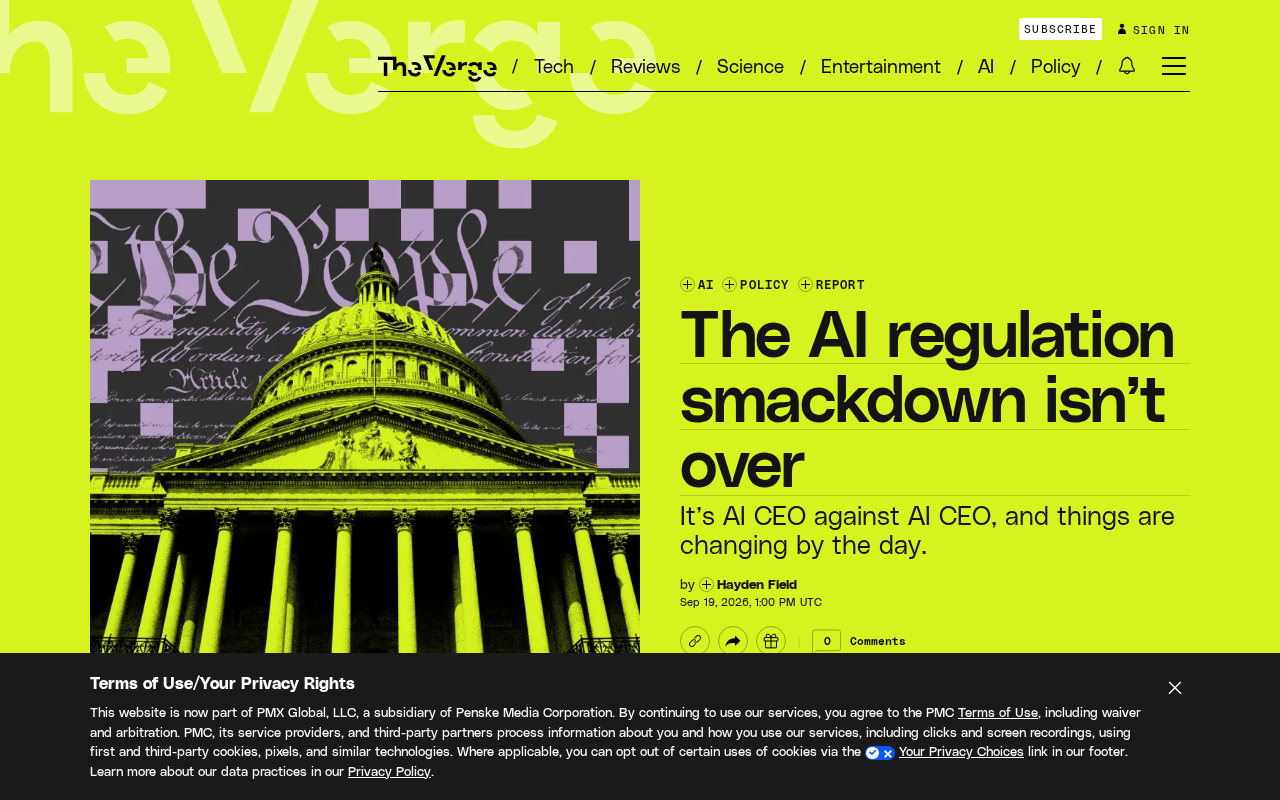
Amodei's Three-Step Regulatory Plan
According to the original report, Amodei's plan contains three core steps aimed at introducing a degree of deceleration into the rapid development of AI technology:
Step One: Embed Third-Party Evaluators Inside Labs
The plan proposes embedding independent, third-party evaluation bodies directly within AI laboratories. The core logic here is to allow external expert oversight of model development in real time — rather than waiting for post-launch audits. This "process-based regulation" approach is more forward-looking than traditional "outcome-based regulation," but it also places significantly higher demands on laboratory transparency.
Step Two: Coordinate Domestically Within the Industry
The second step emphasizes building coordination mechanisms within the U.S. AI industry. Individual companies, driven by competitive pressure, often find it nearly impossible to unilaterally slow their development pace — which means industry-level collective action is needed to avoid a race to the bottom. This step directly addresses the "prisoner's dilemma" at the heart of the AI race: how to get all participants to agree on safety without any single player being disadvantaged.
The prisoner's dilemma plays out in the AI race like this: if one lab unilaterally slows development to ensure safety while a competitor pushes ahead at full speed, the cautious lab loses ground in both market share and fundraising. This structural pressure makes company-level self-regulation largely non-credible — breaking the deadlock requires industry associations, government coordination, or binding compliance frameworks. Similar collective action problems have appeared historically in nuclear energy, pharmaceuticals, and financial derivatives, and were ultimately resolved only through external enforcement mechanisms to varying degrees. What makes AI unique is its extremely short technology iteration cycle, leaving relatively little time for coordination mechanisms to take effect — which is precisely why Amodei treats domestic industry coordination as a standalone step rather than a secondary measure.
Step Three: Push for International Agreements
The third step expands the vision to the international level, proposing that global AI development be coordinated through international agreements. Given the cross-border nature of AI technology and the realities of geopolitical competition, this is undoubtedly the most challenging and hardest-to-implement of the three steps.
The obstacles to building international agreements in the AI domain are far more complex than those facing nuclear non-proliferation treaties or climate accords. Nuclear weapons depend on scarce materials and specific infrastructure, making them relatively verifiable; AI capabilities are embedded in algorithms and compute, with low barriers to proliferation and difficult-to-monitor spread. Existing attempts include the UK-led "Bletchley Park Summit" in 2023 and the resulting Bletchley Declaration, as well as the Hiroshima AI Process under the G7 framework — but these initiatives remain at the level of declaratory principles, lacking enforceable verification and penalty mechanisms. Strategic competition between the U.S. and China in AI further narrows the negotiating space for any substantive international agreement. Amodei's decision to place international agreements third rather than first is itself a pragmatic acknowledgment of today's geopolitical realities.
Why "The Battle Is Far From Over"
The original headline makes the core judgment clear: this contest over AI regulation has not ended. The apparent industry consensus may be nothing more than a temporary, fragile posture.
History shows that when technology leaders publicly express support for regulation, their motivations are rarely simple. Genuine concern about technical risk often intertwines with commercial calculation — specifically, the opportunity to use regulatory standards to entrench one's own leading position. Each of the three pathways — third-party evaluation, industry coordination, and international agreements — involves complex redistribution of interests, and any party's position could shift as circumstances change.
This is precisely why the original piece emphasizes that the battle is "not yet over" — the so-called consensus looks more like a brief pause in an ongoing contest than a final settlement.
What This Means for the Industry
As the head of a leading AI laboratory, Amodei's proposed regulatory framework carries considerable influence as a model for others. Regardless of whether these proposals ultimately translate into actual policy, they at minimum reflect a rising concern within the industry about unconstrained development.
For practitioners and policymakers focused on AI governance, this three-step plan offers a useful starting point for discussion. The real test lies in how to build a regulatory system that is both binding and innovation-friendly — one that preserves technological dynamism without letting it run unchecked. The contest over the future direction of AI is destined to continue.
Related articles

FlyEnv Plugin Review: Visually Running llama.cpp and Managing GGUF Models
FlyEnv launches the official llama.cpp plugin with side-by-side Metal runtime management, public GGUF repository indexing with file type labels, and visual configuration of context, threads, and GPU layers—saving templates and speculative decoding with each model for one-click local LLM inference.

How Can Frontend Developers Advance into AI Agent Development? Deconstructing System-Level Agent Architecture from OpenClaw
Starting from the OpenClaw demo in a Bilibili open class, this article breaks down the three-layer architecture and universal formula of system-level AI agents, and analyzes the path for frontend developers to enter agent development based on TypeScript, including plugin-based design and security/memory layer challenges, with an interview answer framework.

WorkBuddy in Action: How AI Agents Automate Batch File Conversion and Archiving
Bilibili creator Teacher Shanyao tests WorkBuddy vs. Doubao on batch file conversion, showing how AI Agents move from "giving solutions" to "direct execution," with a full workflow and credit cost reference.