The AI Safety Regulation Debate: Who Gets to Define 'Safe'? One Tweet That Made Us Think
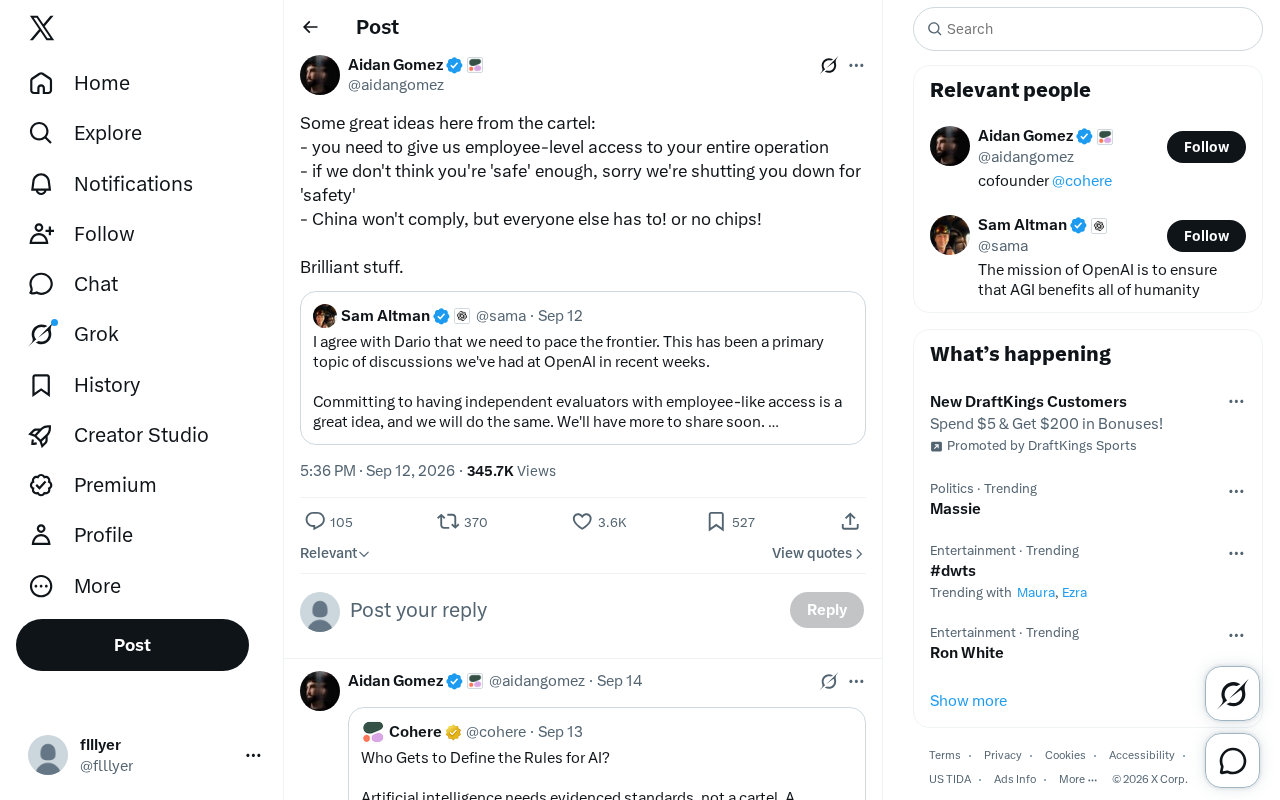
A viral tweet exposes AI regulation's core tension: "safety" as a cover for power monopoly and market protection.
A tweet mocking AI safety regulation proposals — calling them a "cartel's brilliant idea" — highlights three key concerns: employee-level operational access that risks exposing trade secrets; unchecked shutdown authority under the vague banner of "safety"; and a structural asymmetry where China faces no such constraints while everyone else must comply or lose chip access. The article argues these tensions reflect a deeper conflict in AI governance between safeguarding against real risks and preserving innovation, and warns against "safety" being weaponized as a tool of power and market control.
One Tweet and the Battle Over AI Governance
A recent tweet made waves with its sharp, satirical critique of certain AI safety regulation proposals. The author described some regulatory approaches as a "cartel's" "brilliant idea," pointing directly at the potential problems lurking behind the centralization of AI regulatory power.
Using irony, the tweet listed several so-called "regulatory requirements": demanding "employee-level access" to a company's entire operation; allowing regulators to shut down any company they deem insufficiently "safe" — in the name of "safety," of course; and one glaring contradiction — China won't comply with these rules, but everyone else must, or they don't get chips.
The Risk of Concentrated Regulatory Power
Brief as it was, the tweet cuts to the heart of a core controversy in AI governance: where should the boundaries of safety regulation lie, and who gets to define "safety" in the first place?
The phrase "employee-level access to your entire operation" reflects a widespread concern about regulators overreaching into companies' internal affairs. When a regulatory body gains deep access to a company's operations, trade secrets, patents, and competitive advantages may all be exposed. Critics argue that granting such access goes far beyond what legitimate safety oversight requires.
Even more telling is the line: "if we don't think you're 'safe' enough, sorry we're shutting you down for 'safety'." When "safety" becomes a discretionary standard rather than a clear, objective set of rules, it can easily be weaponized to suppress competition or target rivals. That's precisely why the tweet's author put "safe" and "safety" in scare quotes.
Cartel, in economic terms, refers to a small group of companies or institutions that collude to control prices, output, or market access — essentially a monopolistic alliance designed to eliminate competition. The tweet's author borrows this concept to suggest that certain AI regulation proposals may hand established incumbents and regulators a legally sanctioned tool to build market barriers: using "safety review" as a pretext to give dominant players life-or-death power over new entrants, effectively turning regulation into a mechanism for suppressing competition. This line of criticism is hardly new in U.S. tech policy discussions — early regulation of airlines and telecommunications was similarly accused of helping incumbents build moats rather than protecting the public interest.
The Hard Reality of International Competition
The tweet's most striking point is about the asymmetry of international compliance: "China won't comply, but everyone else has to! or no chips!"
This puts a finger on an unavoidable contradiction in today's AI regulation debates. If strict safety rules can only bind some participants but not all AI developers worldwide, such regulations may objectively weaken the competitiveness of those who comply — without actually achieving the goal of "safety." Chips, as the core resource powering AI compute, are being used as a regulatory lever, making this geopolitical game even more complex.
From an industry competition standpoint, excessive regulatory constraints could produce a "race to the bottom" dynamic — compliant companies get hamstrung, while unconstrained players gain room to grow. This concern is especially pronounced against the backdrop of geopolitics in the semiconductor and AI sectors.
Chips as a regulatory lever refers to making export licenses for advanced semiconductors conditional on companies or countries adhering to specific AI development standards. Since 2022, the U.S. has used Export Administration Regulations to restrict exports of high-performance GPUs (such as NVIDIA's A100 and H100 series) to China — a mechanism that has proven to be one of the most practically effective tools in technology governance today. The regulatory proposal alluded to in the tweet may go further, tying chip supply directly to corporate compliance: only companies that submit to regulatory oversight would be able to access compute resources. In practice, this would deeply couple chip allocation with regulatory discretion, creating a new power structure. Critics worry that without transparent standards, this mechanism could evolve into a tool for targeting specific competitors rather than a universally applicable safety guarantee.
How to Think About This Debate
Worth noting: this tweet is a strongly opinionated, satirical expression — it represents the "anti-overregulation" side of the AI governance debate. Real AI safety governance involves multiple considerations — public safety, ethical risks, technology misuse, and more — and cannot be reduced to a simple "regulation vs. freedom" binary.
Proponents of regulation would emphasize that the potential risks of AI — from deepfakes to autonomous weapons, from algorithmic discrimination to large-scale unemployment — all require some form of institutional constraint. Opponents, meanwhile, worry that regulatory power will be monopolized by a handful of institutions and repurposed for rent-seeking or market protection.
The value of this tweet lies in how it distills a crucial reminder: as AI safety governance moves forward, we must be vigilant about the over-concentration of regulatory authority and the risk of "safety" being misused as a pretext. A healthy AI governance framework should strike a balance between guarding against real risks and protecting the vitality of innovation — while honestly confronting the realities of international competition.
Part of the reason current AI safety regulation discussions are so contentious is that two distinct dimensions of "safety" are being conflated. The first is AI system safety (safety), referring to the reliability of model outputs, alignment, and the ability to avoid harmful behavior. The second is national security (security), referring to preventing AI technology from being acquired by adversaries or used in sensitive military and intelligence applications. The former typically requires technical standards and audit mechanisms; the latter relies more on export controls and access restrictions. When both meanings of "safety" are folded into a single regulatory framework, the ambiguity of regulatory goals leaves enormous room for discretionary power — and that is the deeper reason the tweet's author placed "safe" in scare quotes.
Conclusion
This debate over AI regulation is far from over. Regardless of where one stands, all parties should recognize: good governance is neither laissez-faire nor monopolized power — it is institutional design built on transparency, fairness, and accountability. When "safety" is invoked as justification, we need to ask even harder questions: whose safety, defined by whom, and in service of what?
Related articles
What Is Cursor? Core Differences Between This AI Coding Tool and Traditional IDEs
What is Cursor? This guide explains the AI-native code editor built on VS Code, how it compares to traditional IDEs, and its integration with Claude, DeepSeek, and Gemini.
Coze 3.0 Beginner's Guide: A Complete Overview of Agents and AI Applications
A beginner's guide to Coze 3.0: covering agents, AI applications, workflows, and plugins on ByteDance's AI platform, plus a comparison with Dify.
Setting Up the DeepSeek Harness Environment: A Complete Guide to Node.js Installation and Configuration
A beginner-friendly guide to setting up the DeepSeek Harness environment: Node.js installation, Add to PATH, redirecting npm global and cache directories, and configuring system environment variables.