The ALLY Framework: Teaching AI Counselors to Recognize and Repair Alliance Ruptures
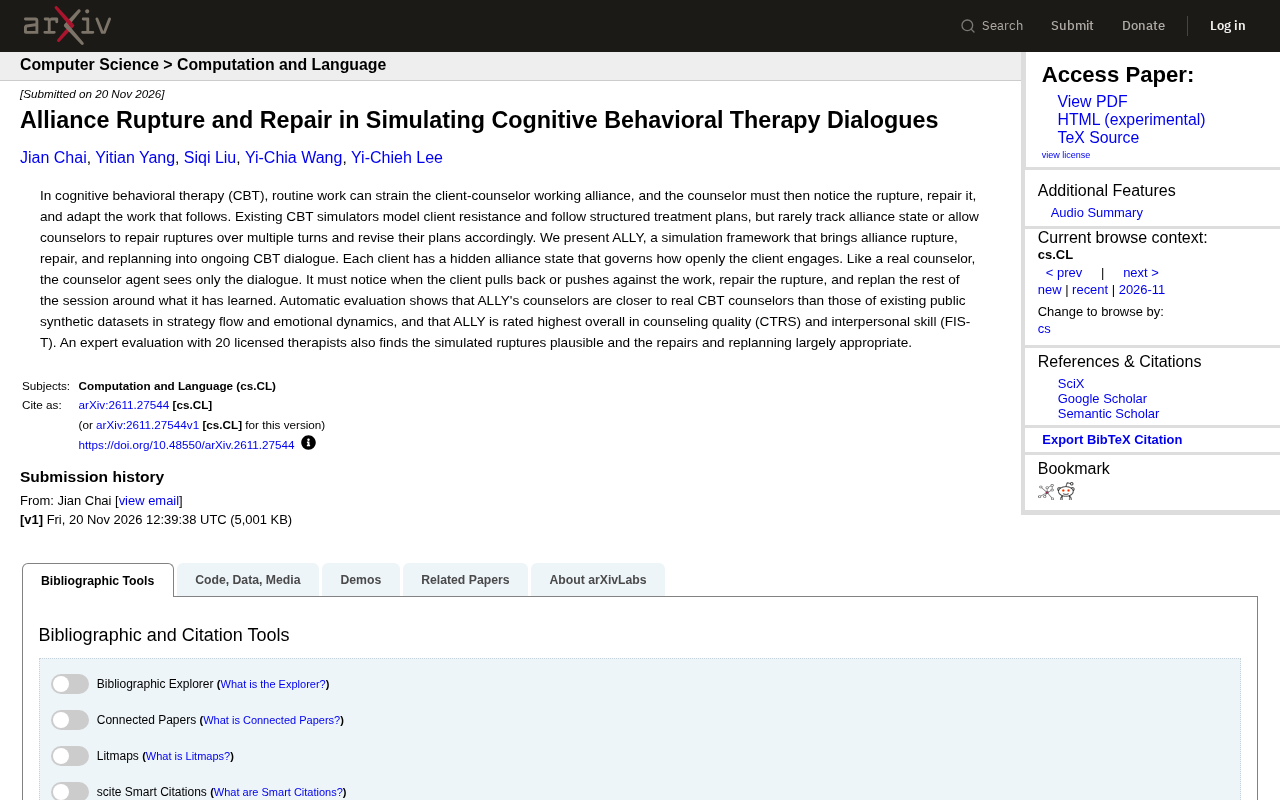
The ALLY framework introduces hidden alliance states and multi-turn rupture-repair mechanisms into CBT dialogue simulation, significantly improving realism.
The article introduces a CBT dialogue simulation framework called ALLY, aimed at addressing the lack of therapeutic alliance dynamics tracking in existing simulators. ALLY gives simulated clients a hidden alliance state that changes with dialogue and affects their openness or defensiveness; the counselor agent can only infer from dialogue content whether the alliance has ruptured and executes a multi-turn cycle of recognition, repair, and re-planning. Automatic evaluation shows that counselors generated by ALLY are closer to real CBT counselors in strategy flow and emotional dynamics than existing public synthetic datasets, with the highest composite scores on CTRS and FIS-T; an expert evaluation by 20 licensed therapists also found the simulated ruptures credible and repair and re-planning largely appropriate. The article notes that the study demonstrates explicit modeling of alliance states and multi-turn repair mechanisms are feasible and effective, offering a new paradigm of dynamic relationship modeling for AI counselor training, though a gap from real clinical settings remains.
In cognitive behavioral therapy (CBT), maintaining the therapeutic alliance often tests a counselor's skill more than the techniques themselves. When clients show resistance or withdrawal during therapy, counselors need to promptly notice this "alliance rupture," repair the relationship, and adjust subsequent treatment plans. Most existing CBT simulators only model client resistance or proceed along a fixed protocol, rarely tracking alliance states, let alone supporting multi-turn repair and re-planning. The recently proposed ALLY framework attempts to fill this gap by embedding alliance rupture, repair, and re-planning into ongoing CBT dialogues.
Alliance Rupture: The Missing Piece in CBT Simulation
In real CBT treatment, the working alliance between counselor and client is the foundation on which therapy can progress. Routine exercises, cognitive restructuring, behavioral experiments, and other tasks can themselves put pressure on clients, triggering alliance ruptures—clients may become avoidant, silent, or directly question the direction of treatment. Traditional CBT simulators typically focus only on client resistance levels or strictly follow structured treatment plans, whereas alliance states are hidden and dynamically changing, and counselors can only catch signals from dialogue. The core design of ALLY is that each simulated client has a hidden alliance state that determines their degree of openness in conversation. The counselor agent can only see the dialogue content and must, like a real counselor, judge from the words whether the client is withdrawing or confronting, then repair the rupture and re-plan the remaining sessions based on new information.
Therapeutic Alliance is a core construct in psychotherapy research, usually defined as a collaborative relationship between counselor and client along two dimensions: the emotional bond and agreement on goals and tasks. The three-factor model proposed by Bordin (1979) is the most commonly used theoretical framework for measuring alliance, and common assessment tools include the Working Alliance Inventory (WAI) and the California Psychotherapy Alliance Scales (CALPAS). Extensive meta-analytic evidence shows that alliance quality is one of the most robust predictors of treatment outcome across therapeutic orientations, with explanatory power even exceeding that of specific techniques. In CBT, the alliance exists not only as a relational background but also directly supports the execution of collaborative tasks such as cognitive restructuring and behavioral experiments; therefore, once an alliance ruptures without repair, dropout risk and loss of efficacy both rise significantly.
Alliance Rupture refers to tension, misunderstanding, or deterioration of cooperation in the therapeutic relationship. Safran and Muran distinguish two types: "withdrawal" (e.g., silence, compliance but detachment, avoidance of emotional topics) and "confrontation" (e.g., directly expressing dissatisfaction, questioning the counselor's competence or the direction of treatment). Rupture itself is not necessarily bad; research shows that effectively repaired ruptures may actually lead to better treatment outcomes, a phenomenon known as the "repair effect." Repair strategies typically include immediately noticing and naming the rupture, empathetically exploring the client's experience, the counselor taking appropriate responsibility, and negotiating adjustments to treatment tasks or goals. The ALLY framework abstracts this clinical cycle of "rupture—repair—re-planning" into a computable dialogue mechanism.
How ALLY Works: Hidden States and Multi-Turn Repair
The ALLY simulation framework contains two key roles: the client agent and the counselor agent. The client agent maintains an internal alliance state that changes as the dialogue progresses and affects its response style—more open when alliance is high, more defensive or avoidant when low. The counselor agent, with access only to the dialogue history, needs to accomplish three tasks: recognize signals of alliance rupture, adopt repair strategies (such as empathy, apology, adjusting task difficulty), and re-plan subsequent treatment steps based on repair outcomes. This multi-turn interaction design makes the simulation closer to the "rupture-repair-adjustment" cycle in real therapy, rather than one-off responses.
Evaluation Results: Closer to Real Counselors
Automatic evaluation shows that counselors simulated by ALLY are closer to real CBT counselors in strategy flow and emotional dynamics than counselors in existing public synthetic datasets. On the two metrics of counseling quality (CTRS) and interpersonal skills (FIS-T), ALLY achieved the highest composite scores. In addition, an expert evaluation involving 20 licensed therapists indicated that the simulated alliance ruptures were considered credible and that repair and re-planning were largely appropriate. These results suggest that explicitly modeling alliance states and supporting multi-turn repair can improve the realism of simulated dialogues and the reasonableness of counselor behavior.
The two evaluation metrics mentioned in the article are standardized rating tools in psychotherapy process research. CTRS (Cognitive Therapy Rating Scale) was developed by Young and Beck to assess a counselor's technical competence in a CBT session, including items such as agenda setting, feedback, understanding the client, interpersonal effectiveness, collaboration, guided discovery, focus on cognition and behavior, and homework, typically scored item by item on a 0–6 scale. FIS-T (Facilitative Interpersonal Skills-Task) derives from the performance-based assessment paradigm developed by Anderson et al., requiring counselors to respond in the moment to standardized "difficult client" stimulus clips, with raters scoring dimensions such as empathy, acceptance, and alliance building. The combination of the two captures the two sides of "technical execution" and "relationship building," so reporting both CTRS and FIS-T can more comprehensively reflect whether the simulated counselor both understands techniques and can maintain relationships. In addition, the expert evaluation used in the article is a subjective human rating whose credibility depends on inter-rater agreement, which is why such studies typically need to report rater reliability.
Implications for AI Counselor Training
The significance of ALLY lies not only in the technical framework itself but also in pointing a direction for AI psychotherapy simulation: real therapeutic dialogue is not linear plan execution but a dynamic process full of relational tension. Incorporating alliance rupture and repair into simulation can help counselors in training (or AI agents) learn to maintain relationships and adjust strategies under pressure. Of course, current evaluation still relies mainly on simulated environments and subjective expert ratings, and there remains a gap from real clinical settings. But ALLY at least demonstrates that hidden alliance states and multi-turn repair mechanisms are feasible and effective, providing a paradigm that subsequent research can draw on.
Related articles

Pure-Code Video Generation Tested: Which AI Model Actually Follows Instructions?
A Bilibili creator tested three AI models' pure-code video generation with unified prompts and three revisions each: Xiaonaomao has a high ceiling but lacks stability, GPT 6.2 Extra models well but only follows half the instructions, and OPAS 5.5 remains the benchmark.

GPT-6 Six-Tier Hands-On Test: Astra Ultra Dominates but Bills Double
GPT-6 six-tier test: Astra Ultra sweeps 3:0 in 3D tasks thanks to sub-agents and runs 14% faster, but hidden backend bills make its real cost 2.6x single-threaded.

GPT-6.2 Astra vs Fable 5.2: Huge Cost-Efficiency Gap Across 12 Real-World Tests
Bilibili creator tests GPT-6.2 Astra vs Fable 5.2 across 12 real tasks: Fable wins 7-5 but costs 7.2x more and takes nearly 5x longer. Token efficiency emerges as the key selection metric.