The American Open-Weight AI Revival: Three-Way Battle Between Safety, National Security, and Enterprise Strategy

America's open-weight AI revival pits enterprise data sovereignty, national security, and AI safety on a collision course.
Three parallel narratives are converging around open-weight AI in the US. At the enterprise level, cost control and data sovereignty are pushing companies from closed APIs toward locally fine-tunable open models — Vercel data shows open models already account for nearly 80% of enterprise token usage. At the industry level, Reflection AI and Nvidia are building "AI factory" models to counter Chinese competitors like DeepSeek. At the regulatory level, Trump's appointment of Jay Clayton as AI czar has elevated national security concerns, while AI safety accountability debates intensify. These three threads follow different logics and point in different directions, but in the coming regulatory cycle they are almost certain to collide — with profound consequences for the American open-source AI ecosystem.
An unreleased open-weight AI model is generating extraordinary buzz across the industry. Many believe it could be the one that reclaims the open-source AI crown for America. But what's truly fascinating isn't the model itself — it's the three distinct narratives taking shape around open-weight models in the US: AI safety, national security, and enterprise strategy. These three threads don't always point in the same direction. When they collide, who wins? And how will they be reconciled?
From the DeepSeek Moment to Enterprise Data Sovereignty
The conversation around open models has shifted dramatically over the past year. The first major inflection point was the DeepSeekAd moment — when this Chinese lab dropped a reasoning model into a free app, giving many people their first real exposure to reasoning-capable AI. The market reaction was violent: Nvidia lost roughly $580 billion in market cap in a single day, driven by a blunt fear: if cheaper Chinese models become the mainstream, does the massive infrastructure investment underpinning the entire market — and the broader economy — still make sense?
Now the narrative is shifting again. The open model conversation has moved well beyond a sandbox for startups and developers, cutting directly to the two pain points enterprises care about most: cost and data sovereignty. A critical question has emerged: does the US actually want to compete in this market, or should it cede that ground to China and focus on defending its lead in closed frontier models?
The distinction between open-weight and open-source is worth clarifying here. Strictly speaking, "open-source" requires publishing training data, training code, and model weights. "Open-weight" means only the model parameter files are released — users can download, deploy, and fine-tune them, but training data and the full training pipeline typically remain proprietary. Meta's Llama series and DeepSeek are both open-weight models. This distinction matters enormously in enterprise decision-making: open-weight models are sufficient for local deployment and fine-tuning, but they don't allow external parties to reproduce the training process or verify data provenance, leaving transparency and auditability limited. The core appeal of "data sovereignty" — the ability to avoid sending internal data to third-party servers — can be achieved through local deployment of open-weight models, which is precisely their greatest draw for enterprises.
Reflection AI and the "AI Factory" Model
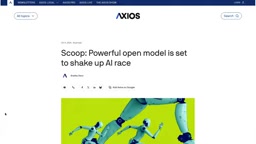
An Axios report that attracted outsized attention speaks to just how hot this space has become. The piece focused on Reflection AI — a company that has cultivated an air of mystery since its founding, raised billions in funding, signed a massive compute deal with SpaceX, and reportedly holds a roughly $1 billion contract with Nebius.
Reflection positions itself as the American answer to Chinese open-weight models — but with no available model, many dismissed this as fundraising rhetoric. According to Axios, the company is preparing to release its first model later this month. Early word suggests it performs quite well, competing directly with Chinese rivals and possessing "sufficient intelligence to help companies build their own low-cost AI systems."
What enterprise AI decision-makers should really pay attention to is Reflection's goal: building an "AI factory" — a system to help enterprises create their own AI systems on top of its models. The company has already signed a sovereign AI factory partnership with Shinsegae Group in South Korea and held closed-door briefings in Washington last week on its new model and AI factory concept.
More important than any single model is the trend it represents. Multiple American labs are reportedly preparing to release open models this month — Nvidia is said to be training Nemotron 4, and Thinking Machines Lab may have something in the works as well. Analyst Andrew Curran put it bluntly: "Is the American open-source renaissance about to begin?"
Nvidia: The Biggest Beneficiary Behind Open-Source AI
Within the American open-source camp, Nvidia is a loud and committed advocate. The company has trained multiple generations of large language models — Nemotron 3.5 has seen widespread adoption, Nemotron 4 is expected to approach frontier performance — and it's also building out models in vertical domains like robotics and autonomous driving.
The logic isn't complicated: Nvidia's core product is GPUs, and that core product benefits enormously from the proliferation of freely available AI models. Its investment portfolio reinforces this stance — Nvidia is a major backer of Reflection AI and several open-source labs, and last month it acquired Hugging Face for $12.9 billion.
At its developer conference, CEO Jensen Huang made the case for preserving open models: "Researchers need open source. Developers need open source. Companies around the world need open source. Open-source models are really, really important... Scientists need it, startups need it, enterprises need it."
Enterprise Trust Is the Real Story
The true shift in this year's conversation has been extending beyond "market impact of infrastructure investment" and "geopolitical competition with China" to how open models actually solve enterprise AI problems. At the center is fine-tuning capability — something closed models don't offer, and precisely where the difference lies.

Palantir CEO Alex Karp put it sharply: "Tech clients want control of their compute, their models, their data stack, and their alpha. They want to know they own the means of production, rather than handing it over to someone else."
Microsoft has systematized this logic. In his essay "The Inverse Information Paradox," CEO Satya Nadella argued that in the AI era, buyers may have to surrender knowledge in order to use what they've purchased — effectively paying twice for intelligence: once with money, and once with the proprietary knowledge they must reveal. The better the model performs, the more knowledge you feed into it, and the more the information asymmetry tilts against you.
Microsoft's solution isn't to sell open models, but to use its own models as a foundation and let enterprises fine-tune alongside a trusted partner. Mustafa Suleiman revealed that Microsoft's MAI model, tuned for McKinsey tasks, achieved the highest quality win rate against the then state-of-the-art GPT-5, while costing 10x less.
The behavioral shift is visible everywhere. Vercel CEO Guillermo Rauch disclosed that on one particular day, open models accounted for 78.4% of token usage on Vercel AI Gateway, with closed models at just 21.6%. Topics that didn't even make the agenda a year ago are now being taken seriously by a wide range of enterprises.
Fine-tuning refers to the process of taking a pre-trained large model and continuing to train it on domain-specific or task-specific data, aligning the model's behavior more closely with particular business use cases. Closed models (like GPT-4 accessed via API) typically don't expose weights externally — users can only influence outputs through prompt engineering, not by modifying the model's internal parameters. Open-weight models allow enterprises to download weights and fine-tune on their own infrastructure, effectively "baking in" internal knowledge, industry terminology, or specific workflows. This is the technical solution to what Nadella calls the "information asymmetry" problem: enterprises embed proprietary knowledge into the model through fine-tuning, while the data itself stays within the enterprise and never flows to the model provider. Microsoft's so-called "frontier tuning" — a service model that starts from a strong base model and fine-tunes it with enterprise data — is the commercial path that emerges from exactly this logic.
Where the Three Lines Converge: The Regulatory Wildcard
The biggest wildcard for the American open-weight AI revival is the regulatory environment. The Trump administration has appointed Director of National Intelligence Jay Clayton as the new AI czar and assembled a cross-agency AI task force that includes FTC Chair Andrew Ferguson, Vice President J.D. Vance, Treasury Secretary Scott Besant, and former AI czar David Sacks. The FTC is becoming an increasingly significant regulatory presence in the AI industry.
Clayton has explicitly framed his role in national security terms first: "The risk of not being first is very high... Being first allows us to better represent the American people against those risks." The appointment hasn't been without controversy — Steve Bannon has questioned Clayton's ties to China, while Tornado Cash developer Roman Storm, drawing on personal experience, takes a pessimistic view of the open-source outlook.

Meanwhile, the AI safety conversation is heating up on a separate track. Sam Altman told Politico that OpenAI and Anthropic have "pretty significant disagreements" on safety philosophy, and offered a widely circulated line: "We believe the world should accept some bad things happening in exchange for the benefits of this technology and people's agency." Though it was pulled from a more nuanced argument, in today's soundbite culture it became the only quote referenced for several days. What Altman was actually trying to express is the classic tension between safety and freedom — that excessive regulation, or restricting AI to a tiny number of gatekeepers, carries risks of its own that shouldn't be dismissed.
Treasury Secretary Besant reinforced a different position: when things go wrong, the frontier labs that enabled those bad outcomes must be held accountable for their own actions. The White House AI summit concluded with agreements among labs, reaffirming the concepts of third-party audits and board-level oversight.

These three threads — enterprise impact, AI safety, and national security — are almost certain to converge in some form during the coming regulatory cycle. But from the enterprise side, the case remains optimistic: markets follow opportunity signals strongly, and in a world where enterprises urgently need to address cost, data privacy, and data sovereignty, open models will only become more attractive.
The Tornado Cash case serves as an important reference point for understanding open-source regulatory risk. Tornado Cash is an open-source privacy mixing protocol running on Ethereum. Its developer Roman Storm was indicted on money laundering charges despite having no personal control over the protocol's operation. The case has become a landmark event in the open-source community — a challenge to the principle that "code is speech." If publishing open-source code can create criminal liability, developers face enormous legal uncertainty. Storm mentioned his pessimism about the open-source outlook precisely because his personal experience exposed a hard reality: even open-source tools released with good intentions can expose their original developers to liability if used for illegal purposes. The same logic applies to open-weight AI models — if an open model is used to generate harmful content or assist in an attack, the legal liability boundaries for the publisher remain deeply unclear. This is also a potential lever for tightened regulation from a national security perspective.
Related articles

Frontend to AI Agent Development: A Frontline Architect Explains Career Paths and Opportunities
A frontline AI architect explains the industry changes and practical paths for frontend developers transitioning to AI Agent development: why pure frontend jobs are disappearing, why Agent + full-stack has become mainstream in hiring, and three transformation routes—Agent development engineer, FDE, and remote contracting—along with corresponding learning strategies.

How to Choose an AI Agent Development Course: Five Pitfall-Avoidance Guidelines
A mechanical-engineering career changer's two-year pitfall-tested checklist for screening AI Agent development courses: complete delivery pipeline, resume-worthy projects, real development perspective, update frequency, and coaching feedback—with concrete judgment methods and pitfall-avoidance tips.

Coze AI Agent Building for Beginners: A Zero-Code AI Agent Development Guide
Coze, ByteDance's one-stop AI application development platform, supports zero-code drag-and-drop AI agent building. This article outlines Coze's core concepts, three advantages, differences between the domestic and international versions, and the distinction between agents and apps, helping beginners quickly get started with AI Agent development.