The Anti-Vibe Coding Backlash: On the Wrong Side of History?

Reddit hot post sparks debate: Is resisting vibe coding a cult or a rational concern?
A Reddit user called the group resisting vibe coding a "cult" and asserted they "will be on the wrong side of history." The post cites hands-on experience with a C++ physics simulation engine to argue that frontier AI models can generate optimized code on performance-critical paths, but emphasizes the necessity of "human-in-the-loop." The author also attributes anti-AI sentiment to foreign bots, though this accusation lacks verifiable evidence; genuine opposition comes from career anxiety, concerns about creative homogenization, and ethical doubts. The post warns that completely rejecting AI tools may weaken competitiveness, but "only vibe coding" is equally dangerous. It ends by calling for tolerance toward beginners and noting that AI is breaking "writing code" into different levels of activity, where binary side-taking thinking hinders understanding of the real changes in technical division of labor.
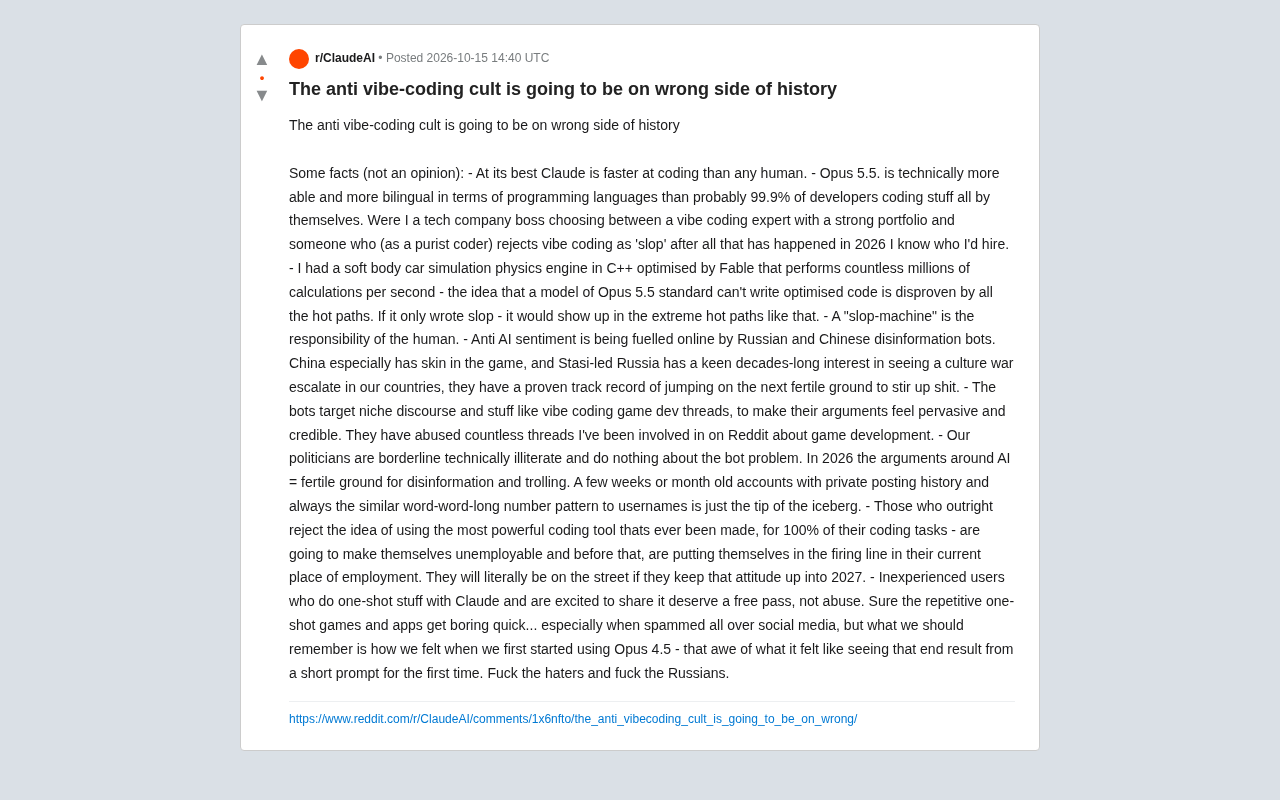
A Reddit user posted in an r/gamedev-related discussion, framing the group resisting "vibe coding" as a "cult" in a near-declaration-of-war tone and asserting they "will be on the wrong side of history." The post mixes intense personal experience, a defense of AI coding tools' capabilities, accusations of geopolitical manipulation, and a warning against "pure hand-coding fundamentalism." Setting aside the emotional rhetoric, the post actually raises several technical and social issues worth unpacking.
The Real Capability Boundaries of Vibe Coding Tools
The core argument of the post is the author's hands-on experience with AI coding tools in extreme performance scenarios. He mentions writing a soft-body car physics simulation engine in C++, where AI-assisted optimized code "executes millions of computations per second," refuting the claim that "models can only write garbage code."
"A model at the Opus 5.5 level cannot write optimized code—this claim is directly refuted by the performance of all hot paths. If it only wrote garbage, these things would show up in extreme hot paths."
Objectively, it's no longer rare for frontier models to generate reasonably optimized C++, Rust, or CUDA code in algorithm-intensive tasks. The key is "human-in-the-loop": experienced developers provide performance constraints, review memory access patterns, and verify numerical stability, while the model quickly generates candidate implementations and iterates. The post's emphasis that "99.9% of developers have less programming language breadth when coding alone than the model" is basically valid at the level of cross-language migration and API recall, but that's a different matter from "replacing systematic software engineering capability." The model can write fast-running hot functions, but that doesn't mean it can independently own the long-term evolution of a million-line codebase.
"Human-in-the-loop" is a frequently mentioned but often misunderstood concept in AI-assisted programming. Its core meaning is: the model generates candidate code, and humans set constraints, check outputs, and correct deviations. This model is crucial because current large language models' failures in code generation are often not "syntax errors" but "semantic micro-differences"—such as improper boundary condition handling, accumulated floating-point precision errors, or race conditions in concurrent scenarios. These issues may not surface in unit tests but can cause crashes under extreme loads. Therefore, experienced developers provide the model with explicit performance budgets (e.g., "ten million floating-point operations per second"), memory access constraints (e.g., "avoid random memory access"), and numerical stability requirements (e.g., "use Kahan summation"). The model then quickly generates multiple candidate implementations under these constraints, and humans select the optimal solution through benchmarking and code review. This division of labor leverages the model's generation speed while retaining human final judgment over system behavior.
"Anti-AI Sentiment Is Stirred Up by Foreign Bots"?
The most controversial part of the post directly attributes the anti-AI wave on the internet to "Russian and Chinese disinformation bots," claiming the bots specifically target niche topics like "vibe coding game development" to make opposing voices appear more widespread and credible.
This accusation needs to be examined separately. On one hand, social media platforms indeed have many low-quality, formulaic accounts with usernames following a "word-word-longnumber" pattern, short registration times, and private posting histories. Whether behind them are commercial troll farms, political manipulation, or simply internet trolls, such accounts amplifying divisive sentiment in hot controversies are a known platform governance challenge. On the other hand, attributing the criticism of a specific tech community entirely to foreign forces lacks verifiable evidence and easily slides into conspiracy theory narratives. A more reasonable observation is: anti-AI sentiment comes simultaneously from genuine career anxiety, concerns about creative homogenization, doubts about training data ethics, and pure aesthetic preferences. Packaging all opponents as "bots" or a "cult" is itself a form of discursive violence.
"Disinformation bots" and "troll farms" are two related but distinct concepts in social media governance. Bots typically refer to automated accounts that mass-publish content and amplify specific topics through programs; troll farms emphasize organized human manipulation, often with commercial or political purposes. Both may manifest as random usernames, concentrated registration times, and repetitive posting patterns. However, identifying them is not easy: ordinary users on platforms may also use similar naming conventions or appear "suspicious" due to privacy settings. More importantly, even confirming bot activity does not prove state support behind it. Academic research typically requires tracing funding flows, IP infrastructure, or internal documents to make attributions. Therefore, attributing the opposition voices of a tech community entirely to foreign forces is methodologically unsound. The more common reality is: commercial troll farms amplify controversies for traffic, political manipulators muddy the waters, and genuine user dissatisfaction gets swept up in this noise, ultimately forming a mixed public opinion field that's hard to trace.
Refusing AI Coding Tools = Career Suicide?
A more practical warning in the post is: developers who "100% refuse to use the strongest coding tool in history" are making themselves unemployable and may even be marginalized in their current positions.
This judgment has a realistic basis. In numerous commercial scenarios like game development, web backend, and data pipelines, engineers who can skillfully orchestrate AI agents, review generated code, and rapidly iterate prototypes do have significantly higher output per unit time than peers who code entirely by hand. In corporate hiring, candidates showcasing "AI-assisted completion of complex systems" in their portfolios are often more attractive than those showing only pure handwritten code. But this doesn't mean "if you can't vibe code, you can't find a job." System design ability, debugging skills, performance tuning experience, and domain knowledge remain key differentiators between senior engineers and prompt operators. The real danger is "only knowing vibe coding": once the model gets stuck or generates subtly erroneous code, those lacking underlying understanding will be helpless.
Be More Tolerant of Beginners
There's a commendable appeal at the end of the post: beginners who are new to AI coding and excitedly share "one-shot generated mini-games" should not be mocked.
"We should remember how we felt when we first used Opus 4.5—that awe when we saw complete results from a short prompt for the first time."
Repetitive, rough "one-click generation" works do get aesthetically tiresome, especially when they flood the feed. But every new tool's early普及 period goes through a process of "mass low-quality output → community filtering → best practice consolidation." Personal attacks on beginners' works don't help improve discussion quality and actually push potential learners into defensive positions. A more constructive approach is: point out specific areas for improvement, or share how to advance from "one-shot generation" to "multi-round iteration + human review" workflows.
"One-shot generation" and "iterative refinement with human review" represent two stages of AI coding workflows. The former means users input a prompt and the model directly outputs a complete runnable program, common in mini-games, simple tools, and similar scenarios. This approach has an extremely low barrier to entry and quickly brings a sense of accomplishment, but it also easily masks design flaws, security vulnerabilities, and maintainability issues in the code. The latter requires developers to break complex tasks into multiple substeps: first have the model generate interface definitions or pseudocode, then gradually fill in implementations, testing and reviewing at each step. This workflow is closer to agile development in traditional software engineering, just delegating some coding tasks to the model. Advancing from "one-shot generation" to "multi-round iteration" requires developers to actively learn how to write more precise prompts, how to design test cases, and how to read and modify AI-generated code. The community's tolerance for beginners' works is essentially protecting the starting point of this learning curve, not condoning low-quality output.
Not Taking Sides, But Refining Division of Labor
The title of this debate is quite clickbait, but it touches on a real fork: AI coding tools are breaking down "writing code" into different levels of activity—rapid prototyping, glue code, hot path optimization, system architecture, security review. Different levels naturally have different degrees of AI dependence. Simplifying "use AI or not" into a binary opposition both underestimates the complexity of the tools and overestimates the universality of a single methodology. What will truly be eliminated by history may not be a particular group of developers, but the discussion approach that refuses to think in detail and only attacks each other with labels.
Related articles

Free Unlimited Claude Code Solution: Agnes AI + CC Switch Setup Guide
No paid subscription needed — pair the free AI platform Agnes AI with the open-source tool CC Switch to provide a backend for Claude Code, enabling unlimited free calls to text, image, and video models. This guide covers the full setup, test results, and usage boundaries.

A Complete Zero-Cost Guide to Getting Started with Claude Code for Beginners in China
A beginner's guide to Claude Code for users in China: two installation methods (command line and IDE plugin), full configuration steps for replacing the official API with the free domestic LongCat model, and a hands-on demo of building a small tool with natural language, plus tips.

When the NSA Gets Involved: The AI Supply Chain Crisis Behind Open-Source CVEs and API Key Hijacking
Multiple open-source projects disclosed severe CVEs in one day, PHP flaws alarmed the FBI, and Railway and OpenCode were breached with API keys stolen. This article breaks down the vulnerability window, AI-accelerated exploitation, and the AI supply chain crisis behind the API key black market, with a developer defense checklist.