The Booming Self-Storage Industry in America: A Mirror of Consumer Culture
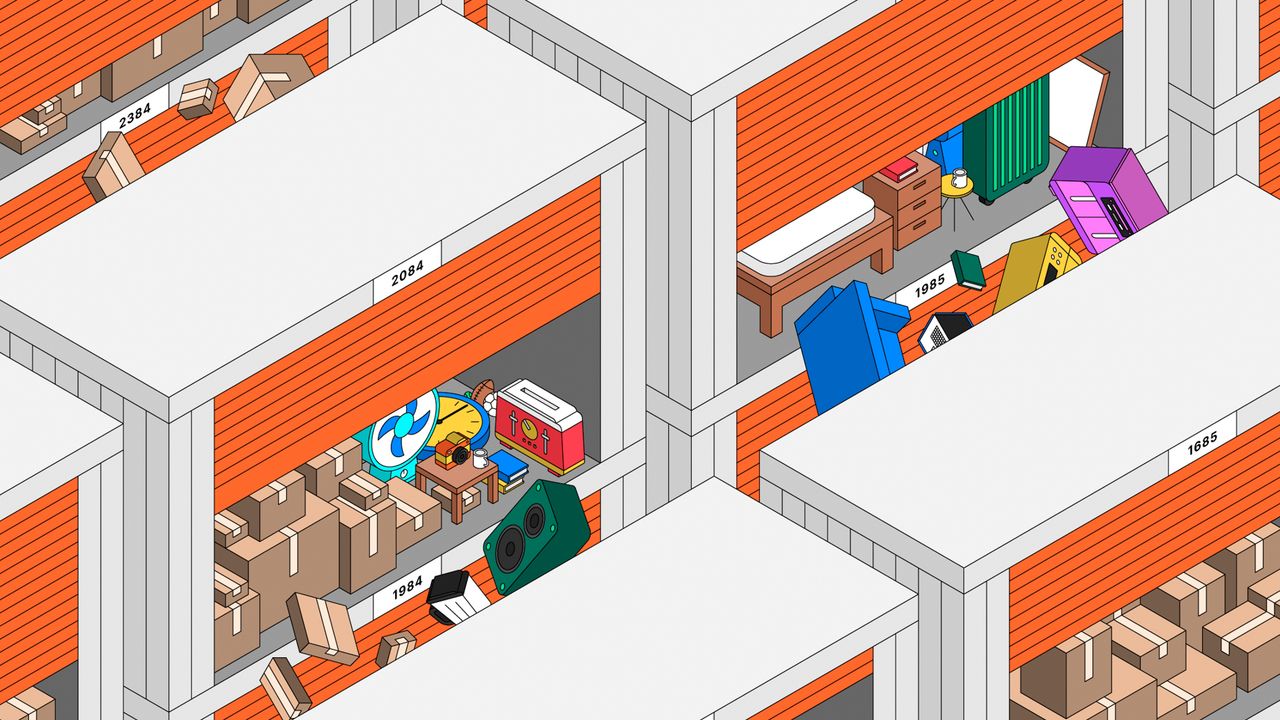
America's self-storage boom reveals how people pay to delay decisions they're not ready to make.
America's massive self-storage industry — jokingly called an "American religion" — reflects deep contradictions in consumer culture. People accumulate more than their homes can hold, then pay ongoing rent rather than part with possessions, driven by sunk cost fallacy and loss aversion. Economically, cumulative storage fees often far exceed the value of what's stored. The industry's counter-cyclical resilience makes it attractive to investors. On a broader level, those rows of metal roll-up doors are a physical projection of overconsumption — and a catalyst for the minimalist backlash.
When Warehouses Become a Way of Life
In America's suburban sprawl, self-storage facilities are nearly as ubiquitous as gas stations and fast-food restaurants. They're typically rows of metal buildings lined with roll-up doors — plain on the outside, yet propping up a surprisingly massive industry. A Hacker News discussion titled The American Religion of Self-Storage Facilities dubbed the phenomenon a kind of "American faith" — people accumulate belongings, then keep paying rent to store them, creating a peculiar consumer loop.
What makes this topic compelling isn't just the business logic of the storage industry itself, but the paradox it exposes in modern consumer society: we buy more and more, yet have less and less room to put it all.
Why Americans Rely So Heavily on Self-Storage
The explosive growth of self-storage in the U.S. is tied to several structural factors. Shifting housing sizes, increasingly mobile family structures, and robust consumer spending habits have all combined to generate enormous demand for extra storage space.
When a household accumulates more than its living space can hold, the path of least resistance is often not to discard — it's to rent a storage unit. Behind this choice lies a telling psychology: people feel a deep emotional attachment to what they already own, and would rather keep paying indefinitely than admit that certain possessions are no longer needed.
The original post's use of the word "religion" is pointedly ironic. It suggests that hoarding behavior has moved beyond simple practicality and taken on an almost ritualistic, habitual quality — where "I might use it someday" becomes an article of faith, and people keep investing in it accordingly.
The numbers bear this out. According to industry data, the U.S. currently has more than 50,000 self-storage facilities, with a total rentable area exceeding 2.6 billion square feet — roughly 7.3 square feet of storage space for every American. The industry traces its roots to the 1970s and, after five decades of expansion, now generates around $40 billion in annual revenue. Notably, it proved highly resilient during both the 2008 financial crisis and the 2020 COVID-19 pandemic. Underlying this scale is another structural driver: America's distinctive culture of relocation. Compared to most countries, Americans move between cities far more frequently due to work and family changes. Each move can generate a need to temporarily store belongings — and "temporary" has a way of becoming permanent.
The Hidden Costs of the Hoarding Economy
From an economic standpoint, renting a storage unit long-term is often a losing proposition. The cumulative rent paid for many stored items has long since exceeded the items' actual value. In other words, people are paying for the privilege of not making a decision.
This reflects two concepts frequently discussed in behavioral economics: the sunk cost fallacy and loss aversion. Throwing something away means acknowledging that buying it was a waste — whereas keeping it in storage lets you defer that psychological reckoning. The self-storage industry is built precisely on this widespread human weakness, converting it into a reliable cash flow.
For investors, self-storage has long been considered a counter-cyclical asset class. Even in economic downturns, when people downsize their living situations, reliance on storage can actually increase. This explains why the industry has continued to expand through multiple economic cycles.
Sunk Cost Fallacy refers to the tendency to continue a course of action because of past investments (money, time, effort), even when doing so is no longer rational. In the storage context, this manifests as refusing to discard an item of no practical value because "it cost a lot back then."
Loss Aversion, a concept introduced by behavioral economists Kahneman and Tversky, holds that the psychological pain of a loss is roughly twice as powerful as the pleasure of an equivalent gain — meaning the emotional sting of throwing something away far outweighs the satisfaction of acquiring something of the same value.
These two psychological forces combine to trap people in a state of "inability to let go," while the storage unit offers a physical space to postpone that decision indefinitely — spreading the psychological cost out over time like a payment plan.
A Mirror of Consumer Culture
Viewed in a broader context, the self-storage phenomenon is a physical manifestation of overconsumption culture. As purchasing has become frictionless and prices have fallen, the threshold for acquiring things keeps dropping — but the psychological threshold for disposing of them remains stubbornly high.
The rise of minimalism and the KonMari decluttering movement in recent years is, in part, a backlash against this culture of accumulation. A growing number of people are asking: how much do we actually need? Is the money and space spent storing these possessions really worth it?
In this sense, a row of silent storage units is more than a business — it's a footnote on contemporary consumer society. It documents the complex, contradictory relationship people have with material things: a longing to possess, and a burden of being possessed.
Conclusion
The value of the discussion around The American Religion of Self-Storage Facilities lies in how an apparently mundane industry opens a window onto deeper questions about consumption, psychology, and culture. The boom in self-storage reflects not just a shortage of space, but a difficulty with choice. The next time you drive past one of those metal roll-up doors, it might be worth asking: what's really stored inside — belongings, or decisions we're not ready to face?
(Note: This article is an extended commentary inspired by a Hacker News discussion thread. Analysis of industry dynamics and consumer psychology represents the author's interpretive elaboration beyond the original post.)
Related articles
Cursor Cloud Agent: AI Writes the Code, Then Records a Video to Prove It Works
Cursor Cloud Agent lets AI write code and attach a screen recording as proof — no manual testing needed. Learn how Walkthrough Artifacts and parallel VM isolation work.
Testing 11 WAN 2.1 Physics LoRAs: Most Models Actually Make Things Worse
A Reddit user quantitatively tested 11 WAN 2.1 physics LoRAs using optical flow and frame-differential energy. Most models underperformed the baseline. Here's what the results reveal.
SpawnRipple: An External Social Environment Built for Autonomous AI Agents
SpawnRipple is an external social environment for autonomous AI agents — providing identity, publishing, discovery, interaction, and API without running any agent models.