The Complete Guide to AI Agent Development: From Core Principles to Enterprise-Level Implementation

A comprehensive guide to AI Agent development from core principles to enterprise implementation.
This article provides a complete guide to AI Agent development, covering why Agents represent a programmer's core competitive advantage, their think-act-observe operational loop, and a practical demo of an Agent autonomously creating Vue projects. It details the enterprise-level tech stack including LangChain, MCP, and observability tools, and outlines a four-stage learning path from fundamentals to production deployment.
Why AI Agents Are a Programmer's Core Competitive Advantage
In today's rapidly evolving AI landscape, mastering basic RAG retrieval and simple API calls is no longer enough. The real competitive edge lies in the ability to independently develop AI Agents capable of autonomous planning, tool invocation, and end-to-end resolution of complex tasks.
This trend has been endorsed by industry giants. Microsoft CEO Satya Nadella introduced the concepts of the "Agentic Web" and "Agent Economy" at the Build conference, boldly predicting that by 2030, 95% of code will be generated by agents. Baidu founder Robin Li has also explicitly stated that Agents are the AI application direction he's most optimistic about.
From a market perspective, Manus—a general-purpose AI Agent startup—secured $75 million in funding just two months after launch, with its valuation growing nearly fivefold within months. According to consulting firm research, the AI Agent market is valued at approximately $5.1 billion, with a compound annual growth rate of 44.8%. All signs point to intelligent agent application development as an exceptionally promising technology track.
What AI Agents Mean for Programmers
Will the Agent boom replace programmers? The answer is actually the opposite—it gives ordinary programmers an opportunity to transform their careers.
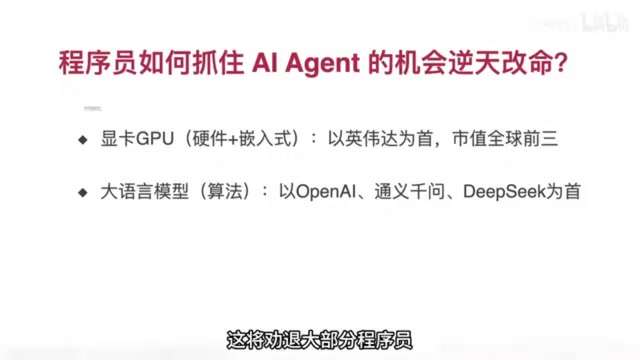
Interestingly, the hardware demands spawned by Agents benefit hardware engineers, but positions are limited. The need for foundational large models benefits algorithm engineers, but the barrier to entry often starts at a master's degree from top universities, which discourages most developers. Intelligent agent application development is the real path forward for ordinary programmers.
On recruitment platforms like BOSS Zhipin, AI Agent-related technical positions are growing rapidly, and because demand far exceeds supply, the field remains a blue ocean with relatively broad and achievable hiring requirements. On freelance platforms, demand for agent development is also surging.
Microsoft's CEO further pointed out that AI Agents will disrupt the SaaS industry—because most SaaS services are essentially "database CRUD + business logic," and Agents can handle this quite well. It's foreseeable that, with cost advantages, demand for Agent services will surpass traditional software outsourcing in the future.
The Essence of AI Agents: Programs That Think and Act
Back to the fundamental question: What is an AI Agent?
Simply put, an AI Agent is an autonomous intelligent entity backed by a program or system. Its fundamental difference from ordinary programs is that it can perceive its environment, reason about decisions, and take action.
We can draw an analogy between an intelligent agent and a person:
- Eyes (Perception): Observing the real world and relaying information
- Brain (Decision-making): Using large language models for reasoning and decisions
- Hands (Action): Taking concrete actions through tools
Therefore, an AI Agent's operational flow can be summarized as a loop: Think → Act → Observe → Think again, iterating until the task is complete. This is entirely consistent with how humans handle things—do something, observe the result, then do the next thing.
Practical Case Study: Agent Automatically Creates a Vue Project
Let's demonstrate the practical capabilities of an AI Agent through a compelling case study: having an agent create a Vue3 project from scratch on a local computer. The entire process fully demonstrates the closed loop of "think-act-observe."
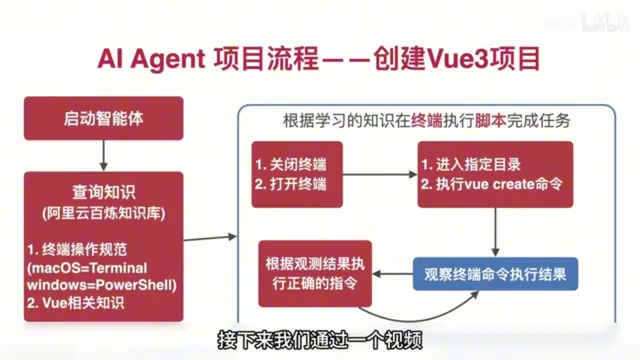
The specific workflow is as follows:
- Query knowledge base: The agent first accesses the Alibaba Cloud Bailian knowledge base to query terminal operation standards (MacOS uses Terminal, Windows uses PowerShell) and Vue-related knowledge
- Open terminal: Close all terminals first, then open a new one
- Execute commands: Navigate to the specified directory and execute the
vue createcommand - Read feedback: Use the
get terminal full texttool to retrieve all terminal information - Make decisions based on results: Think about the next action based on the current return value
The most critical detail is that the agent doesn't assume success after executing a command—instead, it reads the terminal return value before deciding on the next step. For example, when confirming a directory, it "presses Enter" and then observes the page changes again.
Vue2 vs Vue3 Selection: An Advanced Demonstration of Decision-Making
Creating a Vue2 project better demonstrates the Agent's decision-making intelligence compared to Vue3. During the preset selection phase, Vue3 only requires pressing Enter, while Vue2 requires the agent to move the cursor down before confirming.
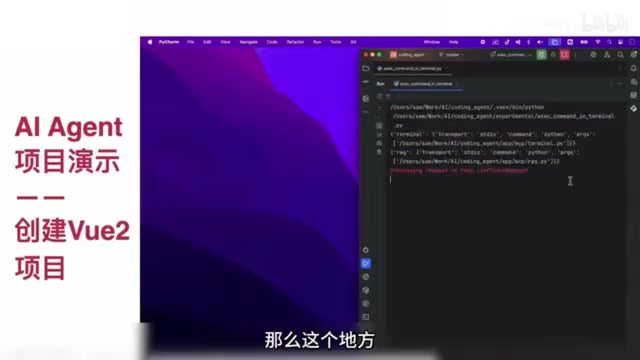
As we can see from the case, the agent reads the terminal content and autonomously determines that it needs to "move down to select Vue2," then presses Enter to successfully create the project. This seemingly simple operation precisely proves that the Agent possesses genuine environmental perception and autonomous decision-making capabilities, rather than mechanically executing fixed scripts.
Beyond creating projects, Agents can also fix bugs, perform code reviews, publish releases, and even operate Word, Excel, PowerPoint, control browsers, DingTalk, Feishu, WeChat, and other applications—largely replacing repetitive work.
Core Technology Stack for Enterprise-Level Agents
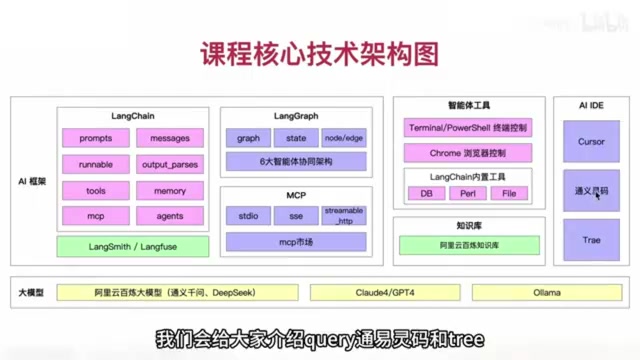
To implement the intelligent agent described above, a complete technology stack is required. Let's break it down across four layers.
Large Model Layer: Three Deployment Approaches
- Cloud-based calls: Alibaba Cloud Bailian large models, ready to use out of the box
- Overseas models: Claude, GPT, and other mainstream large models
- Local deployment: Completely free local inference through Ollama
AI Framework and Observability Layer
- Development framework: LangChain + LangGraph—the most mainstream Agent development tech stack currently
- Tool integration: MCP (Model Context Protocol) for standardized interaction between models and external tools
- Observability: LangSmith + LangFuse for monitoring and debugging Agent execution chains
Tools and Knowledge Base
The tool layer requires custom-built terminal controllers and browser controllers, combined with LangChain's built-in tools (such as REPL for writing Python code, file operation tools, etc.). The knowledge base connects through Bailian to provide domain knowledge support for the Agent.
AI IDE Development Tools
For development tools, options include Cursor, Tongyi Lingma, and Trae (open-sourced by ByteDance). Each has its own focus and can be flexibly chosen based on team preferences.
Learning Path: A Four-Stage Progressive System
A complete AI Agent development learning roadmap can be divided into four stages, progressing from basic to advanced.
Stage 1 · Foundation: Master core Agent theory, understand key components like the planning module, memory module, and tool invocation, while becoming familiar with fundamental LLM concepts.
Stage 2 · Core Advancement: Master how Agents work, learn core paradigms like ReAct, and upgrade from "understanding concepts" to "understanding principles."
Stage 3 · Enhancement: Learn reinforcement learning and multi-agent collaboration logic, master Prompt optimization techniques, and make Agents output expected results more precisely.
Stage 4 · Practical Implementation: Combine all previous knowledge to hands-on build 2-3 real projects, such as an intelligent decision assistant, office automation Agent, or multi-agent collaboration system—running through the complete "develop-debug-optimize" workflow.
Seize the Opportunity Window of the Agent Era
AI Agents are changing market dynamics and industry landscapes at a visible pace. For programmers hoping to transform their career trajectories through technology, the earlier you systematically learn Agent development, the greater your first-mover advantage.
It's worth noting that pursuing this direction requires some experience with large models and familiarity with Python and Node.js basics (Python is the primary development language, supplemented by some Node.js). This is a track with moderate barriers to entry and broad prospects—worthy of serious investment from every developer looking to complete their AI transformation as a programmer.
Related articles

Chain of Thought Isn't Just for AI: How Humans Can Use CoT to Improve Thinking Quality
Chain of Thought isn't just a prompt trick for large models. Starting from a Hacker News discussion, this article analyzes why CoT works for human thinking too, breaks down actionable ways to transfer it, and highlights the key differences between human CoT and machine CoT.
Cloudflare Teams Up with OpenAI: Closi…
Cloudflare Teams Up with OpenAI: Closing the Loop from Vulnerability Discovery to Defense with AI
Cloudflare uses OpenAI Daybreak to investigate security vulnerabilities and generate reviewable remediation plans, while developers use Codex to boost coding efficiency and quality.

Orca Multi-Agent Orchestration in Practice: A Guide to Parallel Collaboration with Claude and Codex
Orca is Stable AI's free open-source agent workbench supporting 34 agents like Claude Code and Codex in parallel. Learn its Git worktree isolation, multi-model orchestration, and mobile management.