The Complete Learning Path to Understanding the Kimi K3 Technical Report

A complete learning roadmap to understand frontier LLM technical reports like Kimi K3.
This article systematically outlines the complete learning path needed to understand the Kimi K3 technical report, covering four core modules: MoE (Mixture of Experts), MLA (Multi-head Latent Attention), distributed training strategies, and modern post-training techniques. It helps developers progress from recognizing terminology to understanding the engineering design philosophy behind each technical decision.
From Recognizing Terminology to Understanding Design Philosophy
Recently, a developer with a solid deep learning background posed a highly representative question on Reddit: What systematic learning path would allow someone to truly understand cutting-edge technical reports like Kimi K3?
The questioner's background is far from weak—he's completed graduate-level deep learning courses, understands Transformer architecture, attention mechanisms, and the fundamental principles of large language models (LLMs), and even has some familiarity with DeepSeek's OCR model. However, he admitted that he lacks in-depth knowledge of MoE (Mixture of Experts), MLA (Multi-head Latent Attention), distributed training, and modern post-training techniques.
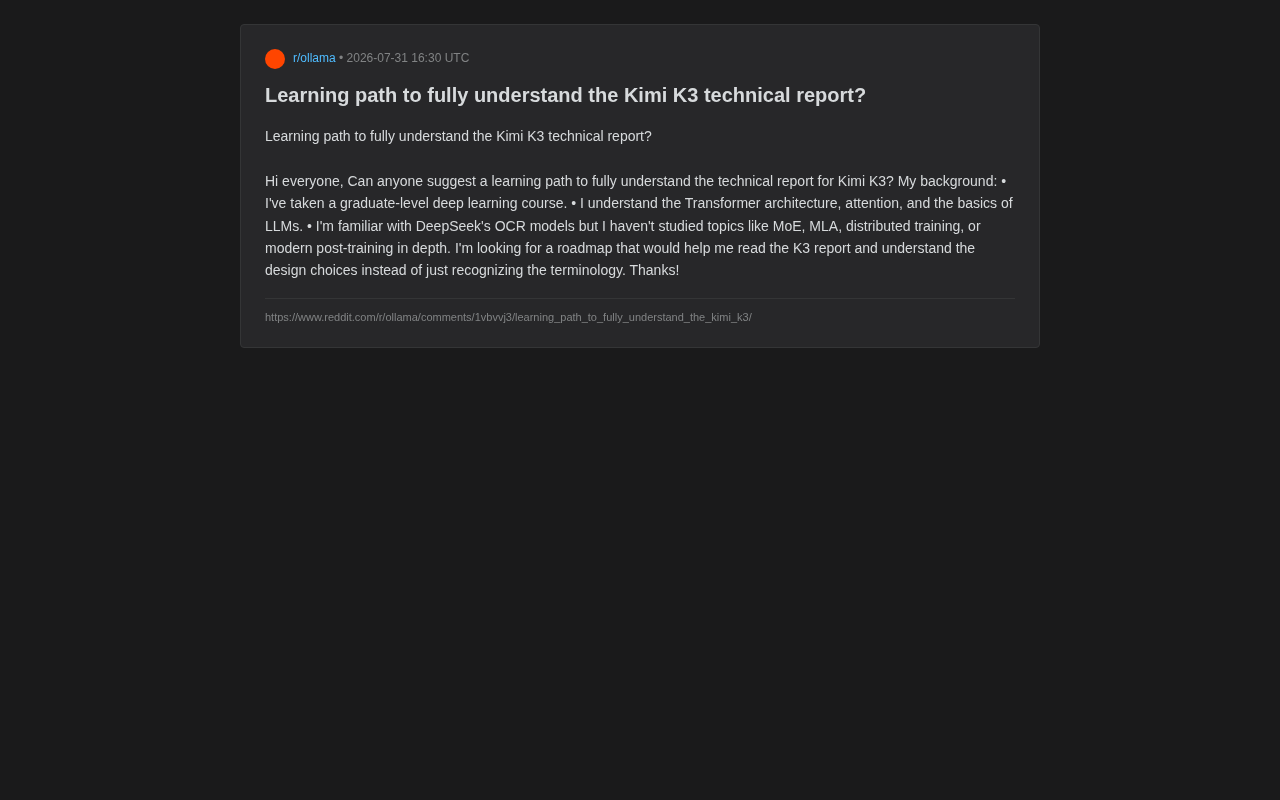
His core need is crystal clear: he doesn't want to stop at "recognizing terminology" but wants to understand the design choices behind each technical decision. This is precisely the dividing line between truly reading a top-tier technical report and merely skimming the surface. This article will outline a complete learning path from fundamentals to the frontier, centered around this need.
Why Understanding LLM Technical Reports Is So Difficult
Modern LLM technical reports (such as those from Kimi, DeepSeek, and the Qwen series) are hard to read not because any single concept is profoundly complex, but because they are high-density collections of multiple engineering decisions.
A single report might involve MoE sparsification at the architecture level, MLA compression of the KV cache at the attention level, complex parallelism strategies at the training level, and combinations of RLHF with various preference optimization algorithms at the alignment level. These techniques are interconnected—missing any piece of the puzzle leaves readers in a state of "understanding the words but not understanding the why."
It's worth noting that LLM technical reports differ significantly from traditional academic papers in their writing logic. Academic papers typically revolve around a single core contribution, with ample background introduction and comparative experiments. Industrial technical reports, however, read more like engineering decision memos—they assume readers are already familiar with major advances from the past year or two, often using just a sentence or two to explain the motivation behind a key design before jumping straight into implementation details. This high-information-density writing style requires readers to have not only vertical depth of knowledge but also horizontal coverage across architecture, systems, alignment, and other subfields' latest developments. Additionally, many ablation experiments and hyperparameter choices in these reports implicitly carry vast amounts of unwritten engineering experience—this "below the iceberg" knowledge often requires reading related works and community discussions to fill in.
The questioner's predicament lies precisely here: he can identify terminology but cannot understand why engineers made specific tradeoffs at specific points. And the essence of technical reports is hidden within these very tradeoffs.
Phase One: Solidifying Advanced Architecture Knowledge
For learners who have already mastered the standard Transformer, the first step should be filling in the architectural evolution of modern large models.
Core Principles of Mixture of Experts (MoE)
MoE is the mainstream approach for scaling model parameter counts today. Its core idea is to replace dense feed-forward layers with multiple "expert" networks, using a routing mechanism (router) to activate only a few experts per token, thereby maintaining low inference compute while having massive total parameter counts.
The MoE concept dates back to Jacobs et al.'s work in 1991, but it truly shone in large language models starting with Google's Switch Transformer in 2022. The core insight is: a model's "knowledge capacity" correlates with parameter count, but inference doesn't need to engage all parameters. Through sparse activation, MoE models can have several times or even tens of times more total parameters while maintaining inference FLOPs comparable to dense models. For example, Kimi K3 has trillion-level total parameters, but the actually activated parameters per token may only be in the tens of billions—meaning its inference cost is comparable to dense models far smaller than its total parameter count.
When studying MoE, focus on these questions:
- How does the routing mechanism work? Why does load imbalance occur? The router is typically a simple linear layer plus softmax, computing the probability of selecting each expert for each token. Due to randomness in early training and the "winner-takes-all" positive feedback loop, certain experts get over-selected while others gradually "starve"—this is the load imbalance problem. It not only wastes model capacity but also creates bottlenecks on certain devices during distributed training.
- How does auxiliary loss mitigate uneven expert utilization? Auxiliary loss adds a penalty term to the main loss function, encouraging the router to distribute tokens more evenly across experts. DeepSeek-V3 further introduced an auxiliary-loss-free load balancing strategy, using dynamic bias adjustment to replace explicit penalties, avoiding the interference of auxiliary loss on main task performance.
- Why does the communication overhead from sparse activation become a bottleneck in distributed training? Since different tokens may be routed to experts on different GPUs, training requires all-to-all communication—meaning each GPU must send data to and receive data from every other GPU. The overhead of this communication pattern scales linearly with GPU count and is one of the most critical system challenges in MoE model training.
It's recommended to start with Google's GShard and Switch Transformer papers, then compare them against DeepSeek-V2/V3's MoE design to understand the evolution from academic prototype to industrial deployment.
MLA (Multi-head Latent Attention) Mechanism Explained
MLA is a key innovation proposed by DeepSeek and widely adopted. It dramatically reduces memory usage during long-context inference by applying low-rank compression to the KV cache. Understanding MLA requires first grasping the memory bottleneck of KV Cache in standard multi-head attention, then seeing how MLA uses latent vectors to reconstruct this process.
To appreciate MLA's value, one must first quantify the scale of the KV Cache problem. In standard multi-head attention (MHA), each layer's each attention head needs to cache complete Key and Value vectors for every generated token in the sequence. For a 70B-level model (assuming 80 layers, 64 attention heads, 128 dimensions per head), at 128K context length, the KV Cache for a single request could exceed 40GB of memory—surpassing the total capacity of a consumer-grade GPU. This means that in long-context scenarios, the memory bottleneck isn't the model weights themselves but these ever-growing caches.
MLA's core mathematical intuition is: although the model has multiple attention heads, the KV representations across these heads contain significant redundancy—they can be compressed into a "latent space" of much lower dimension than the original. Specifically, MLA no longer caches each head's full KV vectors but instead caches only a shared low-dimensional latent vector (with compression ratios typically reaching 8-16x), recovering each head's KV through learned up-projection matrices when needed. This is similar to lossy encoding in image compression: retaining only the most critical information and decoding when needed.
Worth comparing is another popular KV compression scheme—GQA (Grouped Query Attention), used in models like Llama 2/3. GQA's approach is more intuitive: having multiple query heads share the same set of KV heads, thereby reducing KV Cache quantity. The key difference between MLA and GQA is: GQA's compression is "hard sharing"—directly reducing KV head count, potentially losing expressiveness; while MLA's compression is "soft compression"—through learned projection matrices, it can theoretically losslessly represent all information of the original MHA while achieving higher compression ratios. DeepSeek's experiments show that MLA achieves better model performance than GQA under the same KV cache budget.
The learning objective for this step is: understanding that MLA isn't designed to improve accuracy, but to trade memory and throughput efficiency in long-context scenarios—a classic "design choice."
Phase Two: Mastering Distributed Training Systems
If architecture determines what a model "looks like," then distributed training determines whether it "can actually be trained."
Models with hundreds of billions or even trillions of parameters cannot be trained on a single GPU or even a single machine—they require multi-dimensional parallelism strategies. Take a trillion-parameter MoE model as an example: model weights alone in BF16 precision require approximately 2TB of memory, and adding optimizer states (Adam optimizer needs to store first and second moments, approximately 2-3x the weight size) and activation caches, total memory requirements can exceed 10TB. Even using state-of-the-art H100 GPUs (80GB memory), at least hundreds of cards are needed to work together. How to make these GPUs collaborate efficiently and minimize idle waiting is the core problem distributed training systems must solve. This phase should systematically cover:
- Data Parallelism: The most basic form of parallelism. Understand gradient synchronization and ZeRO optimizer state sharding. ZeRO (Zero Redundancy Optimizer) is a core optimization from DeepSpeed, divided into three stages: ZeRO-1 shards optimizer states (saving ~4x memory), ZeRO-2 also shards gradients, and ZeRO-3 further shards model weights—so each GPU only needs to store 1/N of the complete training state. The key to understanding ZeRO is recognizing that in traditional data parallelism, each GPU redundantly stores the complete model replica and optimizer states, and this redundancy can be eliminated.
- Tensor Parallelism: Splitting single-layer weights across multiple GPUs. Understand Megatron-LM's classic implementation. The core of tensor parallelism exploits the decomposability of matrix multiplication—a large matrix multiplication can be split into combinations of smaller matrix multiplications, requiring only minimal communication in between (typically all-reduce operations). Since it requires frequent communication between GPUs within the same layer, it's usually deployed within a single node (between GPUs connected via NVLink) to leverage high-bandwidth interconnects.
- Pipeline Parallelism: Assigning different layers to different devices. Understand the bubble problem and its mitigation. Bubbles refer to idle time when certain pipeline stages wait for upstream data or downstream gradients. For example, in naive pipeline parallelism, when the first stage is processing forward propagation, the last stage can only wait idle. The 1F1B (One Forward One Backward) scheduling strategy significantly reduces the bubble ratio from O((p-1)/m) by interleaving forward and backward computation, where p is the number of pipeline stages and m is the number of micro-batches.
- Expert Parallelism: A parallelism dimension unique to MoE. Understand the cost of all-to-all communication. In expert parallelism, different experts are placed on different GPUs. When a token is routed to a particular expert, its hidden state must be sent from the current GPU to that expert's GPU, and sent back after computation—this is all-to-all communication. Unlike all-reduce (where all nodes exchange and aggregate the same data), all-to-all's communication pattern is "each node sends different data to every other node," causing communication volume to grow linearly with node count and making it difficult to effectively overlap with computation.
Recommended resources include official documentation and papers from Megatron-LM and DeepSpeed. Understanding these systems is necessary to decode statements in reports like "we adopted XX parallelism strategy to achieve XX MFU (Model FLOPs Utilization)"—seemingly understated but carrying tremendous engineering value. MFU is the core metric measuring training system efficiency, representing the ratio of actual compute throughput to GPU theoretical peak compute. Ideally MFU would be 100%, but due to communication overhead, memory bandwidth limitations, and pipeline bubbles, real systems typically achieve 30%-60% MFU. When a report claims over 50% MFU, it means their systems engineering has reached a quite high level—overlap of communication and computation, fine-grained memory management, and well-orchestrated parallelism strategies are all indispensable.
Phase Three: Deep Dive into Modern Post-Training Techniques
Pre-training is only half the story. What makes a model truly "useful" is the alignment work during the post-training phase. This is also the knowledge gap the questioner explicitly mentioned.
Learning Path from SFT to Preference Optimization
The recommended learning path is:
- Supervised Fine-Tuning (SFT): Understand how instruction tuning activates a model's conversational abilities. SFT's core insight is: pre-trained models already possess broad knowledge and capabilities, but they're trained to "continue text" rather than "answer questions." By fine-tuning on high-quality instruction-response pairs, the model learns to express existing capabilities in user-expected formats. Data quality matters far more than quantity at this stage—a small amount of carefully annotated data often outperforms large quantities of low-quality data.
- Classic RLHF Paradigm: Master the basic flow of Reward Models and PPO—this is the foundation for understanding subsequent algorithms. The complete RLHF pipeline includes three steps: first training a reward model (based on comparison data from human preference annotations), then using PPO (Proximal Policy Optimization) to maximize the reward model's scores for the language model, while preventing the model from drifting too far from the pre-training distribution through KL divergence penalties. PPO training instability is the main engineering pain point—it requires simultaneously maintaining four models (policy model, reference model, reward model, value model), is extremely sensitive to hyperparameters, and the reward model is susceptible to "reward hacking," where the model finds exploitative strategies that score high but produce low-quality outputs.
- Modern Preference Optimization Algorithms: Focus on learning DPO (Direct Preference Optimization) and its variants. Understand how they bypass explicit reward models and simplify the training pipeline. DPO's core mathematical insight is: within RLHF's objective function, there exists an analytical mapping between the optimal policy and the reward function—meaning we can express the reward function in terms of the policy itself, transforming the reinforcement learning problem into a simple classification problem. Specifically, DPO trains directly on preference data pairs (one good response and one poor response), increasing the log probability of good responses and decreasing that of poor responses, without needing a separate reward model or RL loop. This simplification makes training more stable and efficient, but introduces new tradeoffs—such as sensitivity to preference data distribution and weaker generalization compared to PPO in certain scenarios. Subsequent variants like IPO, KTO, and ORPO improve upon DPO's limitations in different directions.
- Reasoning Capability Enhancement: Recent reports universally emphasize RL's role in improving reasoning capabilities. Understand the RL training approach based on verifiable rewards. Unlike general RLHF, the key advantage of reasoning reinforcement is: for math and code problems, we can automatically verify answer correctness—math problems have standard answers, and code can run test cases. This means reward signals no longer depend on potentially biased human annotations or reward models, but come from objective verifiers. Works like DeepSeek-R1 and Kimi K1.5 demonstrate this method's power: through RL training on large numbers of math/code problems, models learn advanced reasoning patterns like step-by-step reasoning, self-checking, and backtracking—capabilities that are difficult to "teach" directly through SFT, because they fundamentally require the model to learn a search strategy rather than imitating fixed solution templates. Algorithms like GRPO (Group Relative Policy Optimization) estimate advantage values through within-group relative comparisons, avoiding the overhead of training a value model and becoming the mainstream method in reasoning reinforcement.
The post-training section is often where technical reports differ most between organizations, best showcasing their "secret sauce," and is most worth deeply examining for design motivations.
A Pragmatic Strategy for Reading Technical Reports
After filling knowledge gaps, when returning to reading reports themselves, the "three-pass method" is recommended:
- First pass: Read through the entire document, mark all unfamiliar terms and methods, and build an overall framework understanding.
- Second pass: For each technical choice, actively ask "why this instead of alternatives" and trace back to the corresponding foundational papers.
- Third pass: Connect all decisions in the report to understand how they serve a single goal—typically "training a stronger, more efficient model under limited compute."
It's worth emphasizing that the key to understanding design choices is to always read with constraints in mind. Every technical decision is an optimal solution under constraints of compute budget, memory limits, data scale, inference cost, and more. When you can reproduce these tradeoffs from an engineer's perspective, you've truly understood a technical report.
Conclusion
Moving from "recognizing terminology" to "understanding design" is fundamentally a transformation from knowledge consumer to engineering thinker. For frontier reports like Kimi K3, MoE, MLA, distributed training, and modern post-training form the four pillars. After conquering them one by one, readers gain not just the ability to understand a single report, but a transferable analytical framework for evaluating any frontier model work.
Related articles
Getting Started with Ollama: The Go-To Tool for Running Open-Source LLMs Locally
Ollama is a free, open-source tool for managing and deploying open-source LLMs like DeepSeek locally. Learn what it is, its cross-platform support, CPU/GPU features, and key use cases.

LM Studio vs Ollama vs vLLM: A Deep Dive into Local LLM Deployment Tools
LM Studio, Ollama, and vLLM compared: ease of use, performance, and ideal use cases. Beginners pick LM Studio, developers use Ollama, enterprises go with vLLM.
Getting Started with Ollama: The Essential Tool for Local Open-Source LLM Deployment
Learn what Ollama is and why it matters: a free, open-source tool for deploying LLMs like DeepSeek locally, with GPU/CPU support, cross-platform compatibility, and API access for private AI apps.