The Death of Codex: How OpenAI Buried Developers' Favorite Coding Brand With Its Own Hands

OpenAI folded Codex into ChatGPT, killing a beloved developer coding brand.
OpenAI has fully absorbed the Codex app into ChatGPT, ending a standalone brand beloved by developers. While the overhaul brought real feature upgrades in Computer Use and context handoff, it caused a marketing disaster of brand-recognition collapse—and highlighted the value of the open-source alternative T3 Code.
A Brand Beloved by Developers Just Disappeared
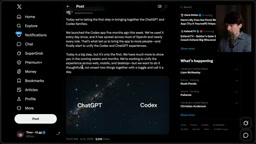
In the fierce competition among AI coding tools, OpenAI's Codex was once one of the most sought-after names in the developer community. With OpenAI announcing a complete overhaul and the launch of "ChatGPT Work," the Codex app has been fully absorbed into ChatGPT—this once-standalone brand, beloved by countless developers, has essentially died.
Well-known tech blogger Theo expressed strong dissatisfaction in a video. He admitted he "really, really loved the Codex app," and even built an open-source clone project called T3 Code specifically in case OpenAI one day screwed it up. Now, that worry has come true.
Interestingly, the name Codex itself has carried too many transformations: from the code-specific model of 2022–2023, to the later CLI tool, to a dedicated model version paired with the CLI, to the desktop app and website… the brand's meaning kept getting diluted. Yet even so, that desktop app still won developers' hearts.
Technical Background: The Evolution of Codex The history of OpenAI Codex traces back to 2021, when it first appeared as a derivative model of GPT-3, fine-tuned specifically on GitHub's open-source code repositories to become the underlying engine of GitHub Copilot. Its core breakthrough lay in the ability to directly translate natural language into executable code, supporting more than a dozen programming languages including Python, JavaScript, and Go. Unlike ordinary language models, Codex's training data composition was heavily skewed toward code corpora—according to OpenAI, the proportion of code-related content in its training set far exceeded that of GPT-3, giving it a qualitative leap in understanding code context, inferring function intent, and completing complex logic chains. In 2022, OpenAI opened the Codex API to developers, once causing an industry sensation, and many startups built derivative products such as code review, documentation generation, and automated testing on top of it. However, as GPT-4's coding capabilities surged dramatically, the dedicated Codex model was gradually replaced by the flagship models—GPT-4 comprehensively outperformed the original Codex on code benchmarks like HumanEval, and the marginal value of maintaining a separate code model plummeted accordingly. The brand began undergoing repeated redefinitions, which planted the seeds for the brand-recognition confusion that would follow.
The Actual Functional Upgrades Brought by the Overhaul
Setting emotions aside, this overhaul did bring some noteworthy functional improvements.
A Unified Plugin Ecosystem and Enhanced Computer Use
The new ChatGPT integrates plugins for PDF management, spreadsheets, presentations, and Sites (beta), while also connecting to mainstream third-party services like Gmail, Slack, Notion, and Google Drive. The plugin layer between ChatGPT and Codex has been unified, eliminating the need to maintain two separate systems.

The biggest highlight is the significant improvement in Computer Use capabilities, including multi-tab support, enterprise-grade browser authentication, and faster execution speed. Combined with GPT-5.6's progress in Computer Use, the overall experience is quite impressive. The built-in browser supports authenticated websites, multiple tabs, and file downloads, and tabs can persist as well.
Technical Background: Agentic Tasks and Computer Use Agentic tasks refer to an AI model's ability to autonomously plan, decompose, and continuously execute multi-step operations, rather than merely responding to a single query. The core of this paradigm lies in the "plan-execute-feedback" loop: the model must not only understand the final goal but also break it down into an actionable sequence of subtasks, dynamically adjusting its strategy based on environmental feedback during execution. Computer Use, meanwhile, was a capability first introduced by Anthropic on Claude 3.5 Sonnet in October 2024, allowing AI to directly manipulate a computer interface—moving the mouse, clicking buttons, typing text—to achieve direct control of the GUI without relying on dedicated API interfaces. The revolutionary aspect of this capability is that the vast majority of real-world software systems were not designed for AI invocation, and only AI that can "see and operate the screen" can truly integrate into existing workflows. OpenAI subsequently followed suit, integrating similar capabilities into Codex and later products. The core challenges of such technology lie in latency (the screenshot → recognition → action response chain is relatively long), error recovery mechanisms (how to detect and correct mistaken operations), and the setting of safety boundaries (preventing AI from executing destructive, irreversible operations). The addition of multi-tab support and enterprise-grade browser authentication was precisely to make such long-running tasks more usable in real work scenarios—which also explains why Codex's capabilities are, for OpenAI, far more than just a "developer-only" tool.
Seamless Context Handoff
Another practical improvement is the context handoff between Pro mode and Codex. Theo noted that he used to first discuss ideas with the Pro model, then manually copy the context over to Codex—now this workflow is built in, sparing the tedious operation.
The overhaul also brought noticeable performance optimizations. Theo mentioned that the old Codex app used to severely overheat his computer for long stretches, whereas the new version barely produces any heat at all. He speculated that this is precisely the version OpenAI had been using internally—the company had long since fully migrated to the unified app, and the old Codex app was riddled with problems, the root cause being that "nobody was maintaining it at all."
A Marketing Disaster: The Collapse of Brand Recognition
However, the functional upgrades cannot cover up the major blunder this overhaul represented at the brand level.
The Naming Dilemma of Codex
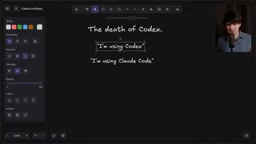
Theo pinpointed the core problem: when someone says "I'm using Codex," you have no way of telling whether they mean the CLI, the GPT-5.3 Codex model, the desktop app, or the website. The confusion in what the brand points to directly leads to recognition failure.
As a contrast, he made an interesting observation: when someone says "I'm using Claude Code," almost everyone knows this refers to the CLI. The brand reference is clear and unified—precisely what Codex lacks.
Industry Background: The Logic of Brand Competition in the Developer Tools Market The AI coding tools market underwent explosive expansion between 2023 and 2025, with the number of new entrants in 2024 alone exceeding the total of the previous three years. Products like GitHub Copilot, Cursor, Windsurf, Claude Code, and Codex formed a fiercely competitive landscape. Against the backdrop of increasingly homogenized model capabilities, brand recognizability and capturing user mindshare became key dimensions of differentiation. For developer tools, brand clarity is especially critical—developers rely heavily on word-of-mouth and community recommendations, and product names often become direct mental anchors for usage scenarios: say "Vim" and it means terminal editing, say "Postman" and it means API debugging, say "Docker" and it means containerization. Once this "name equals scenario" cognitive pattern is established, it produces powerful network effects and switching barriers. Anthropic's Claude Code has a clear brand reference partly because it has always focused on the single entry point of the CLI, never undergoing repeated naming reconstructions—the equation "Claude Code = AI coding assistant in the terminal" is highly stable within the developer community. By comparison, the Codex brand went through many forms in under three years—model, CLI tool, dedicated model, desktop app, web version—and each expansion diluted its original brand-recognition equity, forcing users to attach extensive contextual explanations when recommending it—which, in a developer community where growth is driven by word-of-mouth, is a fatal cost.
From a Star Brand to a "Toggle Switch"
Codex's brand influence once reached considerable heights: OpenAI ran a Super Bowl ad for it, its month-over-month growth once exceeded 5x, and NVIDIA CEO Jensen Huang even emailed Sam Altman to express his excitement about Codex. Developers wore Codex merch to events, and some spontaneously organized Codex-exclusive in-person meetups.
Now, as someone described in the comments: it used to be "bro, you gotta try Codex," and now it's become "bro, you gotta try Codex mode in the new ChatGPT desktop app." This gap in phrasing directly kills the momentum of word-of-mouth spread.
Why This Is a Strategic Misjudgment
Theo's core argument is: part of the reason Codex succeeded was precisely because it "wasn't ChatGPT."
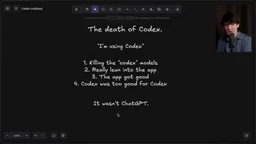
Developers who chose Codex didn't want to use ChatGPT in the first place—if they had, they would have already been using it. What they needed was a standalone interface built by developers, for developers, focused on developers' real-world use cases. This sense of "exclusivity" fostered strong brand loyalty, and folding it into ChatGPT amounts to erasing that uniqueness.
"Codex Did Too Well, and That Ended Up Hurting Codex"
Theo raised an incisive paradox: the Codex team did such an excellent job—so excellent that many people (including himself) once completely abandoned Claude Code. When version 5.4 confirmed that a dedicated Codex model would no longer be trained separately and its capabilities had been folded into the flagship models, Codex's endgame was, in fact, already written on the wall.
Because what Codex excelled at—long-running agentic tasks, the ability to operate a computer—is equally valuable beyond code. Naturally, OpenAI wanted to open up these capabilities to ChatGPT's nearly one billion users. From a business-logic standpoint, this decision is beyond reproach.
Industry Background: The Product Strategy Pivot of AI Labs From late 2024 into 2025, several top AI labs simultaneously shifted their product focus from vertical developer tools toward general-purpose productivity platforms. The underlying logic of this pivot is that, although the developer market has extremely high word-of-mouth value and technical influence (developers are key nodes in the technical decision-making chain and can influence enterprise procurement decisions with a multiplier effect), its user base and payment ceiling fall far short of the general-purpose market aimed at hundreds of millions of ordinary users. ChatGPT's registered users are estimated to exceed 800 million, while there are roughly 27 million professional software developers worldwide—a nearly 30-fold gap between the two. Against the backdrop of investors' persistently high expectations for AI companies' revenue growth, opening up Agentic capabilities from developer-exclusive scenarios to a broader user base is an inevitable choice for major labs under commercialization pressure—which also explains why Claude pushed an Excel plugin, Grok showcased PPT generation capabilities, and Google Gemini deeply integrated the Workspace office suite. However, this strategic pivot is essentially a zero-sum game for attention: once product teams begin optimizing the experience for hundreds of millions of ordinary users, the pace of feature iteration originally focused on core developer users is inevitably diluted. How to expand the general user base without damaging the brand equity deeply bound to the core user group is precisely the hardest balance to strike in this transformation.
Organizational Concerns
Theo also mentioned the news that Fiji Simo, head of OpenAI's applications business, was transitioning to an advisory role (mainly for health reasons). As the key figure responsible for driving products like ChatGPT mobile, the website, and Codex, her departure introduces uncertainty into OpenAI's organizational coordination among research, applications, and developer tools. As Theo put it: "When there's a problem with the driver, you've got a driver problem."
Open-Source Hedge: The Value of T3 Code Stands Out
Facing OpenAI's move, Theo was glad he had prepared in advance. T3 Code was precisely the open-source alternative he built as a last-ditch effort after becoming thoroughly disappointed with the performance issues of the old Codex desktop app.
Because the Codex CLI is open source (the desktop app operates through the CLI's app server), T3 Code was able to leverage this open interface to offer users choices they could modify themselves, lock to old versions, and fix on their own. Currently, thousands of users are running its forks or patched versions, and about a quarter of users have adopted some form of customized version.
Technical Background: CLI Architecture and Open-Source Hedging Strategy The Codex CLI was released on GitHub with an open-source strategy, and its architecture includes an app server layer responsible for establishing a communication bridge between the local process and the AI model. This design allows third-party clients (such as T3 Code) to reuse all core capabilities by calling the app server interface without relying on the official frontend—including task queue management, context persistence, and file system operation permission control. This "open backend, closed frontend" architecture is fairly common in the developer tools domain, with VS Code's Language Server Protocol (LSP) being a classic example—the editor is decoupled from the language service, and any editor can plug into the same language-intelligence backend, which is the technical basis for editors like Neovim and Emacs enjoying the same language intelligence as VS Code. The open-source strategy carries dual significance here: for users, it means auditability, customizability, and the ability to fork independently when a vendor's decisions change; for the ecosystem, it accelerates community accumulation around the core tool, forming network effects. However, the continued availability of the app server depends entirely on OpenAI's business decisions—once the official party stops maintaining it or modifies the interface protocol (for example, privatizing the app server or changing the authentication mechanism), all downstream third-party tools face the risk of compatibility breakage, which is Theo's greatest concern.
Theo admitted: "I originally hedged against the possibility of Codex getting worse, but I never expected it to become a toggle switch inside ChatGPT. But here we are." Fortunately, OpenAI still retains the app server for now, which means third-party tools like T3 Code can still invoke Codex capabilities. But he also worries: the features developers need may continue to be downgraded going forward, making way for new features being stuffed into ChatGPT.
Conclusion: The "Developer-Exclusive Era" of AI Labs Is Drawing to a Close
Theo's final reflection carries considerable industry insight: Codex being renamed to ChatGPT, Claude constantly pushing Excel plugins, xAI loudly showcasing Grok's ability to make PPTs—the era in which major AI labs were once 100% focused on software developers seems to be ending in sync.
He believes that pushing powerful features like Codex and Claude Code to non-developer users is not wrong in direction. But the mistake OpenAI made was: sacrificing a thriving, developer-beloved brand in exchange for superficial integration and unification. This is a fundamental misreading of "how people perceive and discuss these products."
For teams that have only done one thing for a long time, this is a common trap—they lose the ability to step back and examine their product from an outside perspective. And this time, what the outside world saw was a brand funeral full of confusion.
Key Takeaways
Key Takeaways
Related articles

Apple HomeView Hands-On Review: Is the $300 Smart Home Hub Worth It?
Apple HomeView hands-on: a $300 smart home hub with facial recognition for quick account switching, but no App Store or voice recognition. Is the wall-mounted version worth it? Should you buy the first generation?

Meta Muse Wonder Launch: What It Means for Meta's Return to the Frontier AI Race
Meta releases Muse Wonder and WonderFull, benchmarks reach the frontier, community feedback is polarized. An in-depth look at Meta's return to the frontier AI race, its personal agent strategy, and Zuckerberg's different path.

Apple Home Smart Home Lineup Leaked: LG and Schneider Team Up, UWB Door Lock on Board
Apple Home ecosystem gains new LG and Schneider devices: UWB smart lock with proximity unlock, 2.5K dual-camera doorbell, privacy indoor camera, and AirPods-like seamless pairing.