The Design Philosophy Behind Nintendo's Ocarina of Time Remake: The Pursuit of Elegance

Nintendo's Ocarina of Time remake pursues "elegance" through cross-generational collaboration, balancing nostalgia with modern experience.
Nintendo's remake of The Legend of Zelda: Ocarina of Time on Switch 2 attempts to fuse the classic N64-era experience with modern graphics and gameplay. The article's core focus is not the technical upgrades themselves but the fact that the remake team was led jointly by veteran and newer developers: the older generation brings an understanding of the original's pacing, feel, and level logic, while the newer generation injects modern graphics technology and control conventions. Both sides pursue a kind of "elegance"—restrained and purposeful changes that neither make modern elements feel jarring nor reduce nostalgia to mere replication. This reflects how classic game remakes are shifting from "HD-ification" to "experience redesign," showing that team composition and design consensus are the deeper factors determining a remake's success.
Nintendo's remake of The Legend of Zelda: Ocarina of Time on Switch 2 attempts to fuse the classic N64-era experience with modern graphics and gameplay. According to an RSS source, the remake preserves much of the original content while breathing new life into the game through modern technology. More notably, the development team itself embodies a kind of "cross-generational" collaboration—the remake was led jointly by veteran and newer developers (the original article did not fully disclose details of the team's composition).
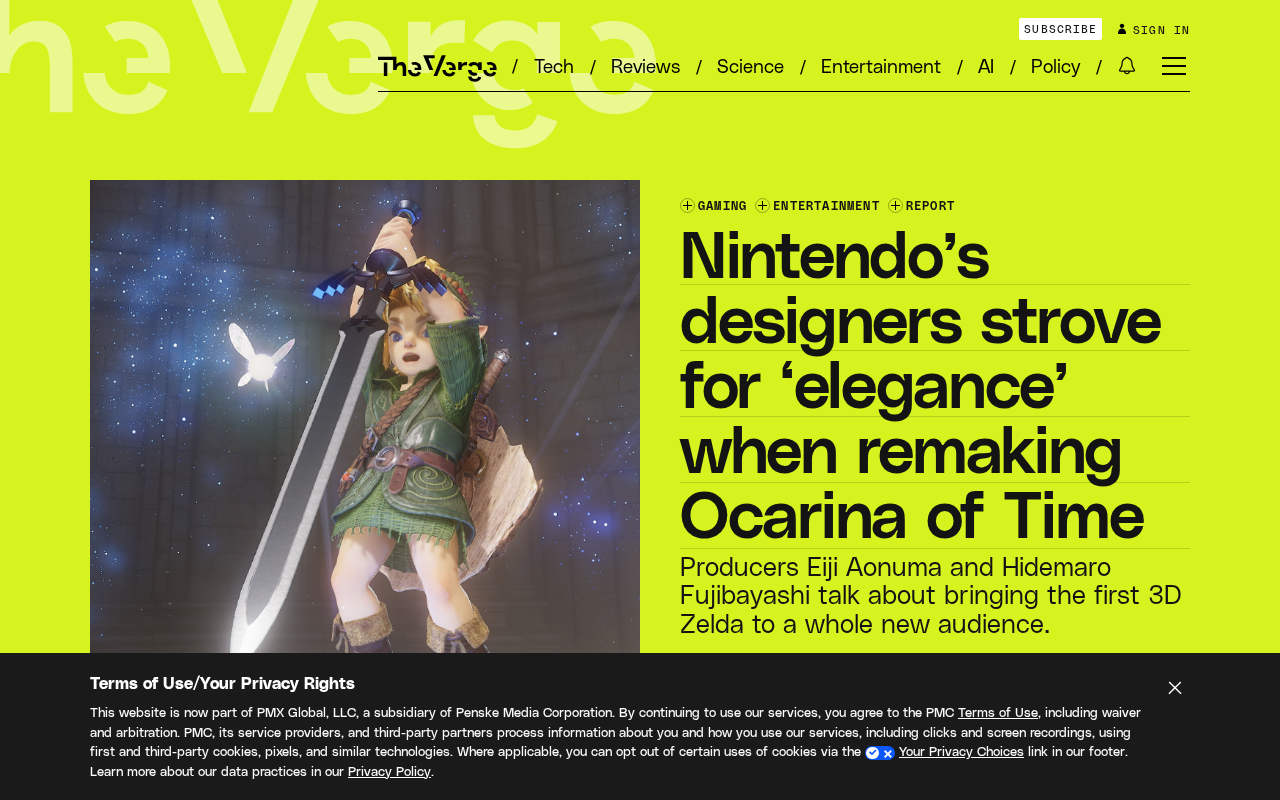
A Development Team Blending Old and New
According to the original article, the remake's development team spans designers from different generations. This "interleaving of eras" in the team's makeup forms a subtle echo of the game's own time-travel theme. The older generation of developers brings a deep understanding of the original's pacing, feel, and level logic, while the newer generation is responsible for injecting modern graphics technology and control conventions.
This collaborative model is not a simple splicing of old and new; it requires both sides to reach consensus on aesthetics and design language. The original article notes that the designers strove for a kind of "elegance"—neither letting modern changes feel jarring nor allowing nostalgic elements to become mere replication.
The Legend of Zelda: Ocarina of Time was originally released on the N64 in 1998 and is widely regarded as the founding work of 3D action-adventure games; its lock-on targeting, context-sensitive actions, and dungeon design established the basic framework for later games in the genre. A so-called "remake" differs from an "HD port": a port typically only increases resolution and frame rate, whereas a remake often involves asset reconstruction, adjustments to control logic, and even redesign of level details. Precisely because the original holds benchmark status in gaming history, any change is easily scrutinized under a magnifying glass by longtime fans, so the development team had to make numerous trade-offs between preserving the original's feel and introducing modern conveniences—which explains why "elegance" became a repeatedly emphasized keyword for the project.
What "Elegance" Specifically Means in a Remake
Although the original article does not elaborate on the specific design details of "elegance," it can be inferred from the features presented in the remake: it means changes should be restrained and purposeful. Modern graphical upgrades and gameplay adjustments are used to enhance the original experience rather than overwrite it. On Switch 2, players can both rediscover the familiarity of the N64 era and avoid being put off by outdated controls or visuals.
This design orientation reflects a broader trend: classic game remakes are shifting from "HD-ification" to "experience redesign." Nintendo's designers clearly recognize that simply increasing resolution is not enough to truly modernize an old game; the real challenge lies in how to make old and new elements coexist harmoniously within the same product.
The shift from "HD-ification" to "experience redesign" is a visible trend in the gaming industry in recent years. Early remakes mostly focused on resolution increases and texture replacement—low in cost but unable to address structural problems such as outdated controls and insufficient guidance; a new generation of remakes is more inclined to redo the UI, add accessibility features, adjust pacing and difficulty curves, and even reconstruct some levels. The judgment behind this shift is that modern players' time budgets and control habits differ from those of twenty years ago, and merely replicating visuals cannot bridge the experience gap. Nintendo's emphasis on "restrained and purposeful" changes in the Ocarina of Time remake is precisely a more conservative but risk-controllable route within this trend.
Implications for the Remake Trend
The design approach of the Ocarina of Time remake offers a case worth noting: when the development team itself spans generations, "elegance" becomes a coordination mechanism. It requires veteran and newer developers to jointly judge which elements must be preserved, which can be adjusted, and which should be discarded. This judgment cannot be accomplished through algorithms or automated tools; it can only rely on an understanding of the original's spirit and a grasp of modern players' expectations.
For readers interested in game remakes and the modernization of classic IPs, this case shows that technological upgrades are only superficial; team composition and design consensus are the deeper factors determining the success or failure of a remake. Nintendo's emphasis on "elegance" this time may well be responding to a core question—a remake is not about moving the past into the present, but about making the past still hold true in the present.
Related articles

The Complete Guide to Choosing Models in Ollama: From Configuration to Quantization Pitfalls
A complete guide to choosing models in Ollama: from checking your hardware to browsing the official library, explaining Tools, Thinking, Vision, and Decision tags, plus trade-offs between parameter size, quantization, and context cache to avoid crashes.

Is Ollama Secure by Default? The Truth About GPU Freeloading and a Self-Check Guide
Ollama binds to loopback by default, but one environment variable or a copied Docker command can expose your GPU. This article explains how GPU freeloading works, the scale of scanning, and DNS rebinding paths, plus a three-layer self-check and fix guide.

Cherry Studio + MCP in Practice: Building Automated AI Agents and a Local Knowledge Base
Based on a Bilibili Cherry Studio tutorial: configure MCP, build automated AI agents for web scraping and report generation, and set up a local knowledge base with Ollama + Qwen3, plus real-world pitfalls.