The Digital Illiteracy Crisis in the AI Era: Cognitive Literacy Gaps Rival Obesity Rates

In the AI era, cognitive and information literacy gaps may be as widespread and damaging as obesity.
A viral tweet comparing America's 41.83% obesity rate to illiteracy rates highlights a hidden crisis: in the AI age, functional illiteracy and poor information literacy are widespread yet invisible threats. As AI tools make answers effortless, cognitive laziness grows. The article argues we need a "cognitive fitness" movement—cultivating critical thinking and information discernment—to counter digital illiteracy that threatens democratic decision-making and social cohesion.
A Tweet That Sparks Deep Reflection
Recently, a short message circulating on Twitter (now X) has sparked considerable discussion. The original post contained just a few words:
41.83% obesity rate in the US
how about 41.83% illiteracy rate?
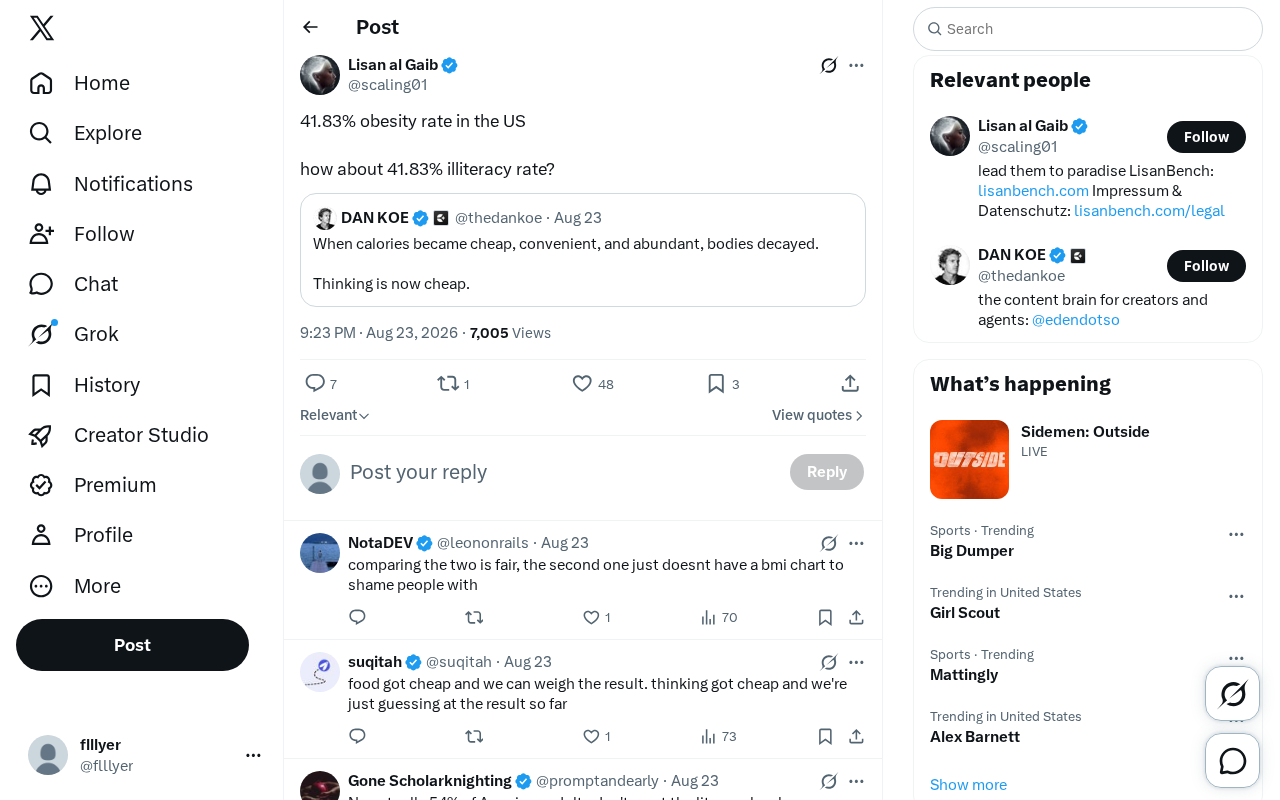
This tweet uses a strikingly powerful comparison, placing two seemingly unrelated social indicators side by side: one is a widely studied and reported public health issue—obesity rates—and the other is a relatively overlooked yet equally alarming social problem—illiteracy rates (or more broadly, "functional illiteracy"). While this analogy carries some rhetorical exaggeration, it touches on a real and profound issue: In an era of information explosion, our attention to physical health far exceeds our concern for cognitive and information literacy.
Behind the Data: The Certainty of Obesity vs. The Ambiguity of Illiteracy
Obesity: A Fully Quantified Health Crisis
America's obesity problem is indeed severe. According to data from the Centers for Disease Control and Prevention (CDC), the adult obesity rate in the U.S. has long remained above 40%. This figure has a clear medical definition (typically BMI ≥ 30), systematic statistical standards, and substantial public health resources devoted to it. In short, obesity is a "fully measured" problem.
The Body Mass Index (BMI) was proposed by Belgian statistician Adolphe Quetelet in the 19th century, calculated as weight (in kilograms) divided by the square of height (in meters). The World Health Organization defines BMI ≥ 25 as overweight and BMI ≥ 30 as obese. The CDC continuously tracks obesity data in the U.S. population through the National Health and Nutrition Examination Survey (NHANES). It's worth noting that BMI itself is controversial—it cannot distinguish between muscle mass and fat mass, nor does it account for differences in fat distribution—but as a population-level epidemiological indicator, it remains the most widely used measurement tool. It is precisely because of such standardized measurement systems that obesity has become a "manageable" public health issue.
Illiteracy: An Invisible Crisis That Defies Easy Definition
By comparison, the concept of "illiteracy rate" is far more complex. Traditional illiteracy (complete inability to read and write) is quite rare in developed countries—the U.S. basic literacy rate exceeds 99%. But when we discuss functional illiteracy—the inability to understand and use complex textual information needed in daily life (such as medication instructions, contract terms, or financial statements)—the picture changes dramatically.
Functional Illiteracy was formally defined by UNESCO in 1978, referring to individuals who possess basic literacy skills but cannot effectively use reading and writing to meet complex demands of everyday social life. The National Center for Education Statistics (NCES) assessments conducted in 2003 and 2017 (NAAL/PIAAC) show that approximately 54% of American adults read below a sixth-grade level, and about 21% fall into the lowest literacy tier. The OECD's Programme for the International Assessment of Adult Competencies (PIAAC) also confirms that the proportion of functional illiteracy in developed countries far exceeds intuitive expectations.
Multiple studies show that a significant proportion of American adults have notable deficiencies in reading comprehension, digital literacy, and information discernment. While the precise figure of "41.83%" in the tweet may not have a rigorous source, the core point it conveys deserves serious consideration: Cognitive deficiencies may be just as prevalent as physical health deficiencies—they're simply harder to see and measure.
The "New Illiteracy" of the AI Era: From Reading to Information Literacy
Being Literate Doesn't Mean Being a Critical Thinker
In the age of artificial intelligence, the definition of "illiteracy" is being rewritten. When large language models like ChatGPT and Gemini can write articles, summarize materials, and even provide decision-making advice on our behalf, a new question emerges: If a person cannot distinguish the truth from fiction in AI-generated content, or assess the credibility of information, then even if they can read and write, they may be "digitally illiterate" in a new sense.
Understanding this risk requires first understanding how these tools work. Large Language Models (LLMs) like ChatGPT and Gemini are based on the Transformer architecture, learning statistical patterns of language through pre-training on massive text datasets. Their core mechanism is "next token prediction"—probabilistically generating subsequent text based on preceding context. This means LLMs are fundamentally powerful pattern-matching systems, not true reasoning engines. They may generate content that appears plausible but is factually incorrect (known as "hallucinations"), and they may inherit biases from their training data. Understanding these technical limitations is itself a crucial component of information literacy—if users treat AI output as authoritative fact rather than reference information requiring verification, they are already cognitively "blind."
Information Literacy and Digital Literacy are becoming more critical capabilities than traditional literacy, specifically including:
- Evaluating the reliability of information sources
- Identifying AI-generated content and misinformation
- Understanding the logic behind algorithmic recommendations
- Possessing basic critical thinking skills
The Paradox of Convenience and Dependence
AI tools have dramatically lowered the barrier to accessing information and completing tasks, but this may also lead to cognitive "atrophy." Just as convenient high-calorie food has fueled the obesity epidemic, readily available AI answers may foster "cognitive laziness"—people increasingly accept ready-made conclusions rather than engaging in deep thinking and independent judgment.
From a psychological perspective, this phenomenon is closely related to Daniel Kahneman's "System 1/System 2" thinking framework. System 1 is fast, automatic, and intuitive; System 2 is slow, effortful, and analytical. Humans naturally tend to rely on System 1 to conserve cognitive resources—an evolutionarily sound strategy, but one that can lead to judgment errors in today's complex information environment. When AI tools provide ready-made answers, they essentially substitute for System 2's function. Long-term dependence may lead to the atrophy of deep thinking abilities, similar to how over-reliance on GPS navigation can diminish spatial memory. This isn't an argument against using AI tools, but rather a reminder: tools should augment, not replace, our thinking capabilities.
This is precisely where the tweet's analogy is brilliant: Excessive convenience, whether dietary or informational, can bring hidden health risks.
Why This Analogy Deserves Our Attention
Visible Problems vs. Invisible Crises
Obesity is a "visible" problem—it manifests physically, has clear medical consequences, and society is actively addressing it. Cognitive and information literacy deficiencies, however, are "invisible"—they don't immediately produce severe consequences and are therefore often overlooked.
But in the long run, if a society develops widespread deficiencies in information discernment and critical thinking, the harm may rival that of a public health crisis—it can degrade the quality of democratic decision-making, intensify filter bubble effects, and amplify the spread of misinformation.
The Filter Bubble concept was introduced by internet activist Eli Pariser in 2011, describing how algorithmic recommendation systems, based on users' behavioral history and preferences, continuously push homogenized content, wrapping users in their own information comfort zones. Related to this is the Echo Chamber effect, where people in closed information environments only encounter voices that align with their own views, reinforcing existing biases. Social media recommendation algorithms, personalized search engine results, and customized AI assistant responses can all exacerbate this phenomenon. Research shows a significant correlation between filter bubbles and political polarization and social fragmentation. When large numbers of citizens lack the ability and awareness to break through their filter bubbles, the quality of collective decision-making at the societal level will inevitably decline.
Education Systems Are Clearly Lagging
Current education systems are significantly behind in addressing AI-era information literacy challenges. Schools devote enormous resources to teaching traditional knowledge but rarely systematically cultivate students' ability to evaluate AI content or resist information manipulation. This stands in stark contrast to the massive resources the public health sector invests in combating obesity.
Some countries are already taking action. Finland incorporates media literacy into its mandatory curriculum starting from primary school, teaching students how to identify misinformation and propaganda techniques. The EU's Digital Education Action Plan (2021-2027) also lists digital literacy as a priority. By comparison, the United States has not yet established a unified information literacy education framework at the federal level, and implementation varies greatly across states. In an era when AI capabilities are growing exponentially, every year of educational lag means another cohort of "digital illiterates" entering society.
Conclusion: We Need a "Cognitive Fitness" Movement
Although this tweet is brief—even provocative—it raises a question worthy of everyone's reflection: While we focus intensely on physical health, have we neglected "cognitive health"?
As AI becomes increasingly ubiquitous, perhaps what we need is not just a "weight loss movement" but a "cognitive fitness" movement—actively exercising critical thinking, cultivating information discernment abilities, and avoiding becoming "digitally illiterate" in the age of algorithms and AI.
Specifically, "cognitive fitness" can include: regularly reading high-quality information sources that challenge your own views, developing the habit of cross-verification before accepting AI-generated answers, learning basic logical fallacy identification, and consciously engaging in deep reading rather than merely skimming fragmented information. Just as physical fitness requires a sustained, structured training plan, cognitive fitness equally demands deliberate, systematic practice.
After all, physical health requires active exercise, and mental health demands deliberate practice just the same.
Related articles

LLaMA-Factory in Practice: A Complete No-Code Guide to Fine-Tuning Large Models
An introduction to LLaMA-Factory, the open-source fine-tuning tool: its 60.1K-star background, supported models and algorithms, local vs. cloud deployment, and CUDA setup steps.

Zeng Ming's Deep Retrospective: Why OpenAI May Not Be the Ultimate Winner — and Why the Corporate System Will Disappear
Zeng Ming's deep retrospective on the AI endgame: model companies are just infrastructure, OpenAI and Anthropic won't be the final winners; the next battle is the Agent entry point standard; the corporate system will disappear as AI restructures collaboration, and only mission-driven companies can survive the cycle.

OpenHands v1.28.0: OpenCode and PI Added as Built-in Agents, API Keys Requestable In-Conversation
OpenHands ships 5 releases in 21 days: v1.27.0 adds OpenCode and PI as built-in agents, v1.28.0 enables in-chat key requests. ACP integration, credential reuse, model list changes, and upgrade advice.