The Flood of AI-Generated Books: How the Publishing Market Can Tackle the Content Dilution Crisis

AI-generated books are flooding the market, diluting content quality and threatening trust in publishing.
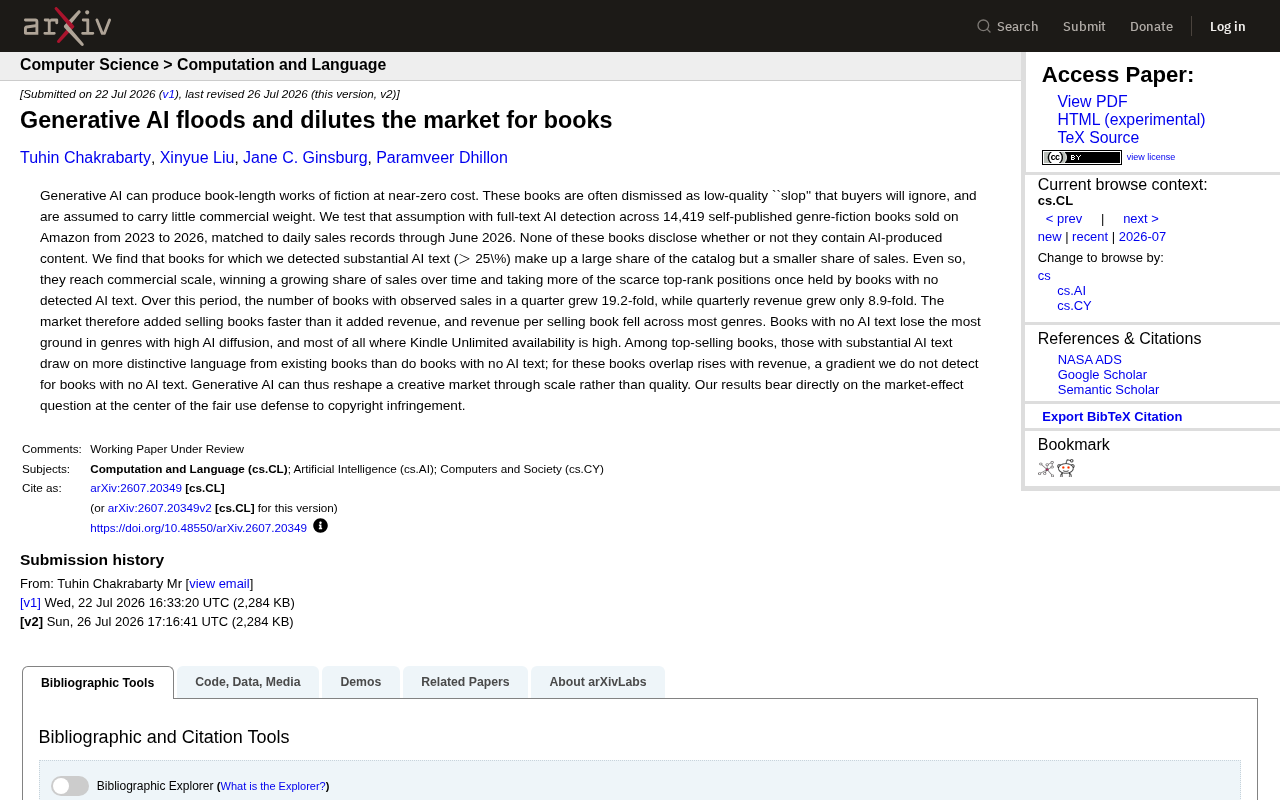
The proliferation of AI-generated books is creating a content dilution crisis in the publishing industry. Low barriers to mass-producing ebooks with LLMs like GPT-4 and Claude are flooding platforms like Amazon KDP with shallow, error-prone content, burying genuine authors' work and misleading readers. With detection technology still immature, the industry needs stronger platform governance, better provenance tools, quality certification systems, and improved reader media literacy to restore trust.
When the Book Market Is Drowning in AI-Generated Content
The proliferation of generative AI is transforming the content creation industry at an unprecedented pace, and the book publishing market has become one of the most vulnerable sectors in this upheaval. Massive volumes of AI-generated books are flooding the market, diluting the value of quality content, and even threatening the fundamental trust between independent authors and readers.
This is not merely a technical issue — it's a complex challenge involving content quality, market integrity, and creative ethics. When anyone can "write" a several-hundred-page "book" in minutes using a large language model, the very medium that has long carried human knowledge and thought faces the serious risk of being diluted by industrialized production.
The Low Barrier Driving the AI Book Flood
In the past, publishing a book required months or even years of dedicated effort from an author, followed by multiple rounds of editing, proofreading, and review. Today, with AI tools like ChatGPT and Claude, a single person can generate dozens of ebooks on different topics in a single day and upload them directly to self-publishing platforms like Amazon Kindle for sale.
These AI tools are built on large language model (LLM) technology. Trained on vast corpora of text data, they learn to predict the probability distribution of the next word, enabling them to produce superficially coherent long-form text. Models like GPT-4 and Claude 3, with hundreds of billions of parameters, can mimic various writing styles and cover virtually any subject area. However, while the content they generate appears fluent, it lacks a genuine foundation of experience and deep thought, and is prone to "hallucinations" — confidently outputting information that seems plausible but is factually incorrect.
The direct consequence of this low barrier is a market saturated with poorly made, shallow, and even factually erroneous AI-generated books. These books often feature enticing titles and carefully designed covers, but their content lacks depth, suffers from logical inconsistencies, and may contain fabricated information produced by AI hallucinations.
Who's Getting Hurt: Readers, Authors, and Publishing Platforms
Readers: Information Traps That Are Hard to Spot
For ordinary readers, the greatest harm lies in the difficulty of distinguishing authentic content from fakes amid the deluge of books. An AI-generated book on health, investing, or parenting that contains misinformation can cause real-world harm to readers. Worse still, these books often achieve high search rankings through fake reviews and keyword optimization, further misleading consumers.
There have been documented cases of AI-generated books about mushroom foraging appearing on the market, containing incorrect identification information about poisonous mushrooms — the kind of error that could be life-threatening in practice. This highlights the severe dangers of AI content proliferation in certain domains.
Independent Authors: Real Creativity Buried Under Noise
For genuine authors who have poured their hearts into their work, the flood of AI books means their creations are buried beneath a sea of noise. When a platform's recommendation algorithms and search results are dominated by low-quality AI content, the chances of high-quality original works gaining visibility are dramatically reduced.
Even more concerning is the "impersonation" phenomenon — some AI-generated books misuse the names of well-known authors or imitate their styles, damaging real authors' reputations and income. This behavior isn't just a copyright issue; it's a direct assault on the creative ecosystem.
Self-Publishing Platforms: The Regulatory Dilemma
Self-publishing platforms, with Amazon as the leading example, find themselves caught in a bind. On one hand, the open self-publishing model is the cornerstone of their success; on the other, the flood of AI content is eroding platform credibility and user experience.
Amazon Kindle Direct Publishing (KDP) is the world's largest self-publishing platform, where authors simply upload their files and can have books listed for sale within hours, without the review process of traditional publishers. Since its launch in 2007, this model has genuinely provided publishing opportunities for countless independent authors, but it also means the platform lacks the editorial oversight and fact-checking quality gates found in traditional publishing systems. KDP's royalty-sharing model of up to 70% further incentivizes the mass production of low-quality content.
Amazon has previously introduced policies requiring self-published authors to disclose whether content was AI-generated and has imposed limits on the number of books uploaded per person per day (currently 3 per day). However, these measures have proven limited in practice — disclosure is voluntary, and upload limits are easily circumvented.
The Deeper Issue: Redefining Content Value in the AI Era
The Dilution Effect: Bad Money Drives Out Good
There's a classic economic concept known as "bad money drives out good" (Gresham's Law), which originally described how, when two currencies of the same face value but different actual gold content circulate simultaneously, people tend to hoard the full-value currency and spend the debased one, eventually driving good money out of circulation. In the book market, this principle manifests as follows: when the market is flooded with cheap, low-quality AI content, reader trust in the entire ebook market declines, and the prices they're willing to pay drop accordingly. This ultimately squeezes the survival space of authors who genuinely invest in creation, forming a vicious cycle.
This dilution effect extends beyond the book market to news, blogs, academic papers, and other content domains. Generative AI has dramatically reduced the marginal cost of content production while simultaneously lowering the average quality of content across the board.
Technical Challenges in AI Content Detection and Governance
Currently, AI-generated content detection technology remains immature. Existing AI text detection tools (such as GPTZero, Originality.ai, and others) primarily analyze a text's perplexity and burstiness to determine whether content was AI-generated. Perplexity measures how predictable a text is — AI-generated text tends to be more "predictable," while human writing contains more unexpected vocabulary choices and sentence structure variations. However, AI text that has been paraphrased or mixed with human editing can easily bypass these detections, and these tools have even lower accuracy rates for non-English content. This creates technical difficulties for platforms attempting governance.
The industry is exploring solutions such as digital watermarking and content provenance technologies. Digital watermarking embeds invisible statistical markers during the AI generation process, making content traceable to a specific model. Industry organizations like C2PA (Coalition for Content Provenance and Authenticity) are working to establish unified content provenance standards. However, these solutions require cooperation across the entire ecosystem to be effective. No single platform or tool can fundamentally solve the problem on its own.
Where's the Way Out: Rebuilding Content Trust in the Book Market
Facing this crisis, potential solutions span several dimensions:
Strengthened Platform Responsibility: Publishing platforms need to establish stricter content review mechanisms, restrict bulk uploads and obviously low-quality content, and mandate AI usage disclosure.
Upgraded Detection Technology: Develop more reliable AI content detection and provenance technologies that allow readers to clearly understand how a book was created.
Quality Certification Systems: Establish trusted author verification and content quality certification mechanisms to help quality content stand out, enabling readers to quickly identify trustworthy works.
Reader Media Literacy: Cultivate readers' media literacy, improving their ability to identify AI-generated content and encouraging a discerning attitude when purchasing books.
Conclusion: Safeguarding Content Ethics in the AI Era
Generative AI is itself a powerful tool — it can assist creation and improve efficiency. The problem lies not in the technology itself, but in how it's used. When AI is employed to mass-produce junk content for short-term profit, what's damaged is the entire content ecosystem and the foundation of knowledge dissemination.
The dilution crisis facing the book market is, in reality, a microcosm of the challenges confronting the entire digital content industry. How to embrace AI's efficiency while safeguarding content quality and creative ethics is the core question the content industry must answer. Technological progress should not come at the cost of information credibility — and that requires the collective effort of platforms, creators, regulators, and readers alike.
Related articles

EmbeddedSass for .NET: A Sass Compilation Solution Without Node.js Dependencies
EmbeddedSass for .NET uses the official Embedded Sass Protocol, enabling .NET developers to compile Sass/SCSS natively without Node.js. Learn how it works and integrates with ASP.NET.

San Francisco to Singapore Time Difference: The Trans-Pacific Routine of Silicon Valley Tech Workers
SF and Singapore are 15-16 hours apart, and frequent travel between them is now routine for tech workers. Explore the time difference challenges, AI industry globalization, and talent flows.

Anthropic Launches Official Claude Code Plugin Directory: A Curated High-Quality Extension Ecosystem
Anthropic launches claude-plugins-official, a curated directory of high-quality Claude Code plugins. Learn about its positioning, core value, and impact on the AI coding ecosystem.