The Four-Stage Learning Path for AI Agent Development: A Complete Guide from Beginner to Practitioner

A complete four-stage roadmap for AI Agent development, from fundamentals to real-world implementation.
This article systematically breaks down the four-stage learning path for AI Agent development: mastering core concepts, understanding principles like the ReAct paradigm, optimizing performance through reinforcement learning and multi-agent collaboration, and finally implementing real-world projects. Whether for job hunting or monetizing projects, Agent development has become an essential hardcore skill in the LLM era.
Why Has Agent Development Become the Core of the LLM Field?
If you're still stuck building basic RAG (Retrieval-Augmented Generation) systems or making simple API calls, then you may already be falling behind in today's competitive AI job market. RAG is a technical paradigm that emerged around 2020, solving the "knowledge cutoff" and "hallucination" problems of large language models by retrieving relevant documents from an external knowledge base before generating a response. However, RAG is essentially still a "Q&A pipeline" that lacks proactive planning and multi-step execution capabilities. As the reasoning abilities of models like GPT-4 and Claude have improved dramatically, the industry has gradually realized that the key to truly unleashing the potential of LLMs lies in giving them the ability to "take agentic action"—and this is exactly the technical backdrop for the rise of the Agent paradigm.
AI job requirements have long since evolved. The ability to merely call large model APIs and string together prompts is no longer scarce. What truly constitutes core competitiveness is the ability to independently design and develop intelligent Agents.
The biggest difference between an Agent and an ordinary AI application lies in its autonomy. Rather than passively receiving instructions and returning results, an Agent can autonomously plan tasks, proactively call tools, and form a closed loop to solve complex problems. To put it in an analogy: an ordinary AI application is like an assistant that only answers questions, while an Agent is like an employee who can understand goals, break them into steps, and complete an entire workflow independently.
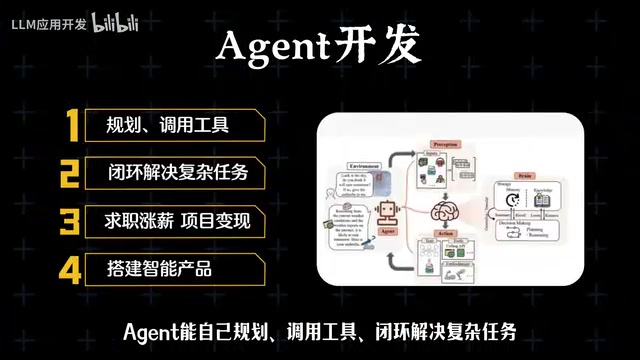
Whether you're looking to change jobs, monetize projects, or build intelligent products, AI Agent development has become an unavoidable hardcore skill. The earlier you master it systematically, the better positioned you'll be to seize the initiative in this technological wave. Below, we'll walk through the complete four-stage learning path, covering the entire journey from getting started to real-world implementation.
Stage One: Getting Started with the Fundamentals—Master the Core Concepts
The first step in learning Agent development is not to rush into writing code, but to build a solid foundation. The focus of this stage is understanding the essence of Agents and their core theoretical architecture.
First, you need to clearly understand what an Agent actually is and what core components it consists of. A complete AI Agent typically includes the following key modules:
- Planning Module: Responsible for breaking down complex tasks into executable sub-steps. Engineering-wise, this is usually implemented based on the instruction-following capabilities of LLMs, with representative approaches including Tree of Thoughts and HuggingGPT;
- Memory Module: Enables the Agent to remember context, historical interactions, and intermediate results. In engineering implementations, this is divided into short-term memory (conversation history within the context window) and long-term memory (historical summaries stored in vector databases); tools like Mem0 and Zep are designed specifically to address this;
- Tool Use: Grants the Agent the ability to call external tools, APIs, or functions. This typically relies on OpenAI Function Calling or the Tool interfaces of various frameworks, allowing the model to structurally invoke external systems such as search engines, code executors, and databases.
Together, these three modules form the Agent's complete cognition-action loop.

That said, you also need to become familiar with the basic working principles of large language models (LLMs), since the LLM is precisely the core brain that drives the Agent's reasoning and decision-making. Only by clarifying these fundamental concepts will you avoid confusion when later studying principles and doing hands-on work. This stage may seem tedious, but it's the key factor that determines how far you can go.
Stage Two: Core Advancement—Master Principles and Design Paradigms
After laying a solid foundation, you need to advance from "understanding concepts" to "understanding principles." The goal of this stage is to gain a deep understanding of the Agent's action mechanisms and to master the industry's classic Agent design paradigms.
The most representative of these is the ReAct paradigm. ReAct (Reasoning + Acting) was proposed by Google Research in 2022, with the paper "ReAct: Synergizing Reasoning and Acting in Language Models" published at ICLR 2023. Its core innovation lies in interweaving "chain-of-thought reasoning" with "external tool invocation": the model first outputs a Thought (internal reasoning), then an Action (calling a tool), and finally receives an Observation (the tool's returned result), looping through these three steps until the task is complete. Experiments have shown that compared to pure reasoning or pure action approaches, ReAct significantly improves accuracy on multi-hop question answering and interactive tasks, and it is currently one of the underlying logics behind mainstream frameworks like LangChain and AutoGPT.
ReAct combines "Reasoning" and "Acting," allowing the Agent to first think and reason before deciding on the next action when executing a task, then continuously adjust based on environmental feedback—forming a complete loop of "think → act → observe." This paradigm greatly enhances the Agent's ability to handle complex tasks.
Beyond this, there are classic methodologies such as Chain-of-Thought and Plan-and-Execute. Understanding the differences between these paradigms and their applicable scenarios will help you choose the most appropriate architecture in real-world development.
This stage also focuses on tackling common challenges in development: how to design effective feedback loops, how to prevent the Agent from getting stuck in infinite loops, and how to control invocation costs. Only by truly understanding the Agent's core operating logic can you consider yourself an entry-level Agent developer.
Stage Three: Strengthening and Enhancement—Optimizing Agent Output Performance
Once you can build a functional Agent, the next problem to solve is "how well it runs." This stage focuses on performance optimization, covering three important directions.
Reinforcement Learning
Introduce reinforcement learning (RL) approaches to allow the Agent to optimize its decision-making strategies through continuous interaction with the environment, thereby performing more stably and intelligently on specific tasks.
It's worth noting that introducing RL into LLM Agent optimization has become a hot direction in both academia and industry. RLHF (Reinforcement Learning from Human Feedback) has been used by OpenAI for the alignment training of GPT-series models; at the Agent level, algorithms such as PPO and GRPO are used to optimize tool-selection strategies and the quality of multi-step decision-making. Recently, models like DeepSeek-R1 have demonstrated significant improvements in reasoning ability through pure RL training, further validating RL's potential in advancing Agent intelligence. For application developers, understanding the design of RL reward mechanisms helps in building self-improving Agent systems.
Multi-Agent Collaboration
The capabilities of a single Agent are ultimately limited, whereas Multi-Agent collaboration can handle more complex scenarios. Multi-agent systems (MAS) are not a new concept in the AI field—they appeared as early as distributed AI research in the 1990s—but they've made a qualitative leap when combined with LLMs: each Agent possesses natural language understanding and generation capabilities, transforming the communication protocol between Agents from structured messages into natural language dialogue. Current mainstream frameworks include Microsoft's open-source AutoGen, Stanford's MetaGPT (which simulates the role division of a software company), and CrewAI, among others. Engineering-wise, the focus needs to be on solving task allocation strategies, message-passing mechanisms, conflict arbitration, and avoiding deadlock states between multiple Agents.
Understanding how multiple Agents divide labor and cooperate, communicate with each other, and coordinate decisions is an essential skill for advanced developers. For example: one Agent handles planning, another handles execution, and a third handles review and validation—the three working together to accomplish the overall goal.
Prompt Tuning
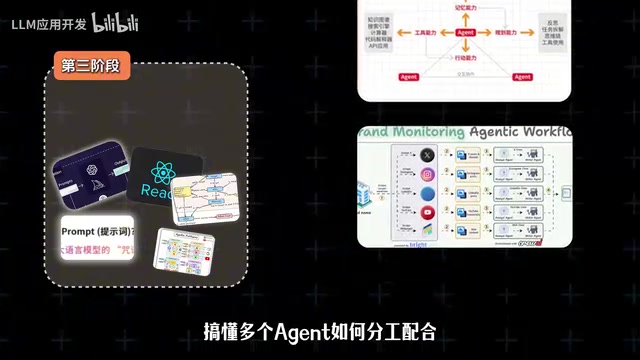
The quality of a prompt directly determines the precision of an Agent's output. Through systematic prompt tuning techniques, you can make the Agent understand intent more accurately and produce target results more precisely, greatly improving practicality. This is a core soft skill that appears simple but actually requires extensive hands-on accumulation.
Stage Four: Real-World Implementation—Connecting to Actual Business Scenarios
No matter how much theory you learn, it ultimately has to be put into practice. The core of Stage Four is to connect all the previously acquired knowledge and personally complete 2 to 3 full hands-on projects.

Recommended directions for hands-on projects include:
- Intelligent Decision Assistant: Capable of analyzing information, offering suggestions, and aiding decision-making;
- Office Automation Agent: Automatically handles repetitive work such as emails, schedules, and documents;
- Multi-Agent Collaboration System: Comprehensively applies collaboration logic to build complex task-processing pipelines.
The key is to fully run through the entire process of development, debugging, and optimization, transforming abstract theoretical knowledge into demonstrable, tangible results. These hands-on projects not only validate your technical abilities but also become weighty additions to your resume, directly boosting your competitiveness in job hunting and project acquisition.
Final Thoughts: How to View This Learning Path
Overall, this four-stage path—core concepts → principle paradigms → performance optimization → real-world implementation—follows a reasonable progression from theory to practice and offers strong guidance for beginners.
It should be noted that claims like "from beginner to expert in seven days" are largely marketing gimmicks. AI Agent development involves multiple dimensions such as large model principles, engineering implementation, and system design; true mastery requires long-term project accumulation and continuous learning. But it's certainly true that Agents are one of the most worthwhile directions to invest deeply in within the current LLM application field. Rather than feeling anxious, it's better to steadily advance step by step along a clear path, truly internalizing the skills of each stage—only then can you take the initiative in the AI wave.
Key Takeaways
Related articles
Altman: Taking OpenAI Public This Year Would Be 'Ill-Advised'
OpenAI CEO Sam Altman says going public this year would be 'ill-advised,' even as the company has confidentially filed IPO paperwork. Here's what it means for AI.
An Open Letter to Dario: If AI Safety Is Real, Open the Model Weights
Developer Jacob's open letter to Anthropic CEO Dario Amodei went viral on Hacker News, challenging the contradiction between AI safety rhetoric and closed-source models: if safety truly matters, why not open the weights?
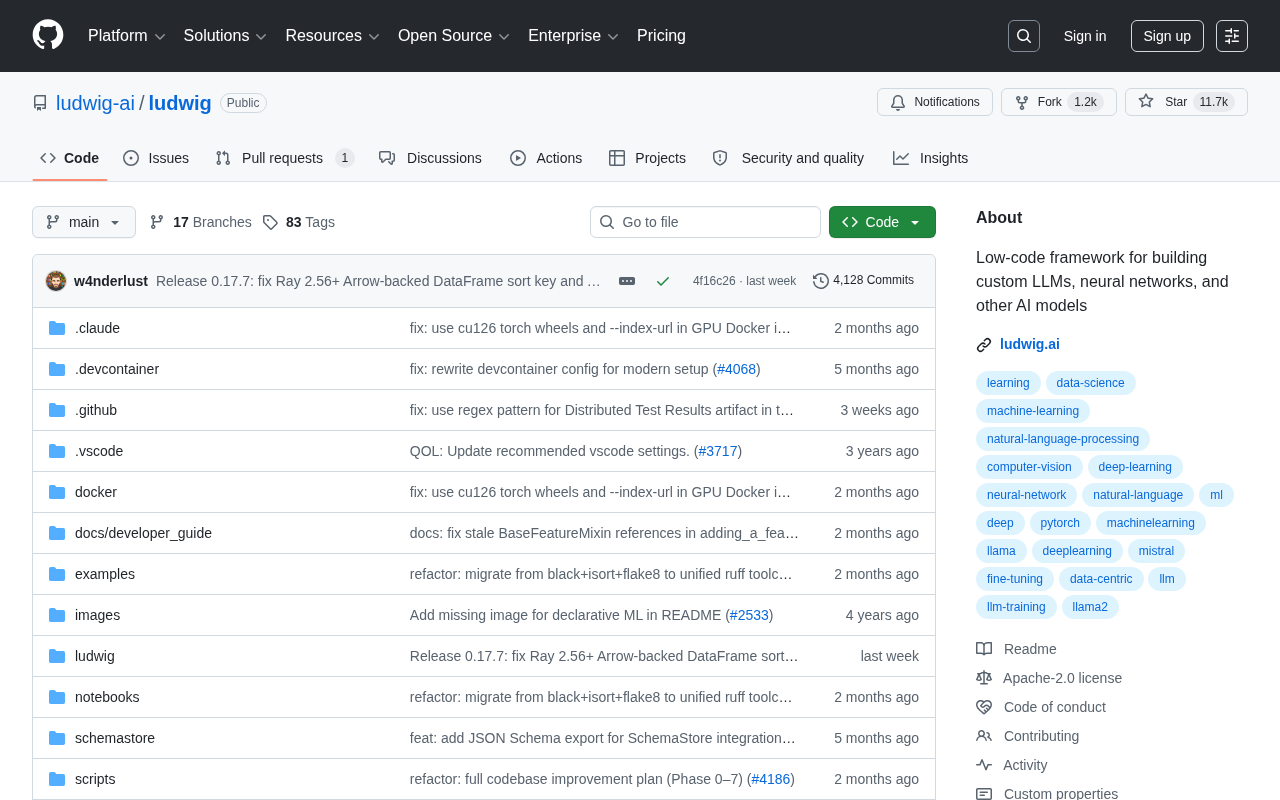
Ludwig: Building Custom LLMs and Neural Networks with Declarative Low-Code Configuration
Ludwig is an open-source low-code ML framework that builds custom LLMs and neural networks via declarative YAML config — no boilerplate training code required.