The Future of Electoral Systems: How Technology Is Reshaping Voting and Democracy

Election technology evolves under legitimacy, ballot secrecy, and public trust—paper and algorithms will coexist.
Drawing on Isaac Arthur's perspective as an Ohio election board chairman, the article examines how technology may reshape every stage of elections. Electoral systems are deeply conservative, requiring real pain points to change. Ballot design trades off simplicity against information; Arrow's impossibility theorem proves no perfect aggregation rule exists, and ranked-choice, approval, and score voting each involve trade-offs. Proportional representation and weighted voting are not future inventions—technology lowers administrative costs but does not create political momentum. Algorithmic districting stays technically neutral, but "fairness" still needs political definition. Eligibility, time windows, and remote e-voting face three challenges: secrecy, device security, and public confidence. Paper ballots persist because they are independently auditable and trusted, with over 98% of U.S. jurisdictions using paper-record systems. The deepest challenge is legitimacy—losers must believe the process was fair, which cannot be fully engineered.
The Future of Electoral Systems: How Technology Is Reshaping Voting and Democracy
Elections seem simple—ask everyone what they want, count the answers, and let the most popular choice win. But as Isaac Arthur reveals on his Science & Futurism show, an election is actually a stack of problems layered on top of each other: How much information should a ballot let you express? How should preferences be counted? How do ballots translate into legislative seats? Who is eligible to vote? How do you verify that the vote was fair? And when computers, digital identity, cryptography, and artificial intelligence enter the picture, how do the answers to these questions change?
As chairman of an Ohio election board, Isaac Arthur dissects the technical evolution of electoral systems from the dual perspective of a practitioner and a futurist. Here are the key insights distilled from his analysis.
Why Are Electoral Systems So Conservative?
Electoral systems are unusually conservative technology—and "conservative" here has nothing to do with political leaning. Once a system is familiar, legitimate, and widely trusted, changing it carries high costs. Swapping out a phone app might cost you a week of grumbling, but change the rules that decide who holds public office, and everyone will ask: is this really about improving elections, or about helping one side win more?
This conservatism has its rationale. A new method doesn't get adopted just because it's mathematically elegant; usually there has to be a problem people actually feel: too many candidates, long lines, overly long ballots, recurring "spoiler" worries, expensive runoffs, districts seen as unrepresentative, inaccessible polling places, cybersecurity threats, or simply old equipment reaching end of life.
Technology itself also creates pressure. When people can bank, work, and sign contracts from anywhere, being told to show up at a particular school gym at a particular time on a particular Tuesday feels increasingly arbitrary. When a computer can draw ten million legal district maps before lunch, old assumptions about how boundaries should be drawn become hard to sustain.
Ballot Design: The Trade-Off Between Simplicity and Information
The most intuitive electoral question is how much information the ballot itself can carry. Plurality voting asks you to pick one candidate, and whoever gets the most votes wins. Its great advantage sounds almost trivial: people understand it. Isaac Arthur admits he leans toward keeping the procedural knowledge a voter needs to cast a valid ballot as low as possible—not knowledge of how to think about candidates, but how much explanation is needed before voting.
But plurality voting deliberately throws information away. Suppose 40% of voters prefer Alex first, 35% prefer Bob, and 25% prefer Carol. Under plurality, Alex wins. But if nearly all Bob voters think Carol is better than Alex, and nearly all Carol voters think Bob is better than Alex, then a majority actually prefers either of the other two over Alex. The problem is that we quietly changed the question itself: do we want the candidate with the most first-choice votes, the most broadly acceptable candidate, the candidate who beats every rival head-to-head, or a legislature that reflects the composition of the electorate as closely as possible?
More complicated still is the cyclical nature of collective preference—a majority prefers Alex over Bob, a majority prefers Bob over Carol, and a majority prefers Carol over Alex. Arrow's impossibility theorem formalizes this deep problem: once there are at least three options, no method of aggregating ranked preferences can always satisfy all seemingly reasonable conditions.
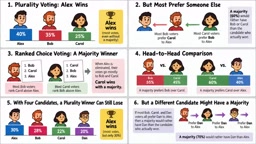
So there is no mathematically perfect voting system sitting in a filing cabinet waiting for civilization to mature enough to adopt it. There are only a series of trade-offs. Ranked-choice voting tries to compress a second round into the first ballot: voters rank candidates, and if no one clears 50%, the lowest is eliminated and votes are transferred. Modern scanners and software make complex transfers faster and more manageable, but the results are less intuitive, and auditors must verify the transfer process rather than just the totals. Isaac Arthur himself is more skeptical of ranked-choice voting than many reform advocates, largely because he places high value on simplicity and transparency for voters. Still, he acknowledges the value of ranked systems in multi-seat nonpartisan elections, such as school boards or township trustee races.
Approval voting lets voters mark every candidate they find acceptable. It may favor candidates with low disapproval rates over those with high approval rates, leading to low-profile "good guy" candidates winning—a mixed blessing. Score voting allows rating candidates from 0 to 5, but strategic voting follows—using only the highest and lowest scores is more influential than honestly describing every level of preference.
Arrow's impossibility theorem is one of the few results in social science with mathematical rigor, proposed by economist Kenneth Arrow in 1950. Its core statement is: when there are at least three options and at least two voters, any collective decision rule satisfying a set of seemingly mild conditions will produce contradictions or disorder under some preference combinations. These conditions typically include: unrestricted domain (any preference combination should be accepted), weak Pareto principle (if everyone prefers A to B, the collective should too), independence of irrelevant alternatives (the relative evaluation of A versus B should not be affected by the presence or absence of C), and non-dictatorship (the result should not be determined by a single person). The real meaning of the theorem is not "democracy is impossible" but "no ranking aggregation rule can simultaneously satisfy all intuitively reasonable axioms." This directly explains why real electoral systems always trade off among comprehensibility, representativeness, and stability rather than seeking a mathematically optimal solution.
From Ballots to Seats: The Technical Conditions for Proportional Representation
Changing the ballot is only one way to reform elections. Keeping the same ballot but changing what it produces matters just as much. Most of the United States uses single-member districts: one geographic district elects one representative. Candidate A gets 51%, B gets 49%, and A represents the entire district. Repeat this across hundreds of districts, and the composition of the legislature can diverge sharply from the overall vote share.

Proportional representation is not a future invention. New Zealand replaced plurality voting with mixed-member proportional representation after a 1993 referendum. Technology can make proportional systems easier to administer and explain—rapid tabulation, interactive ballot instructions, public simulations, audit software—but it does not create the political reasons for adopting them. That reason is usually "we think the seats don't faithfully reflect the composition of the electorate," while opponents say "the alternative weakens something else we value."
Single-member districts give voters a specific connection to a specific place; larger proportional districts may reflect overall political opinion more accurately but weaken local ties. Party lists give parties more control over who enters public office. Multi-seat districts give voters more choice while producing longer ballots and complex counting. Proportional systems often make coalition governments more common—some see this as healthy compromise, others as a way to ensure no one actually gets the result they voted for.
So Isaac Arthur predicts that future democracies will not converge on a single voting method but will diversify and experiment more—especially in cities, states, new constitutions, and new space settlements that may eventually exist beyond Earth. Those places can start from a blank slate—though history reminds us that a blank slate does not automatically produce a better system.
Mixed-member proportional representation (MMP) is a proportional system combining single-member districts with party lists. Voters typically have two votes: one for their local candidate and one for a party. District seats are still won by plurality, but party-list seats are allocated compensatorily according to each party's nationwide vote share, so that each party's total seats approximate its vote share. New Zealand has used MMP since 1996, following several referendums that drove the change. The key technical difficulties of MMP lie in handling "overhang seats," setting thresholds, and coordinating list seats with district seats—all highly dependent on reliable tabulation software and transparent rules. It preserves the connection between voters and local representatives while mitigating the disconnect between seats and vote share under single-member plurality, but the cost is more frequent coalition governments and more complex government formation negotiations.
Algorithmic Districting: The Illusion of Technological Neutrality
After each decennial census, districts must be redrawn. Equal population is only one goal; people also want contiguous and compact districts, fewer county and city splits, legal requirements for minority representation, competitive elections, and protection of communities that genuinely share local interests. These goals conflict almost immediately.
Modern GIS and computer cartography can evaluate vast numbers of maps, combining detailed demographic and electoral data to estimate the consequences of moving boundaries district by district. This can make gerrymandering more precise, and it can also make detecting it more complex—analysts can generate thousands or millions of legal comparison maps and ask whether the adopted map is an extreme outlier. AI may push both directions further: searching enormous design spaces to satisfy a long list of public criteria, or quietly finding legal maps that maximize advantage for one faction. Technology remains admirably neutral in this arms race.
An incorruptible algorithm still needs someone to define "fair." Should it maximize compactness, minimize county splits, maximize competitive districts, protect communities of interest, or make statewide seat totals approximate statewide vote share? All of these sound reasonable yet produce very different maps. Isaac Arthur says he has heard presentations from all sides on methods to develop the ideal fair map, but has yet to see one, and he himself doesn't know how to do it objectively.
Another response is to make individual boundaries matter less—larger multi-seat districts or proportional systems can reduce the importance of moving a single street. Another idea is weighted voting: if representatives no longer need equal voting weight, districts could allow coherent communities to remain between 500,000 and 2 million residents, with representatives casting votes of different weights in the legislature (1.3 votes or 0.78 votes). Technically it's not hard—it can be run with pen and paper and a calculator, and computers make it trivial—but it would require a constitutional framework very different from the current structure of the U.S. Congress.
Gerrymandering refers to deliberately manipulating district boundaries to give a party or group disproportionate advantage in elections. Typical techniques include "packing" (concentrating opponents into a few districts to waste their votes) and "cracking" (dispersing opponents across multiple districts so they cannot form a majority). Modern geographic information systems and computing power allow mapmakers to precisely simulate hundreds of thousands of map plans, assessing partisan lean and ethnic composition block by block, to design highly optimized maps. At the same time, the same technology allows independent analysts to generate large numbers of "neutral" comparison maps and use statistical methods to detect whether an actual map deviates from a reasonable range. However, the algorithm itself does not define fairness: criteria such as compactness, county and city integrity, competitiveness, minority representation, and partisan proportionality conflict with one another, and choosing which to prioritize is always a political decision, not a technical one.
Who Is Eligible to Vote: Can Technology Untie the Administrative Knot?
Before an election can record any preference, it must determine who has the right to participate. This sounds like a philosophical question—a companion episode will explore children, artificial minds, uploaded consciousness, and whether your copy gets another vote—but it is already an important issue. Should people who work in or own property in a town vote there? Should someone who lives there temporarily for a few years vote locally, in their hometown, or in both?

America's current basic rule is one person, one vote, attached to the place you designate as your primary residence. Much of this is administrative necessity. Trying to run a property-tax election where only property owners can vote is chilling enough, but technology may change that. Voter registration systems must handle moves, deaths, name changes, naturalization, crossing jurisdictional boundaries, duplicate records, and plain old data errors. As systems become more automated and interconnected, registration can become less visible to voters—a good thing in this context. You register once, and your registration moves with you. Printing ballots on demand is already feasible, and it's conceivable that your ballot could be printed at any authorized polling place, with the special add-ons your jurisdiction allows.
Does Election Day Still Need to Be a Single Day?
Modern technology has been eroding the time and place constraints of voting for years. The COVID-19 pandemic accelerated this trend, much as it did remote meetings. In the most recent U.S. election, only about 37% of ballots were cast in person on Election Day itself, roughly a third were cast early in person, and about 30% by mail. Election Day remains a legal deadline and cultural focal point, but for a large share of voters, the election is already an election period.
Overseas voters, military personnel, people working 12-hour shifts, those with limited transportation, caregivers, travelers, and people who live far from polling places all bear higher real costs under a system that insists on a single location and a narrow time window. Resilience matters too—storms, power outages, cyber incidents, pandemics, or local emergencies make it far harder to disrupt an election if voting is spread across time and multiple locations. Electronic poll books, real-time registration data, on-demand ballot printing, improved mail tracking, and vote centers that allow voting at any authorized location all make this easier.
But extended windows have costs too. Ballot collection and chain-of-custody issues become more important, especially when third parties collect absentee ballots. Election officials must secure ballots, equipment, and records for longer periods. Mail voting depends more on the postal service. More voting methods also mean more procedures to explain and more failure modes to train for. An election lasting weeks means some people vote before debates, scandals, emergencies, or major news, while those who vote later know about them. Future societies may not simply maximize convenience but lean toward a balance of convenience, shared information, observability, and administrative control that their technology and political culture can support.
Why Can't We Vote by Phone?
This is the future-election question Isaac Arthur hears most often. I can transfer thousands of dollars by phone, file taxes online, buy stocks, sign contracts, access medical records, and send encrypted messages—why am I still filling in ovals with a pen?
The demand is easy to predict: younger voters expect online government services; military and overseas voters have long faced distance problems; disabled voters or nursing home residents might benefit from electronic ballot delivery. But elections have a set of security requirements that ordinary online transactions usually don't. Your bank wants to know you authorized a transfer and is happy to keep a permanent record linking you to it. Elections must authenticate you while generally not wanting to keep a permanent record linking identity to choice—and especially not wanting to give you a receipt that conclusively proves how you voted. That is the deep logic of the secret ballot. The secret ballot not only hides your choice from the government but also makes coercion and vote buying harder, because voting choices cannot be reliably proven. Polling places provide a controlled environment that phones struggle to replicate, allowing election officials to reasonably ensure voters are alone and freely making a private choice.
Then there's the device problem. Election officials can harden, test, seal, inventory, and observe equipment they own, but they cannot secure every personal phone and laptop in the country. Outdated, infected, stolen, rooted, remotely monitored devices—or ones running game apps unusually interested in contacts and banking information—could tamper with votes. Even if the server is completely secure, malware can alter the ballot before it arrives. Blockchain doesn't magically solve this: if malware changes Alex to Bob and writes it to an extremely secure ledger, we've simply created an extremely secure permanent record of the wrong vote.

Estonia already allows internet voting in national elections. One way to handle coercion is to let voters cast another electronic vote later that supersedes the earlier one, while an in-person paper vote can override the internet vote. That way, someone monitoring you at home cannot be sure you won't change it afterward. Future systems might use stronger digital identity, biometrics, dedicated secure hardware, and end-to-end verifiable cryptography to give voters and observers evidence that ballots were correctly recorded and counted without publicly revealing anyone's vote. But one core problem always remains: voter confidence in the system does not have to match actual security. People worry not only that their own vote will be changed but also about forged ballots, and about less cautious people being tricked or hacked. Given the power and budgets available to governments, elections are always targets—and this is far cheaper than a military invasion.
So the most likely path is not everyone suddenly voting through the same phone app. Remote electronic voting may first expand to groups with the greatest distance or accessibility pressures, subject to good stress testing, while ordinary domestic elections remain more conservative, slowly adopting tested and upgraded systems. Secure voting kiosks, supervised remote locations, electronic delivery of blank ballots, or dedicated systems for overseas voters may grow substantially before unrestricted at-home voting becomes common.
End-to-end verifiability (E2E-V) is a design goal for a class of cryptographic voting protocols, intended to let voters and independent observers verify three things: every ballot was correctly recorded, all recorded ballots were correctly counted, and no forged ballots were included. Typical mechanisms include voters receiving an encrypted receipt at the polling place that they can later check against a public bulletin board to confirm their ballot was included, while the protocol ensures the receipt cannot be used to prove voting choice to a third party, thus preserving the secret ballot. The core value of E2E-V is to shift trust partly from "believing the software wasn't tampered with" to "believing in mathematics and public audits." But it cannot solve the problem of malware infecting a voter's device—if malware alters voter intent before encryption, all subsequent cryptographic proofs merely provide a reliable record of the wrong input. Therefore E2E-V is usually combined with paper records and risk-limiting audits rather than relied on alone.
Why Paper Refuses to Die
A few years ago, while an office was reviewing new voting equipment, vendors naturally emphasized system features and cost. At one point, Isaac Arthur told a vendor bluntly: even if you gave these machines to us for free, I still wouldn't want them.
Voters like paper. They like picking up a pen, physically marking a choice, being able to read clearly what they selected, feeding the ballot into a scanner, and knowing the ballot will be securely locked away in case of a recount. People are particular about the paper itself—too thin or too flimsy, and some voters feel it isn't official or reliable enough. Thick, official, and rather expensive paper. From a purely technical standpoint this seems silly, but from an election administration standpoint it is not silly at all: public confidence is one of the outputs an electoral system must produce.
If a mathematically excellent system that nearly all computer scientists consider secure is seen by half the voters as a mysterious black box and suspected of being able to manufacture ballots, I haven't necessarily improved the election. Paper has remarkable virtues precisely because it is an unglamorous technology. Scanners can count thousands of ballots quickly, but if someone challenges the result, humans can physically inspect those ballots and recount them, with no special training or technology required. You don't need to understand cryptographic proofs—just eyes, and maybe reading glasses.
This is not nostalgia. More than 98% of U.S. election jurisdictions now use voter-marked paper ballots or systems that produce an auditable paper record, and the federal Election Assistance Commission has formally recognized paper-based, software-independent voting systems. This points to one of the futures Isaac Arthur considers most likely: increasingly sophisticated election technology wrapped around a very stubborn physical core. Better registration databases, stronger electronic poll books, on-demand printing that makes vote centers more flexible, faster and more accurate scanners, software that automatically reconciles and flags anomalies, cryptography that helps authenticate records, AI that helps officials check logs or spot suspicious patterns worth human attention—but after all of that, the authoritative evidence may still be a stack of marked paper.
Ohio conducts post-election audits after every election. Risk-limiting audits go further: instead of automatically recounting every ballot, officials examine a sample of the paper records that produced the count, expanding the sample as necessary, until there is strong evidence that the reported results match the ballots. New technology does not always replace old systems; sometimes its best work is helping old systems prove themselves effective.
The Deepest Challenge: Legitimacy
Winners matter, but losers must believe they genuinely lost fairly—and if that is also true, it's easier to convince them. They don't have to like the result, endorse the winner, or stop arguing, but they need enough confidence in the process to accept that this is the outcome until the next chance to change it. Shouting at them that everything is fine usually doesn't work well, especially when they can point to errors—and errors are often common enough.
This may be the hardest of all requirements to engineer, because it doesn't reside entirely in voting machines, paper ballots, cryptography, voter databases, or constitutions. It resides in the minds of voters. The future will give us more ways than ever to collect, count, verify, and translate people's preferences. The real question is: which new capabilities will make elections better, not merely more complex? Because democracy has never truly suffered from a shortage of ways to count people's opinions; the harder problem has always been building a system that people believe counts those opinions.
One-line Summary
Election technology evolves under the constraints of legitimacy, ballot secrecy, and public trust—paper and algorithms will coexist for a long time.
Paragraph Summary
Drawing on the perspective of Isaac Arthur, chairman of an Ohio election board, the article systematically examines how technology might reshape every part of elections. Electoral systems are unusually conservative; change must be driven by real pain points, not mathematical elegance. Ballot design trades off simplicity against information, Arrow's impossibility theorem proves no perfect aggregation rule exists, and ranked-choice, approval, and score voting each involve trade-offs. Proportional representation and weighted voting are not future inventions; technology lowers administrative costs but does not create political momentum. Algorithmic districting remains technically neutral, but "fairness" still needs political definition. Voting eligibility, time windows, and remote electronic voting face three challenges—secrecy, device security, and public confidence—and phone voting is unlikely to become widespread soon. Paper ballots persist because they are independently auditable and trusted by the public, with more than 98% of U.S. jurisdictions using paper-record systems. The deepest challenge is legitimacy—losers must believe the process was fair, and that cannot be fully engineered.
Related articles

Altman Declares: The Cybersecurity Crisis Is Unsolvable and There Are Too Many Vulnerabilities to Patch
OpenAI CEO Sam Altman publicly admits he can't fix all security vulnerabilities and that the cybersecurity crisis will keep worsening. This article analyzes the industry reality behind this statement: exploding software complexity, the double-edged sword of AI, and the need to shift security paradigms from "zero vulnerabilities" to resilient defense.

Product Hunt Launches Visual Launch Editor, Saying Goodbye to Tedious Form Filling
Product Hunt launches a Visual Launch Editor with in-place editing for name, tagline, gallery, and maker info, auto-saved drafts, and a checklist to guide creators.

Zelensky Speaks: How We Held Kyiv Against 200,000 Russian Troops
Zelensky recalls the early Russia-Ukraine war: 200,000 Russian troops drove on Kyiv while Ukraine's main forces were in the east. He explains how mobilization grew the army from 200,000 to 800,000 and how Kyiv and Chernihiv oblasts were recaptured.