The GPT-6.1 Sol "Leak" Mystery: Looped and Nested Model Architectures Come Into Focus

A Reddit user reverse-engineers GPT-6's likely looped transformer and nested model architecture from public inference speed data.
A Reddit user analyzed Artificial Analysis inference speed data to speculate that GPT-6 Astra uses a looped transformer architecture — executing multiple forward passes per token to gain effective depth without adding parameters. Leaked figures suggest 6-Sol/Astra ran 3 passes while 6.1-Sol dropped to 2, with both measuring ~60 tok/s, consistent with batched inference synchronization. A bolder hypothesis proposes that Astra, Sol, and Luna share one set of weights, differentiated only by pass count and active parameters — akin to NVIDIA's nested model demo. The author stresses this is speculation, but suggests that if proven viable, open-source teams like DeepSeek and Qwen may follow with similar experiments.
A Reddit user has conducted a "detective-style" analysis of the underlying architecture of OpenAI's next-generation GPT-6 series, drawing on publicly available inference speed data. While these models are closed-source, the two core technical concepts at the heart of the discussion — looped transformers and nested models — carry meaningful implications for the broader local AI community. If these architectures truly scale to industrial deployment, the open-source world may well follow suit.
Looped Architecture: Trading Compute for "Effective Depth"
The discussion starts with widespread speculation about GPT-6 Astra: it is believed to use a looped transformer architecture, meaning the model performs multiple forward passes before outputting each token, rather than the conventional single pass.
The core logic here is "trading compute for depth." By recursively reusing the same set of weights, a model can achieve greater effective depth, allowing each parameter to be leveraged repeatedly — at the cost of significantly higher compute per token.
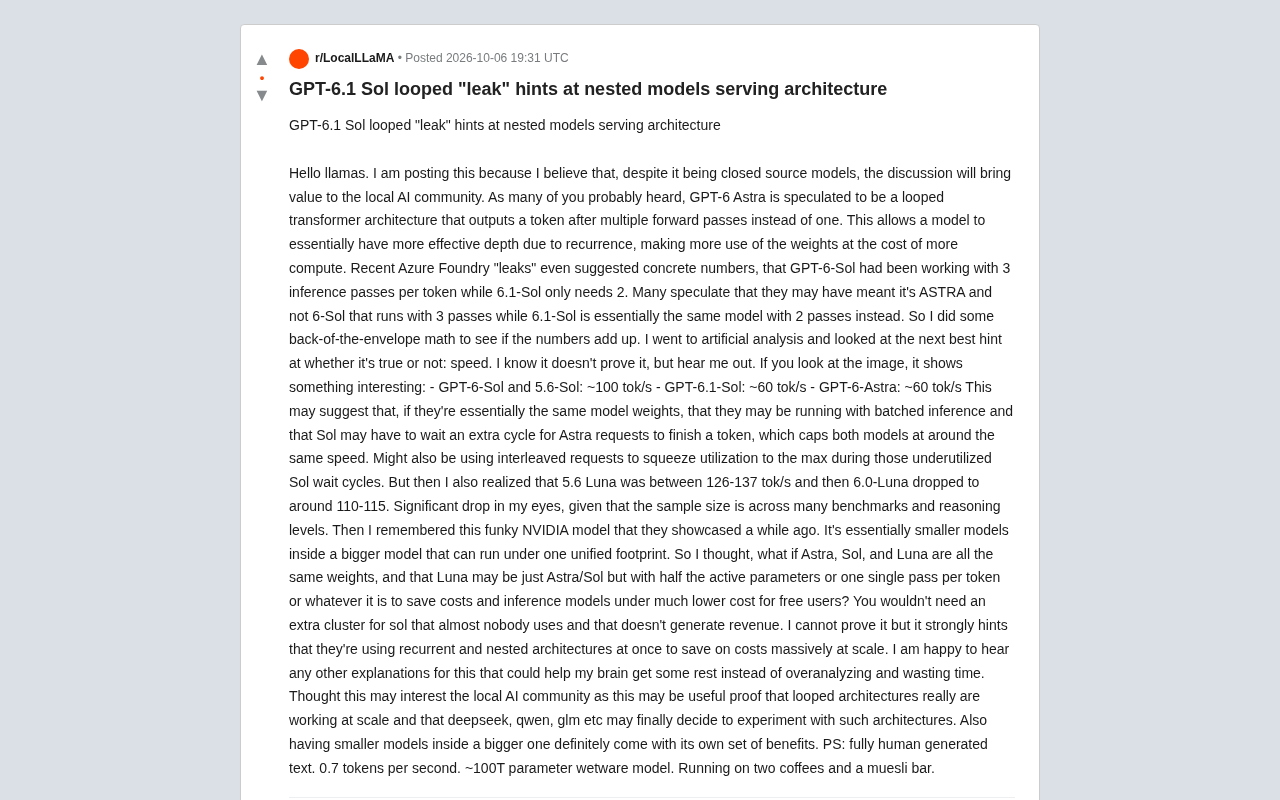
According to Azure Foundry "leak" information cited in the original post, some quite specific numbers were put forward: GPT-6-Sol reportedly ran at 3 forward passes per token, while GPT-6.1-Sol requires only 2. Many commenters believe the 3-pass variant is actually Astra rather than 6-Sol — with 6.1-Sol essentially being the same model dialed down to 2 passes.
Looped Transformers are not a new concept — academic literature has explored their theoretical foundations in several papers. The core idea is to replace the standard stacked-layer structure of a Transformer with "the same set of layers executed N times in a loop," which is theoretically equivalent to a much deeper network without any increase in parameter count. This shares a spiritual kinship with recurrent neural networks (RNNs), though the key difference is that each loop iteration uses identical weight copies rather than independent parameters across time steps.
This architecture involves a fundamental engineering trade-off at inference time: more loop iterations mean higher per-token latency, but also greater "thinking depth." This is distinct from the popular Chain-of-Thought or reasoning model approach, which generates additional tokens externally — the looped architecture internalizes that extra compute within the model's forward pass, making the output appear instantaneous to the user. For tasks that demand deep reasoning but can tolerate some latency (such as code generation or mathematics), this trade-off may prove well worth it.
Reverse-Engineering Architecture from Inference Speed
Since directly verifying closed-source models is impossible, the original poster turned to inference speed (tok/s) data from Artificial Analysis as an indirect signal. He explicitly acknowledged this cannot constitute proof, but the data reveals an intriguing pattern:
- GPT-6-Sol and 5.6-Sol: approximately 100 tok/s
- GPT-6.1-Sol: approximately 60 tok/s
- GPT-6-Astra: approximately 60 tok/s
If 6.1-Sol and Astra share the same weights and run in a batched inference environment, Sol requests may need to wait an extra cycle until Astra's requests finish generating tokens — pulling both down to similar throughput levels. The poster further speculates that the server may use interleaved requests to squeeze utilization out of compute that would otherwise sit idle during Sol's waiting periods.
Another observed pattern is the speed change across the Luna series: 5.6-Luna sits at 126–137 tok/s, while 6.0-Luna drops to 110–115 tok/s. Given that the samples span multiple benchmarks and inference tiers, the author considers this drop quite significant.
Batched Inference is a core optimization technique for large-scale language model serving: inference servers group multiple user requests into a single batch and process them in one GPU forward pass, amortizing the fixed overhead of memory bandwidth and compute startup — dramatically improving hardware utilization. However, when the same set of weights must serve requests with different loop counts (e.g., Astra at 3 passes, Sol at 2), requests finish at different times, forcing some to "wait" for others to complete their full loop cycle before being dequeued. This phenomenon flattens the apparent throughput across different model tiers — which is one plausible explanation for why 6.1-Sol and Astra converge in speed. Interleaved Requests refers to a scheduling strategy that inserts new requests during waiting intervals, converting idle compute caused by synchronization waits into productive work.
Nested Models: One Set of Weights, Multiple "Identities"
What really ties the analysis together is the poster's recollection of a "peculiar" model NVIDIA demonstrated previously — multiple smaller models nested inside a single large one, all runnable within a unified deployment footprint.
This leads to a bold hypothesis: Astra, Sol, and Luna may all share the same underlying weights.
- Luna might be a "lite" version of Astra/Sol, activating only half the parameters or running just one forward pass per token, serving free-tier users at minimal cost;
- Models like Sol — rarely used and generating little revenue — wouldn't need their own dedicated cluster;
- Overall, using looped and nested architectures simultaneously could dramatically cut costs at scale.
In other words, the different product names may simply represent different configuration tiers of the same base model, varying across two dimensions: number of forward passes and number of activated parameters. This explains the speed differences while aligning with the commercial intuition of "give paying users more compute, serve free users with leaner configurations."
The nested model technique NVIDIA demonstrated follows the same line of thinking as academic Matryoshka representation learning. The key insight is training the model so that subsets of it (fewer layers, fewer attention heads, or lower activation dimensions) are independently capable — rather than pruning after the fact. This allows the same weights to be "sliced" on demand: flagship scenarios use all parameters and all loop iterations, while lightweight scenarios activate only a subset with fewer passes, both sharing the same model file and inference cluster.
From a deployment engineering perspective, this means operators no longer need to maintain separate model copies and corresponding GPU memory footprints for each product tier. At data center scale, consolidating multiple "virtual models" onto a single physical set of weights can significantly improve GPU utilization, reduce cold-start overhead, and simplify the operational complexity of version updates.
What This Means for the Open-Source Community
The poster openly admits that all of this "cannot be proven" — it amounts to strong hints rather than hard evidence. But his argument is that if looped architectures can reliably operate at industrial scale, this sends an important signal: open-source model teams like DeepSeekAd, Qwen, and GLM may start seriously experimenting with these architectural approaches.
Nested models also offer unique benefits in their own right — covering multiple tiers from flagship to entry-level with a single set of weights dramatically reduces both deployment and operational costs, making it especially attractive for open-source teams with limited resources.
It bears emphasizing that the content here originates from a single community speculation post. The data and model names cited are all unverified "leaks" and inferences — readers should treat this as an exploration of architectural ideas rather than established fact. Even so, the engineering value of both looped and nested architectures as technical directions remains well worth watching for the local AI community.
Related articles

Frontend to AI Agent Development: A Frontline Architect Explains Career Paths and Opportunities
A frontline AI architect explains the industry changes and practical paths for frontend developers transitioning to AI Agent development: why pure frontend jobs are disappearing, why Agent + full-stack has become mainstream in hiring, and three transformation routes—Agent development engineer, FDE, and remote contracting—along with corresponding learning strategies.

How to Choose an AI Agent Development Course: Five Pitfall-Avoidance Guidelines
A mechanical-engineering career changer's two-year pitfall-tested checklist for screening AI Agent development courses: complete delivery pipeline, resume-worthy projects, real development perspective, update frequency, and coaching feedback—with concrete judgment methods and pitfall-avoidance tips.

Coze AI Agent Building for Beginners: A Zero-Code AI Agent Development Guide
Coze, ByteDance's one-stop AI application development platform, supports zero-code drag-and-drop AI agent building. This article outlines Coze's core concepts, three advantages, differences between the domestic and international versions, and the distinction between agents and apps, helping beginners quickly get started with AI Agent development.