The Growing Perception Gap Around LLM Capabilities: Why Our Understanding of AI Is Fracturing

Diverging user experiences are fracturing consensus on what LLMs can actually do.
The rapid adoption of LLMs has produced a paradox: users drawing on genuine, real-world experience are arriving at near-opposite conclusions about the same tools. The gap has two main roots — wide variance in how people use these tools (skilled prompt engineering can unlock dramatically more capability, making the experience gap between expert and novice users surprisingly large) and domain-specific performance (LLMs excel at common coding and general writing but fail regularly on precise reasoning and niche expertise). This fracture has real costs: rising communication overhead within teams, organizational decisions that swing between blind optimism and excessive skepticism, and a benchmark ecosystem too disconnected from real workflows to provide a reliable shared reference point. Closing the gap requires shifting debates from abstract capability claims to concrete task contexts, and continuously updating assumptions as models evolve.
A Fracturing Consensus on AI Capabilities
As large language models (LLMs) continue to mature, a fascinating phenomenon has emerged: people's understanding of what LLMs can and cannot do is diverging at an accelerating pace. The core issue is captured well in the original discussion title — "Consensus on LLM capabilities is collapsing, and the perception gap keeps widening."
This isn't a simple "optimists vs. pessimists" debate. It's a deeper kind of fracture: different users, drawing on genuinely different lived experiences, are arriving at near-opposite conclusions about the same class of tools. Some argue LLMs are already capable of handling complex engineering tasks; others insist they can't even guarantee basic factual accuracy. Both sides can point to abundant real-world examples to support their case.
A note on sourcing: this article is based on a Hacker News discussion thread. The original material is limited in scope and leans toward opinion rather than empirical research.
Why the Gap Exists
A Wide Variance in How People Use These Tools
The same model produces dramatically different results depending on who is using it. Skilled users know how to craft context, decompose tasks, and iterate on prompts — squeezing the model's capabilities to their limits. Less experienced users might toss in a vague question and walk away disappointed by the output.
This variance makes "LLM capability" itself a slippery concept. When we ask "can an LLM write code?", the answer depends heavily on who's asking, how they're asking, and what they're trying to accomplish. The capability boundary is no longer defined solely by the model — it's co-determined by the quality of the human-AI interaction.
This phenomenon is known in research circles as prompt sensitivity — the same model may produce answers of wildly different quality in response to subtly different phrasings of the same question. Academic studies have shown that simply reordering elements of a prompt, adding a persona, or instructing the model to "think step by step" (i.e., Chain-of-Thought prompting) can swing accuracy by tens of percentage points on the same task. This means "model capability" is, in large part, a property of the human-AI system as a whole, not an intrinsic property of the model in isolation.
For everyday users, this sensitivity acts as an invisible barrier. Someone without prompt engineering experience is effectively interacting with a severely underutilized model, while someone with the right techniques is using what amounts to a completely different tool. This is why the experience gap between "knowing how to use it" and "not knowing how to use it" can sometimes exceed the capability gap between successive generations of models.
Capability Varies Dramatically Across Domains
LLMs perform very differently depending on the domain. In areas with abundant training data and clear patterns — common programming languages, general-purpose writing — the results can be impressive. In tasks requiring precise reasoning, long chains of logic, or niche specialized knowledge, they frequently fail in ways that are hard to detect.
Someone using an LLM exclusively to write marketing copy and someone using it for complex legal reasoning will naturally come away with completely different impressions. This domain-specific distribution of capability means "it's incredibly useful" and "it's fundamentally unreliable" can both be true at the same time.
Real-World Consequences of the Growing Gap
Higher Communication Costs
When team members lack a shared understanding of what AI tools can do, collaboration becomes harder. One person pushes for deep AI integration into workflows; another is wary of output risks. They often can't find common ground because their baseline assumptions about "is this tool reliable?" are entirely different.
Decisions That Swing to Extremes
The perception gap also distorts organizational and product decisions. Blind optimists may hand off critical processes to automation that isn't ready, creating hidden risks. Excessive skeptics may miss opportunities where AI could genuinely improve efficiency. Both extremes carry real costs.
The Absence of Meaningful Benchmarks
One of the root causes is the lack of a widely accepted evaluation framework that reflects real-world usage. Existing benchmarks are often disconnected from practical applications — a high score doesn't mean a model is actually useful — which amplifies the influence of subjective experience and allows "works great for me" and "completely useless for me" to coexist without resolution.
Major benchmarks like MMLU, HumanEval, and GSM8K were designed primarily for academic comparison, measuring accuracy on closed-form problems rather than performance in open-ended, multi-turn, ambiguous real-world workflows. HumanEval, for instance, tests whether a model can complete isolated function stubs — but real engineering work typically involves locating bugs in large codebases, understanding business logic, and making changes across multiple files. These are fundamentally different demands.
The contamination problem makes things worse: because benchmark questions are widely discussed on the internet, models may have effectively "seen the answers" during training, inflating test scores. These structural flaws are widening the gap between leaderboard rankings and actual user experience — which is why a model that leads on benchmarks may not be meaningfully more useful in a specific business context than its predecessor.
How to Narrow the Gap
Bridging this divide may depend less on settling the debate of "how capable are LLMs really?" and more on pulling the conversation back to concrete contexts:
- Define task boundaries clearly: When discussing capability, start by specifying the task, domain, and quality requirements;
- Make best practices explicit and reusable: Surface high-quality prompt engineering and collaboration techniques so they can be shared, reducing the gap between expert and novice users;
- Build evaluations grounded in real workflows: Measure models against actual tasks from real work environments, not abstract scores;
- Keep updating your priors: Models are iterating rapidly — conclusions from a few months ago may already be obsolete. Clinging to outdated impressions is itself one of the sources of the gap.
Final Thoughts
The fracturing perception of LLM capabilities is, at its core, a classic growing pain of a rapidly evolving technology spreading into mainstream use. The more powerful the tool and the broader its application, the more easily people's judgments — formed from partial experiences — come into conflict with one another. Acknowledging that this gap exists matters more than rushing to pick a side. It's a reminder that any sweeping claim about "what AI can or can't do" deserves a follow-up question first: under what conditions?
Related articles
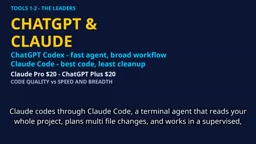
2026 AI Coding Tools Comparison: Claude, ChatGPT, Gemini — Which Is the Best?
A 2026 comparison of five mainstream AI coding tools — Claude Code, ChatGPT Codex, Gemini, DeepSeek, and GitHub Copilot — on real projects, pricing, and code quality, to help you decide where that $20/month should go.

ChatGPT Codex Can Clone Any Software? Testing the Risks and the Truth
YouTube shorts claim ChatGPT Codex or Claude Code can clone Adobe, Excel, and Figma for lifelong free use. We break down the feasibility, legal risks, and DM-funnel tactics—and explain what AI coding tools are truly good for.

Kilo Code Is Free to Install but Charges for API: Cost Estimation and Configuration Guide
Kilo Code is free to install, but connected AI models are billed per token. This guide covers VS Code extension and CLI setup and shows how to estimate API costs.