The Hidden Cost of Streaming Diarizer Adaptation: When Forgetting Masquerades as Progress

Small-data adaptation boosts diarization accuracy but silently degrades speaker identity consistency—a flaw aggregate metrics hide.
A study on streaming speaker diarization systems reveals a hidden cost of small-data adaptation: improvements in detection accuracy can mask degradation in the temporal consistency of speaker identity. The extra confusion introduced stems mainly from "identity drift" in who-spoke-when, not from errors in speaker count—something aggregate metrics like DER cannot capture. Local-remapping diagnostics show adaptation fundamentally alters how the model maintains speaker assignments internally, with different corpora exhibiting different degradation patterns. Rehearsal mitigates identity drift but at the cost of cross-domain transfer, exposing an inherent three-way tension between detection accuracy, identity consistency, and knowledge retention. The authors recommend jointly evaluating all three dimensions when adapting streaming diarizers.
A Truth Hidden Behind Metrics
In speech processing, small-data adaptation is often seen as a shortcut to better model performance. A brief fine-tuning on a small amount of target-domain data can visibly boost speech detection accuracy. But a new study published on arXiv exposes an easily overlooked problem: this seemingly comprehensive improvement may be masking a regression in speaker attribution.
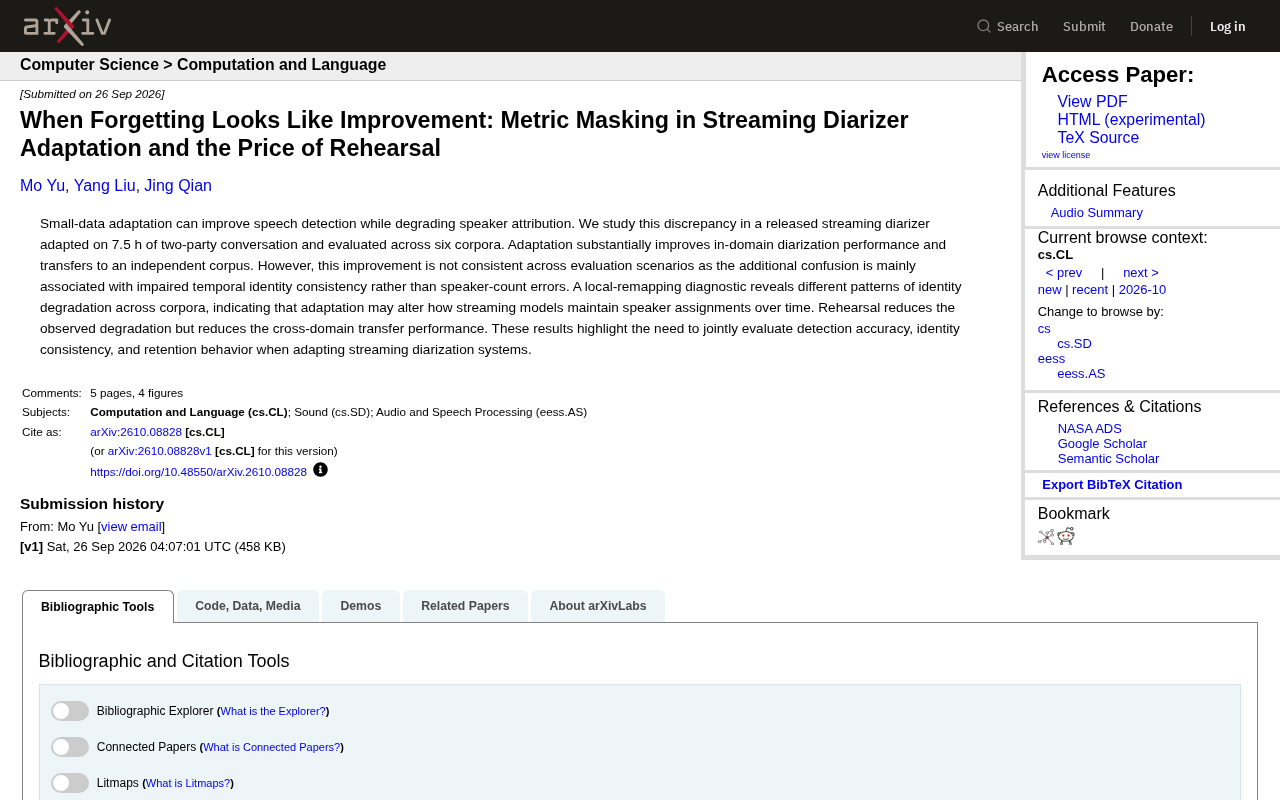
The research team took an existing streaming diarizer as their subject, adapted it using 7.5 hours of two-party conversational data, and systematically evaluated it across six different corpora. Their conclusion cuts directly to a blind spot pervasive in the industry — a single diarization metric cannot truthfully reflect the full picture of model behavior.
Speaker Diarization is the task of segmenting a multi-speaker audio recording by speaker identity, answering the question of "who spoke when." The key distinction between streaming and offline diarization systems is that streaming systems must produce results in real time without access to the full audio context, and cannot retroactively correct already-emitted speaker labels. This makes the temporal continuity of speaker identity extremely fragile — once an attribution shifts at a given point in time, subsequent segments that depend on prior state can suffer cascading errors.
Diarization Error Rate (DER) is the most commonly used aggregate evaluation metric in this field, composed of missed speech, false alarms, and speaker confusion, weighted together. The limitation of DER as an aggregate metric lies precisely here: the confusion component does not distinguish between "misidentifying the number of speakers" and "misidentifying when each speaker is active," and therefore cannot independently reflect the temporal stability of speaker identity. This provides the institutional backdrop for the evaluation blind spot this paper reveals.
Why Adaptation Gains Are Not Always Trustworthy
On the surface, the adaptation results look quite promising. The study shows that adaptation not only substantially improves in-domain diarization performance, but that this improvement also transfers to an independent corpus. In other words, the model performs better both in conversational scenarios it has seen and in a completely new one.
But a deeper analysis reveals the problem: this improvement is inconsistent across evaluation scenarios. The additional confusion that arises is not primarily due to errors in estimating the number of speakers, but is instead concentrated in degraded identity consistency along the temporal dimension.
This is a critical distinction. Errors in speaker count are a visible problem that standard metrics can capture. Identity consistency issues are more insidious — the model may correctly identify that "two people are speaking," yet mix up "who is speaking when" as time progresses. For streaming systems, this kind of temporal identity drift is particularly damaging, since the system must continuously maintain speaker assignments without access to full context.
What Local Remapping Diagnostics Reveal About the Degradation Pattern
To pinpoint the root cause, the research employed a local-remapping diagnostic approach. The results showed that identity degradation across different corpora manifests in different patterns.
The significance of this finding is that the adaptation process may fundamentally alter how the streaming model maintains speaker assignments over time. Fine-tuning doesn't simply adjust detection thresholds — it reshapes the model's internal logic for handling identity continuity. Because different data distributions trigger different forms of degradation, diagnosing and fixing the problem becomes considerably more complex.
This kind of mechanism-level change is precisely what aggregate metrics cannot detect. When a composite metric like DER goes down, developers can easily be misled into thinking the model has improved across the board, while certain critical capabilities are quietly eroding.
Local Remapping is a diagnostic technique for streaming speaker diarization systems. Its core idea is to optimally align (typically using the Hungarian algorithm) the model's output speaker labels with reference annotations within a sliding time window, thereby separating "global identity drift" from "local segment recognition errors." If the model undergoes a global identity flip after a certain point in time (e.g., all of speaker A and B's labels are swapped), local remapping can still yield near-zero local error scores, quantifying the loss attributable purely to broken identity consistency. Compared to computing global DER directly, this method more precisely targets the temporal identity drift specific to streaming systems, rather than conflating it with other types of errors.
The Price of Rehearsal Mitigation: You Can't Have It Both Ways
To address the forgetting problem, the study validated rehearsal, a classic continual learning strategy. Rehearsal combats catastrophic forgetting by mixing in samples from the original training data during adaptation.
The experimental results confirm its double-edged nature: rehearsal does reduce the observed identity degradation, but it also lowers cross-domain transfer performance. This means that in order to preserve the model's original identity consistency capability, one must sacrifice its advantage in generalizing to new domains.
This reveals an intrinsic trade-off in streaming diarizer adaptation — detection accuracy, identity consistency, and knowledge retention are in tension, and cannot all be optimized simultaneously. Rehearsal is not a free lunch; it merely shifts the problem from one dimension to another.
Catastrophic Forgetting is a classic problem in neural networks under continual learning: when a model is fine-tuned on new data, weight updates overwrite previously learned knowledge, causing a sharp drop in performance on older tasks. Rehearsal is one of the most direct strategies against forgetting — by randomly mixing in a portion of original training samples during each fine-tuning run, it forces the model to simultaneously maintain its fit to the old distribution. This strategy has been well-validated in domains like image classification, but in streaming speaker diarization it faces two additional constraints: first, original training data may be unavailable in full due to copyright or privacy concerns; second, the choice of rehearsal ratio is itself a hyperparameter trade-off, where too high a ratio limits adaptation speed and too low a ratio offers insufficient protection. The experimental results in this paper provide concrete empirical data for this trade-off in the speech diarization domain.
Implications for Engineering Practice
The most important contribution of this research is to prompt practitioners to reconsider the evaluation framework for streaming speaker diarization systems. The research team explicitly states that when adapting streaming diarization systems, it is necessary to jointly evaluate detection accuracy, identity consistency, and retention behavior — not rely on any single aggregate metric.
This conclusion is especially worth heeding for teams building applications such as meeting transcription, call center analytics, or real-time captioning. A model that appears to have "improved across the board" on a validation set may frequently confuse speaker identities in real-world long-conversation scenarios — a form of regression that is precisely where user experience is most sensitive, yet is most easily missed by standard testing pipelines.
The concept of metric masking captures the heart of the issue: when the very tools we use to measure progress have blind spots, forgetting can be disguised as improvement. Building a multi-dimensional, fine-grained evaluation framework is a necessary prerequisite for avoiding this kind of trap.
Related articles

Apple HomeView Hands-On Review: Is the $300 Smart Home Hub Worth It?
Apple HomeView hands-on: a $300 smart home hub with facial recognition for quick account switching, but no App Store or voice recognition. Is the wall-mounted version worth it? Should you buy the first generation?

Meta Muse Wonder Launch: What It Means for Meta's Return to the Frontier AI Race
Meta releases Muse Wonder and WonderFull, benchmarks reach the frontier, community feedback is polarized. An in-depth look at Meta's return to the frontier AI race, its personal agent strategy, and Zuckerberg's different path.

Apple Home Smart Home Lineup Leaked: LG and Schneider Team Up, UWB Door Lock on Board
Apple Home ecosystem gains new LG and Schneider devices: UWB smart lock with proximity unlock, 2.5K dual-camera doorbell, privacy indoor camera, and AirPods-like seamless pairing.