The Hidden Monopoly Behind TI Graphing Calculators

TI graphing calculators have held a near-monopoly for decades through institutional lock-in with testing standards and curricula, not technical merit.
Texas Instruments graphing calculators have dominated student shopping lists since the early 2000s, with hardware barely changed in decades yet prices remaining stubbornly high. The reason isn't technical superiority — it's deep institutional lock-in with standardized tests like the SAT and AP, classroom curricula, and textbook ecosystems. This "hidden monopoly" reveals a competitive barrier harder to breach than any technological moat: once a product is written into rules and habits, even superior alternatives can't easily displace it. The case offers a universal lesson for the tech industry — market position must be understood through the institutional network a product inhabits, not just its specs and price.
One Device, Two Decades of Classroom Standard
Since the early 2000s, Texas Instruments (TI) graphing calculators have held a firm spot on nearly every student's back-to-school shopping list. This seemingly unremarkable plastic device has barely changed in appearance, remained stubbornly expensive year after year, and yet continues to be the default choice for math classrooms and standardized tests alike. TI's dominance in the calculator market actually stretches back even further.
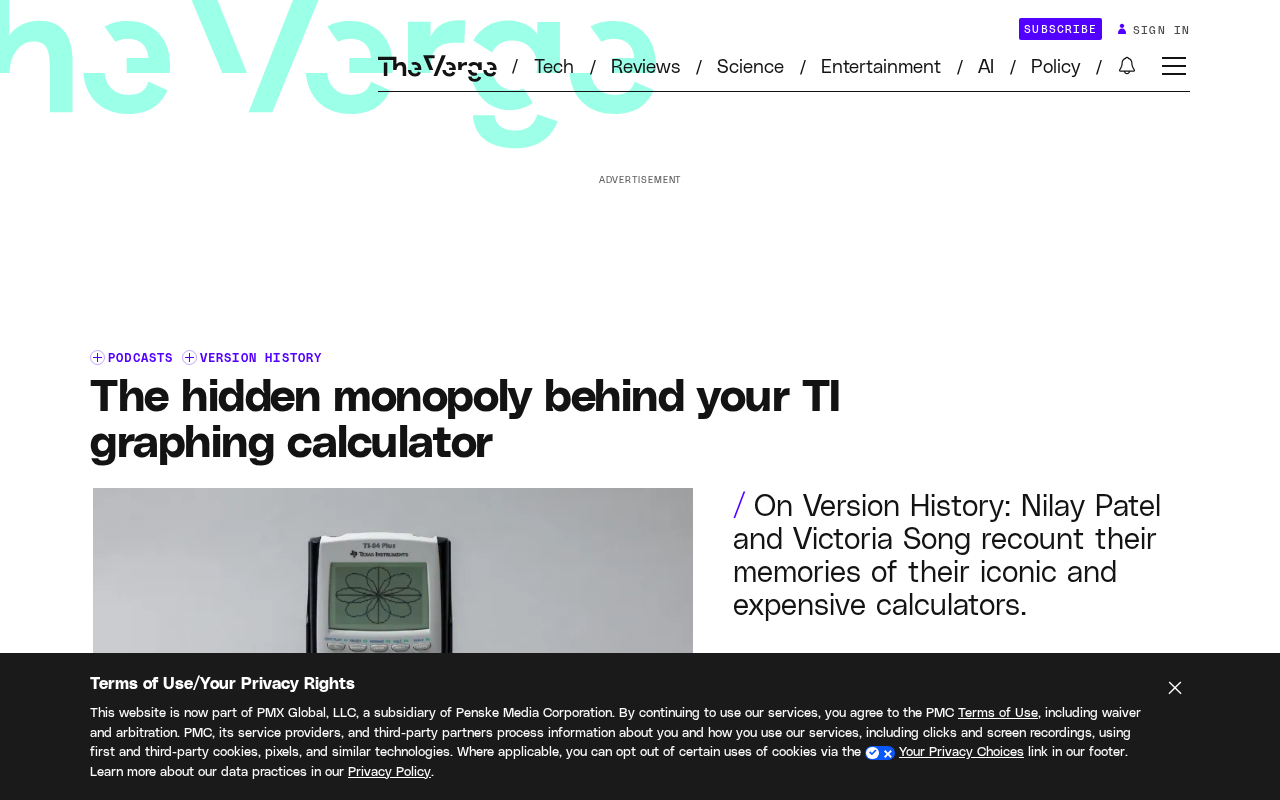
In a recent episode of The Verge's Version History, David Pierce joins Nilay Patel and Victoria Song to unpack this long-overlooked phenomenon: why has a device that is technologically obsolete managed to maintain a near-monopoly for decades in a world of rapidly evolving consumer electronics?
Why an Outdated Device Refuses to Die
The graphing calculator's remarkable staying power isn't rooted in technical superiority — it's rooted in deep institutional entrenchment within the education system. Standardized tests like the SAT and AP exams in the United States specify exactly which calculator models are permitted, and TI products have long sat at the heart of those approved lists. This creates a classic case of institutional lock-in: teachers build curricula around specific models, testing bodies approve those devices, and parents have no choice but to buy what's on the list.
The direct consequence of this entrenchment is that TI can sustain premium pricing with virtually no hardware upgrades. By comparison, equivalent computing functionality is available today in any free app on a smartphone — yet the rules of classrooms and exam halls keep those alternatives firmly off the table.
Take the TI-84 series as an example. Launched in 2004, its core hardware specs have remained almost unchanged ever since, while the retail price has consistently hovered between $100 and $130 — far above what the underlying hardware costs could justify. The SAT's calculator policy is set by the College Board; AP exam policies are determined by individual subject committees. Both bodies are notoriously conservative when updating their approved lists. Getting a new device onto the whitelist can take years of review and testing. This means that even when a competitor launches a more capable product, it faces a "blackout period" during which it can't be used in exams — and in the education market, exam eligibility is essentially the only thing that drives purchasing decisions. This lag effect functions as a competitive barrier that TI benefits from without having to actively maintain.
How the "Hidden Monopoly" Was Built
The term "hidden monopoly" in the episode's title gets at the core issue. TI's advantage doesn't rest entirely on open market competition. Instead, it's reinforced by a closed ecosystem built through alignment with educational institutions, testing standards, and textbook publishers. Once a product becomes the de facto standard for curricula and exams, competitors — even those offering cheaper or more powerful alternatives — struggle to dislodge it, because user choice is effectively constrained by rules set long before any purchase decision is made.
This model offers a case study worth serious reflection across the tech industry: monopoly doesn't have to come from a technological moat. It can come from deep integration with institutions, habits, and standards. And that kind of lock-in is even harder to break than pure technical superiority, because it reshapes the entire context in which purchasing decisions are made.
Economists describe this phenomenon as the compounding effect of Network Externality and Path Dependence. Network externality means that as more people use a product, its value increases further — teachers are familiar with TI's interface, supplementary textbooks use TI keystrokes for their screenshots, classroom demonstrations default to TI, all of which makes buying a TI the "rational choice" for incoming students, independent of how good the product actually is. Path dependence explains why this pattern is so hard to reverse: once a standard becomes embedded in institutional structures at some historical juncture, the cost of replacing it compounds over time until the price of switching far exceeds the cost of staying put. The QWERTY keyboard layout and Windows' dominance in enterprise markets are classic examples of the same mechanism.
Lessons for the Tech Industry
What makes the TI calculator story so compelling is what it reflects about a broader commercial reality: once a product is written into standards and embedded in processes, it acquires a staying power that far exceeds the intrinsic value of the product itself. This is especially visible in educational technology, and it plays out repeatedly across any industry bound by standards and compliance requirements.
For readers tracking the evolution of technology, this case is a reminder: when assessing a product's market position, you can't just look at specs and price. You have to understand the institutional network it's embedded in. The TI graphing calculator is a textbook example of a product that is "technologically stagnant yet institutionally unassailable."
Note: This article is based on a preview of The Verge's Version History episode. For the full discussion, please refer to the original episode.
Related articles

GPT-Next Leak, Gemini 4 Argon Imminent: AI News Roundup
GPT-Next leak suggests extreme efficiency; OpenAI's 28-day shipping pledge boosts speed 50%; Gemini 4 Argon nears release; Anthropic subscription value report sparks debate.

GPT-Next Leaked, Gemini 4 Argon Speeds Up, Fable 5.5 May Launch Today
OpenAI's GPT-Next model leaks, expected to be extremely low-cost and possibly part of the 28-day release plan; Gemini 4 Argon internal testing accelerates, NanoBanana 2.1 is live; Semi Analysis tests show Claude Max's equivalent API value is about 5 times that of ChatGPT Pro; Fable 5.5 may launch today.

Gemini 4 Argon Launches Globally: Key Highlights from the AI Daily Brief
Google opens Gemini 4 Argon globally across Pro and Ultra subscriptions and the API, and demonstrates robot control. This article rounds up open-source models, Agent infrastructure, cost transparency, and safety governance updates.