The Hidden Privilege Escalation Risk in AI Agents: How hallpass Returns Authorization to the System

Use hallpass to enforce fail-closed, per-user authorization on every Agent write path instead of relying on prompt rules.
A developer discovered that their ops Agent's single write path — opening GitOps PRs — could be triggered by anyone chatting with the Bot, regardless of their actual repo permissions. Adding prompt-level rules doesn't help, since API calls always carry the Bot's own credentials. The fix is to query authoritative systems like GitHub directly before any write operation, with user identity sourced from session context rather than model output — structurally blocking prompt injection. This logic is packaged as the open-source tool hallpass, using a fail-closed strategy across 21 systems and integrating via a simple decorator.
A Write-Operation Vulnerability Nobody's Talking About
A developer shared their experience building an internal ops Agent on Reddit, exposing a security blind spot that's easy to overlook in real-world AI Agent deployments: When an Agent executes a write operation, whose permissions is it actually using?
The ops Agent in question was deliberately restrained in its design. A single tool call could assess a service's health from multiple angles in about 15 seconds. Because all reads went through a read-only account, the developer placed no restrictions on read operations. There was exactly one path that could change system state — opening a Pull Request to the GitOps repository.
The problem lived entirely in that one write path. The Bot's token could open that PR on behalf of anyone who talked to it — even someone who had no push access to that repository themselves. In other words, the Agent had inadvertently become a privilege-bypass machine, handing out a "pass" to anyone who asked.
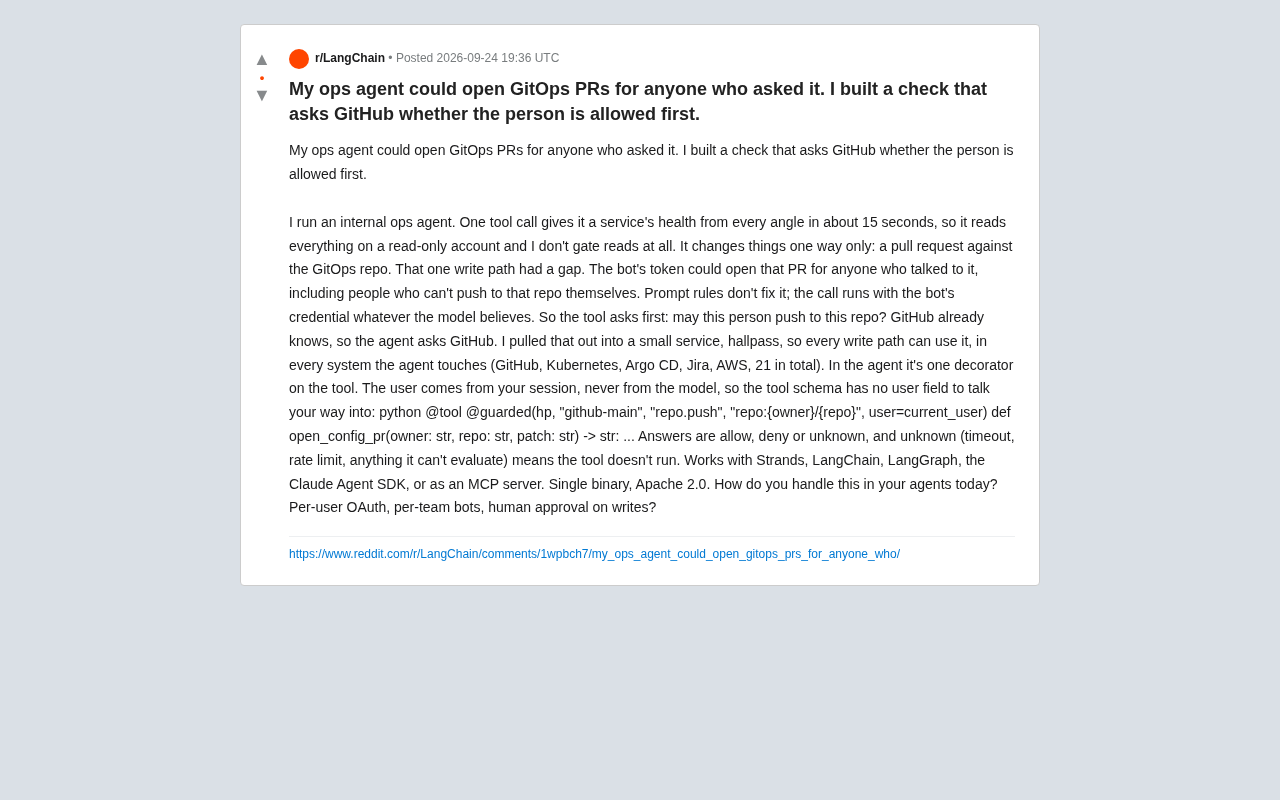
Why Prompt Rules Can't Save You
Many developers' first instinct is to add a rule to the system prompt like "only allow authorized users to perform actions." But the author cuts straight to the point: prompt rules don't fix this problem.
The reason lies in credential ownership. No matter who the model "believes" the caller is, every API call it makes carries the Bot's own credentials. The model can be misled, jailbroken, or manipulated — but the underlying token permissions are real and constant. Any attempt to constrain permissions using natural language is, at its core, building a security boundary on the "judgment" of a probabilistic model — which is simply not acceptable in security engineering.
This exposes a core principle of Agent security: identity and authorization must come from a trusted session context, never from the model's output.
This problem has a formal name in security: the Confused Deputy Problem. The classic scenario: a high-privileged "deputy" (the Bot, in this case) is leveraged by a lower-privileged caller to perform actions that exceed the caller's own permissions. The Bot itself hasn't been compromised — it faithfully executed the request — yet the result is a privilege escalation. In traditional software, this is typically mitigated through mechanisms like CSRF tokens and OAuth scopes. In Agent architectures, because intent is expressed through natural language, the boundaries are blurrier and the attack surface expands accordingly. Prompt injection attacks exploit exactly this: once malicious content is mixed into the context, the model may be guided to bypass natural-language-level "permission rules," while the underlying credentials receive no protection whatsoever.
The Solution: Return Authorization Decisions to the System Itself
The developer's approach is refreshingly pragmatic: since GitHub already knows whether a given person has push access to a given repository, just ask GitHub directly.
So before executing any write operation, the tool makes a query: can this person push to this repository? The answer has three possible values — allow, deny, and unknown. The critical design decision is what happens with unknown: whether it's a timeout, rate limiting, or any situation where the result can't be evaluated, if the result is unknown, the tool does not execute. This is a classic fail-closed security strategy — it prevents accidental permission grants due to service anomalies.
The developer extracted this logic into a small standalone service called hallpass, designed to be reused across every write path, covering all systems the Agent touches — GitHub, Kubernetes, Argo CD, Jira, AWS — 21 systems in total.
GitOps is an operational model that uses a Git repository as the single source of truth for infrastructure and application configuration. All changes are submitted via Pull Request, reviewed, and merged — then automatically synchronized to production by tools like Argo CD or Flux. This model naturally provides audit trails and access control: who can merge PRs, who can push directly, is all governed by branch protection rules and team permissions. But this also means that if an Agent can open PRs as a Bot, bypassing the permission system, the security assumptions of GitOps are already broken — and the audit log only records the Bot's actions, not the identity of the actual requester. The fail-closed strategy (deny on failure) contrasts with fail-open (allow on failure) — the latter defaults to permitting operations when a service is unavailable, which is a dangerous default in security-sensitive contexts.
Engineering Implementation: One Decorator Does the Job
On the Agent side, integrating hallpass requires nothing more than adding a decorator to a tool:
@tool
@guarded(hp, "github-main", "repo.push", "repo:{owner}/{repo}", user=current_user)
def open_config_pr(owner: str, repo: str, patch: str) -> str:
    ...
The cleverest detail here is user=current_user: the user identity comes from your session — never from the model. This means the tool's schema has no user field that the model could "argue over" or fill in. The possibility of prompt injection altering identity is blocked at the structural level. This approach — making privilege escalation inexpressible by design — is far more reliable than validating after the fact.
According to the original post, hallpass is compatible with popular Agent frameworks including Strands, LangChain, LangGraph, and the Claude Agent SDK, and can also run as an MCP server. It ships as a single binary under the Apache 2.0 open-source license.
MCP (Model Context Protocol) is an open protocol proposed by Anthropic to standardize how AI models interact with external tools and data sources. By running hallpass as an MCP server, it can be invoked uniformly by any MCP-compatible client — including the Claude desktop app and various Agent frameworks — without needing separate integration for each one. This architecture means authorization logic can exist as an independent infrastructure layer, decoupled from any specific Agent implementation. Regardless of which framework is used to build the Agent, all write-operation permission checks flow through the same path, making unified auditing and policy management straightforward.
What This Means for Agent Developers
The value of this case study isn't the tool itself — it's what it highlights: a pattern being overlooked by a large number of teams: read operations in Agents can be permissive, but every write path must be bound to real, per-user permission checks.
As more teams connect Agents to production ops, code commits, ticketing systems, and cloud resources, the combination of "Bot credentials + whoever happens to be chatting" will become a pervasive attack surface. A few viable approaches:
- Per-user OAuth: Each user operates with their own authorization token, providing natural permission isolation;
- Per-team bots: Scope Bot permissions by team, reducing the blast radius of any single privilege escalation;
- Human approval for write operations: All state-changing actions go through a manual confirmation step;
- An authorization proxy like hallpass: Query the authoritative system before any tool execution.
The author also posed an open question to the community in the original thread: how are you handling this today? This is a genuine reflection of the fact that Agent engineering has yet to converge on unified best practices. For any team building Agents with write access, taking authorization decisions out of the model's hands and returning them to the system — sooner rather than later — is a lesson worth taking seriously.
Related articles

JobRunner MCP Server: AI Agents Can Now Fix Failed Java Jobs
JobRunner launches an open-source MCP server enabling AI agents to view cluster status, diagnose failures, and recover Java jobs—incident response from any cloud coding environment or existing agent.

MLAI Digital Launches 9 Security Agents: MCP Server Safeguards the Full Lifecycle of Agentic AI
MLAI Digital launches Security MCP Server with nine built-in specialized security agents covering vulnerability discovery, attack simulation, prompt injection detection, API and infrastructure assessment, and accelerated remediation—embedding security validation across the full Agentic AI lifecycle from development to production.

Running Isaac Lab on H100 GPUs: Exploring Better Approaches
Exploring optimization methods for running Isaac Lab on NVIDIA H100 GPUs, including MIG configuration, mixed precision, TensorRT acceleration, and community experience to improve robotics simulation and reinforcement learning efficiency.